


New Perspectives on Chronic Obstructive Pulmonary Disease
- PMID: 36097591
- PMCID: PMC9464005
- DOI: 10.2147/COPD.S365771
New Perspectives on Chronic Obstructive Pulmonary Disease
Abstract
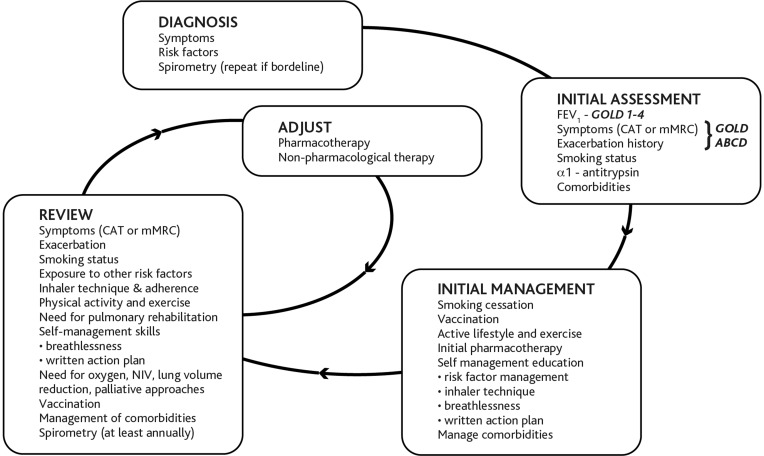
Chronic obstructive pulmonary disease (COPD) is a major cause of morbidity and mortality worldwide; many recent advances have been made in many aspects of the disease. The aim of this article is to illustrate and discuss some of these advances in the management of different types of patients. Large-scale trials have confirmed that long-acting bronchodilator therapy, particularly using the combination of LABA/LAMA, remains the mainstay of COPD treatment, with special attention being paid to careful selection of inhaler devices. The initial choice of pharmacological therapy is based on the GOLD ABCD grouping of patients. It is very important to stress that there is a need to implement a management cycle because COPD is a chronic disease with varying clinical course and a high number of potential comorbidities that may affect morbidity and mortality. Therefore, regular reevaluation of the patient is mandatory. This allows identification of characteristics aimed at maximizing the benefits for a specific patient or a subset of patients. Within this context, the role of the blood eosinophil count as a marker of inhaled corticosteroids response to prevent future exacerbations in patients who, despite appropriate bronchodilator therapy, still suffer from them has been proven to be a useful simple biomarker in medication selection. These advances support the concept of precision medicine, with the goal that patients get the right medicine at the right time for the right reason. Finally, recent studies have shown that early life events may be of critical relevance for the development of COPD. With this as a background, concepts to identify individuals at risk and early identification of cases have become an important objective of current research with the hope of maximizing the effects of therapy and the possibility of impacting disease progression.
Keywords: ABCD grouping; COPD; LABA/LAMA; eosinophil; management cycle.
© 2022 Celli et al.
Conflict of interest statement
Bartolome R Celli reports having received compensation from Advisory Boards and consultation fees from Glaxo Smith Kline, Boehringer-Ingelheim, Astra Zeneca, Novartis, Pulmonx, CHIESI, Menarini and Bayer. He does not have shares or interest in any company, neither does any member of his family. He has not received or had any relationship with tobacco money. Dave Singh has received personal fees from Aerogen, AstraZeneca, Boehringer Ingelheim, Chiesi, Cipla, CSL Behring, Epiendo, Genentech, GlaxoSmithKline, Glenmark, Gossamerbio, Kinaset, Menarini, Novartis, Pulmatrix, Sanofi, Teva, Theravance and Verona Claus Vogelmeier gave presentations at symposia and/or served on scientific advisory boards sponsored by AstraZeneca, Boehringer Ingelheim, CSL Behring, Chiesi, GlaxoSmithKline, Grifols, Menarini, Novartis, Nuvaira, OmniaMed and MedUpdate, reports personal fees from Aerogen, grants, personal fees from AstraZeneca, Boehringer Ingelheim, Chiesi, CSl Behring, GlaxoSmithKline, Grifols, Novartis. Alvar Agusti: Research project funds: AZ, GSK, Menarini. Lectures: AZ, Chiesi, GSK, Menarini. AB: AZ, Chiesi, GSK, MSD, Menarini. The authors report no other conflicts of interest in this work.
Figures
References
-
- Vestbo J, Hurd SS, Agustí AG, et al. Global strategy for the diagnosis, management and prevention of chronic obstructive pulmonary disease: GOLD executive summary. Am J Respir Crit Care Med. 2013;187:347–365. - PubMed
-
- Celli BR, Wedzicha JA. Update on Clinical Aspects of Chronic Obstructive Pulmonary Disease. N Engl J Med. 2019;381:1257–1266. - PubMed
-
- Global Strategy for the diagnosis, management, and prevention of chronic obstructive pulmonary disease; 2022. Available From: https://goldcopd.org/wp-content/uploads/2021/11/GOLD-REPORT-2022-v1.0-12.... Accessed November 2021.
-
- Agusti A. The path to personalised medicine in COPD. Thorax. 2014;69:857–864. - PubMed
