


Self-esteem in the context of intimate partner violence: A concept analysis
- PMID: 36098265
- PMCID: PMC10087188
- DOI: 10.1111/nuf.12798
Self-esteem in the context of intimate partner violence: A concept analysis
Abstract
Aim: To explore the meaning of self-esteem in the context of intimate partner violence (IPV).
Background: IPV is a preventable public health issue. The dynamic of IPV diminishes women's self-esteem. Defining self-esteem will guide the development of IPV interventions in healthcare settings.
Design: Walker and Avant's eight-step approach was used.
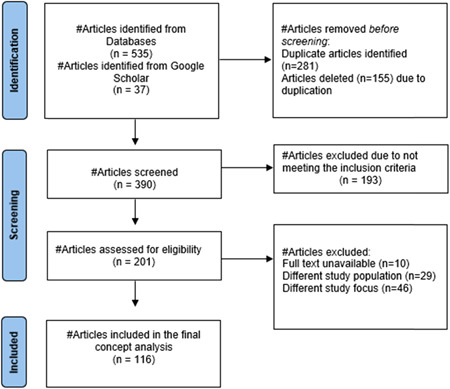
Data source: The search was conducted from Oxford Dictionary of English online, CINAHL, APA PsycInfo, PubMed, Women's Studies International, and Google Scholar.
Review methods: No limits on the year of publication were applied.
Results: Defining attributes of self-esteem are self-concept, self-affirmation, and self-respect. Antecedents of self-esteem are exposure to IPV and victim-blaming attitudes by healthcare professionals. Consequences include depression, substance abuse, and posttraumatic stress disorder. Empirical referents include self-worth, self-competence, self-blame, self-evaluation, self-confidence, and self-determination.
Conclusions: Current literature is limited in its definition of self-esteem in the context of IPV. Women experiencing IPV with low self-esteem might not seek help for IPV from nurses. Nurses could develop culturally appropriate IPV screening tools that assess the changes in self-esteem among women from different sociodemographic and cultural backgrounds. The defining attributes could contribute to developing comprehensive IPV screening tools in healthcare settings.
Keywords: concept analysis; intimate partner violence; self-esteem; violence against women.
© 2022 The Authors. Nursing Forum published by Wiley Periodicals LLC.
Conflict of interest statement
The authors declare no conflicts of interest.
Figures
References
-
- World Health Organization . WHO multi‐country study on women's health and domestic violence against women. Accessed October 20, 2021. http://www.who.int/reproductivehealth/publications/violence/24159358X/en/
-
- Smith SG, Zhang X, Basile KC, et al. The National Intimate Partner and Sexual Violence Survey (NISVS): 2015 Data Brief – Updated Release. National Center for Injury Prevention and Control, Centers for Disease Control and Prevention; 2018. Accessed October 21, 2021. https://www.cdc.gov/violenceprevention/pdf/2015data-brief508.pdf
MeSH terms
LinkOut - more resources
Full Text Sources
Medical
Research Materials
