Date of birth and the incidence of acute ischemic stroke in Hungary
- PMID: 36098448
- PMCID: PMC10280757
- DOI: 10.33588/rn.7506.2021479
Date of birth and the incidence of acute ischemic stroke in Hungary
Abstract
Introduction: The effect of the date of birth on the incidence of cardiovascular disease was confirmed in earlier studies. We aimed to determine whether the season of birth may be associated with a higher incidence of stroke in later life by analyzing thrombolysis numbers according over a ten-year period in Hungary.
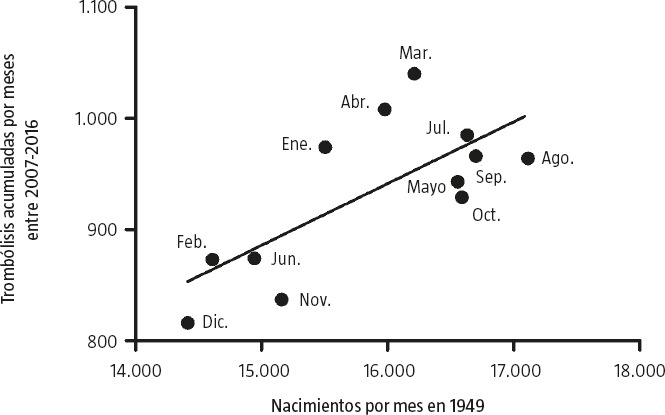
Patients and methods: We analyzed daily thrombolysis numbers between 2007 and 2016 according to the patients' date of birth based on seasons. The correlation between cumulative thrombolysis numbers between 2007 and 2016 per month and birth numbers per month based on data of the 1949 census were also examined.
Results: Our results indicate that being born in the spring and summer in the northern hemisphere may be associated with a higher frequency of ischemic stroke necessitating thrombolytic treatment. This equates to a higher risk when conception and early pregnancy occur in the summer and autumn months.
Conclusions: This, however, cannot be defined as a causal relationship if we consider the number of live births in 1949, as both measures change similarly during the year, as indicated by the strong positive correlation between thrombolysis frequency according to date of birth between 2007 and 2016 and the number of births in the 1949 census by month.
Title: Fecha de nacimiento e incidencia del ictus isquémico agudo en Hungría.
Introducción. El efecto de la fecha de nacimiento sobre la incidencia de enfermedad cardiovascular se ha confirmado en estudios anteriores. Nuestro objetivo fue determinar si la temporada de nacimiento puede estar asociada con una mayor incidencia de accidente cerebrovascular en etapas posteriores de la vida mediante el análisis de las cifras de trombólisis durante un período de 10 años en Hungría. Pacientes y métodos. Analizamos las cifras diarias de trombólisis entre 2007 y 2016 según la fecha de nacimiento de los pacientes según las estaciones. También se examinó la correlación entre las cifras de trombólisis acumuladas entre 2007 y 2016 por mes, y las cifras de nacimientos por mes según los datos del censo de 1949. Resultados. Nuestros resultados indican que nacer en primavera y verano en el hemisferio norte puede estar asociado con una mayor frecuencia de accidentes cerebrovasculares isquémicos que requieren tratamiento trombolítico. Esto equivale a un mayor riesgo cuando la concepción y el embarazo temprano ocurren en los meses de verano y otoño. Conclusión. Esto, sin embargo, no puede definirse como una relación causal si consideramos el número de nacidos vivos en 1949, ya que ambas medidas cambian de manera similar durante el año, como lo indica la fuerte correlación positiva entre la frecuencia de trombólisis según la fecha de nacimiento entre 2007 y 2016, y el número de nacimientos en el censo de 1949 por mes.
Conflict of interest statement
Conflicto de intereses: No declarado.
Figures
References
-
- Addo J, Ayerbe L, Mohan KM, Crichton S, Sheldenkar A, Chen R, et al. Socioeconomic status and stroke:an updated review. Stroke 2012;43:1186-91. - PubMed
- Addo J, Ayerbe L, Mohan KM, Crichton S, Sheldenkar A, Chen R, et al. Socioeconomic status and stroke:an updated review. Stroke. 2012;43:1186–91. - PubMed
-
- Folyovich A, Matis R, Al-Muhanna N, Jarecsny T, Dudas E, Janoska D, et al. Christmas, acute ischemic stroke and stroke-related mortality in Hungary. Brain Behav 2021;11:e02104. - PMC - PubMed
- Folyovich A, Matis R, Al-Muhanna N, Jarecsny T, Dudas E, Janoska D, et al. Christmas, acute ischemic stroke and stroke-related mortality in Hungary. Brain Behav. 2021;11:e02104. - PMC - PubMed
MeSH terms
LinkOut - more resources
Full Text Sources
Medical