Review
. 2023 Jan;95(1):e28143.
doi: 10.1002/jmv.28143. Epub 2022 Sep 22.

Pan-coronavirus fusion inhibitors to combat COVID-19 and other emerging coronavirus infectious diseases

Affiliations
Review

Pan-coronavirus fusion inhibitors to combat COVID-19 and other emerging coronavirus infectious diseases

Qiaoshuai Lan et al. J Med Virol. 2023 Jan.

Abstract

Severe acute respiratory syndrome coronavirus 2 (SARS-CoV-2), the causative agent of the currently ongoing coronavirus disease 2019 (COVID-19) pandemic, has posed a serious threat to global public health. Recently, several SARS-CoV-2 variants of concern (VOCs) have emerged and caused numerous cases of reinfection in convalescent COVID-19 patients, as well as breakthrough infections in vaccinated individuals. This calls for the development of broad-spectrum antiviral drugs to combat SARS-CoV-2 and its VOCs. Pan-coronavirus fusion inhibitors, targeting the conserved heptad repeat 1 (HR1) in spike protein S2 subunit, can broadly and potently inhibit infection of SARS-CoV-2 and its variants, as well as other human coronaviruses. In this review, we summarized the most recent development of pan-coronavirus fusion inhibitors, such as EK1, EK1C4, and EKL1C, and highlighted their potential application in combating current COVID-19 infection and reinfection, as well as future emerging coronavirus infectious diseases.

Keywords: COVID-19; EK1; coronavirus; fusion inhibitor; heptad repeat 1; lipopeptide.


Conflict of interest statement

S. J., L. L., and S. X. are inventors of some patents related to the SARS‐CoV‐2 fusion inhibitors described in this review. The remaining authors declare no conflict of interest.

Figures
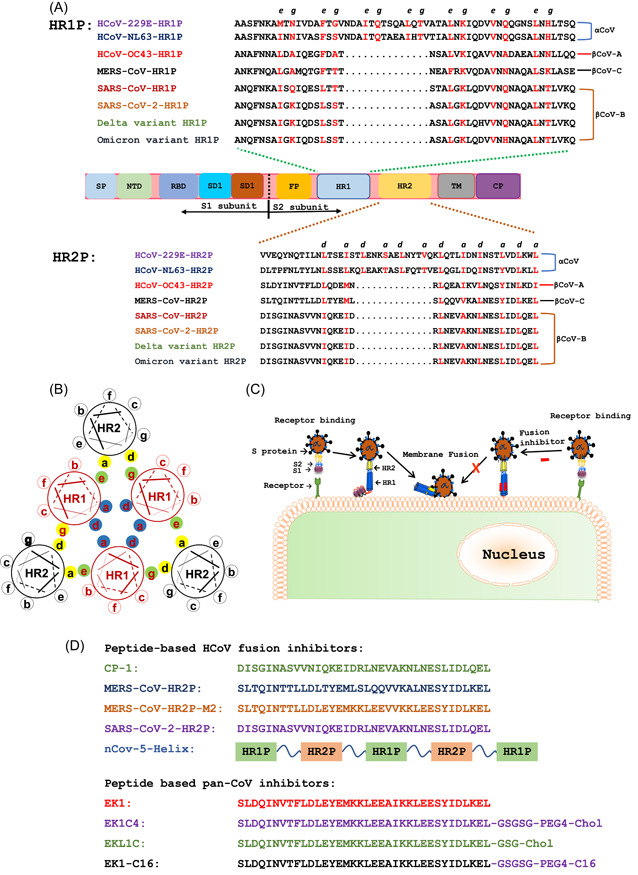
Figure 1
Figure 1
Sequences of peptides derived from the HR1 and HR2 domains and pan‐CoV fusion inhibitors and their mechanisms of action. (A) Functional domains of human CoV S protein and peptides derived from the HR1 and HR2 domains. Spike protein consists of the S1 and S2 subunits. Signal peptide (SP), N‐terminal domain (NTD), receptor‐binding domain (RBD), and subdomains 1 and 2 (SD1 and SD2) are located in the S1 subunit. Fusion peptide (FP), heptad repeat 1 (HR1), heptad repeat 2 (HR2), transmembrane region (TM), and cytoplasmic domain (CP) are located in the S2 subunit. Key amino acid residues at the e and g sites in the HR1 and a and d positions in the HR2‐helical wheels responsible for HR1−HR2 interaction are shown in red. (B) Key amino acid residues involved in the interaction between HR1 and HR2 helices to form 6‐HB. Residues located at the a and d positions in one HR1 helical wheel (shown as blue shadow) interact with those at the d and a positions in another HR1 helical wheel, respectively, to form an internal trimer, while the residues at e and g positions (green shadow) interact with those at a and d positions (yellow shadow) in the HR2 helices to form 6‐HB. (C) Viral fusion and entry mediated by S protein and the mechanism of action of pan‐CoV fusion inhibitors. The viral entry of HCoVs is initiated by binding of RBD in the S1 subunit to the receptor on the host cell, followed by 6‐HB formation via HR1−HR2 interaction of HR1 and HR2 domains in the S2 subunit. Pan‐CoV fusion inhibitors can inhibit viral fusion with and entry into the host cell. (D) Sequences of peptides and lipopeptides with pan‐CoV fusion inhibitory activity. HCoVs, human coronaviruses; pan‐CoV, pan‐coronavirus; 6‐HB, six‐helix bundle.

References

    1. Hu B, Guo H, Zhou P, Shi ZL. Characteristics of SARS‐CoV‐2 and COVID‐19. Nat Rev Microbiol. 2021;19(3):141‐154. - PMC - PubMed
    1. Lan Q, Xia S, Lu L. Coronavirus entry inhibitors. Adv Exp Med Biol. 2022;1366:101‐121. - PubMed
    1. Zhou P, Yang XL, Wang XG, et al. A pneumonia outbreak associated with a new coronavirus of probable bat origin. Nature. 2020;579(7798):270‐273. - PMC - PubMed
    1. Xiang R, Yu Z, Wang Y, et al. Recent advances in developing small‐molecule inhibitors against SARS‐CoV‐2. Acta Pharm Sin B. 2021;12(4):1591‐1623. - PMC - PubMed
    1. Zhou H, Møhlenberg M, Thakor JC, et al. Sensitivity to vaccines, therapeutic antibodies, and viral entry inhibitors and advances to counter the SARS‐CoV‐2 omicron variant. Clin Microbiol Rev. 2022. 10.1128/cmr.00014-22 - DOI - PMC - PubMed

Publication types

Supplementary concepts
