. 2023 Feb;19(2):721-735.
doi: 10.1002/alz.12757. Epub 2022 Sep 13.

Biomarkers for dementia in Latin American countries: Gaps and opportunities

Mario A Parra  1 Paulina Orellana  2   3 Tomas Leon  4   5 Cabello G Victoria  2   6   7 Fernando Henriquez  6   8   9 Rodrigo Gomez  5   10 Constanza Avalos  2   3 Andres Damian  11 Andrea Slachevsky  5   6   8   12 Agustin Ibañez  2   3   4   13   14 Henrik Zetterberg  15   16   17   18   19 Betty M Tijms  20 Jennifer S Yokoyama  13   21 Stefanie D Piña-Escudero  22 J Nicholas Cochran  23 Diana L Matallana  24   25   26 Daisy Acosta  27 Ricardo Allegri  28   29 Bianca P Arias-Suárez  30 Bernardo Barra  31   32 Maria Isabel Behrens  12   33   34   35 Sonia M D Brucki  36 Geraldo Busatto  37 Paulo Caramelli  38 Sheila Castro-Suarez  22   39 Valeria Contreras  40 Nilton Custodio  41 Sergio Dansilio  42 Myriam De la Cruz-Puebla  13   43   44   45 Leonardo Cruz de Souza  37   46 Monica M Diaz  47   48 Lissette Duque  49 Gonzalo A Farías  33 Sergio T Ferreira  50 Nahuel Magrath Guimet  22   28 Ana Kmaid  51 David Lira  41 Francisco Lopera  52 Beatriz Mar Meza  22   53 Eliane C Miotto  36 Ricardo Nitrini  36 Alberto Nuñez  49 Santiago O'Neill  54 John Ochoa  55 Maritza Pintado-Caipa  22   41 Elisa de Paula França Resende  13   38   46   56   57 Shannon Risacher  58 Luz Angela Rojas  59 Valentina Sabaj  60 Lucas Schilling  46   56   61 Allis F Sellek  62 Ana Sosa  63 Leonel T Takada  36 Antonio L Teixeira  64   65 Martha Unaucho-Pilalumbo  22   66 Claudia Duran-Aniotz  2   3
Affiliations

Biomarkers for dementia in Latin American countries: Gaps and opportunities

Mario A Parra et al. Alzheimers Dement. 2023 Feb.

Abstract

Limited knowledge on dementia biomarkers in Latin American and Caribbean (LAC) countries remains a serious barrier. Here, we reported a survey to explore the ongoing work, needs, interests, potential barriers, and opportunities for future studies related to biomarkers. The results show that neuroimaging is the most used biomarker (73%), followed by genetic studies (40%), peripheral fluids biomarkers (31%), and cerebrospinal fluid biomarkers (29%). Regarding barriers in LAC, lack of funding appears to undermine the implementation of biomarkers in clinical or research settings, followed by insufficient infrastructure and training. The survey revealed that despite the above barriers, the region holds a great potential to advance dementia biomarkers research. Considering the unique contributions that LAC could make to this growing field, we highlight the urgent need to expand biomarker research. These insights allowed us to propose an action plan that addresses the recommendations for a biomarker framework recently proposed by regional experts.


Conflict of interest statement

Conflicts of interest

HZ has served at scientific advisory boards and/or as a consultant for Abbvie, Alector, Annexon, Artery Therapeutics, AZTherapies, CogRx, Denali, Eisai, Nervgen, Novo Nordisk, Pinteon Therapeutics, Red Abbey Labs, Passage Bio, Roche, Samumed, Siemens Healthineers, Triplet Therapeutics, and Wave has given lectures in symposia sponsored by Cellectricon, Fujirebio, Alzecure, Biogen, and Roche, and is a co-founder of Brain Biomarker Solutions in Gothenburg AB (BBS), which is a part of the GU Ventures Incubator Program (outside submitted work).

Figures
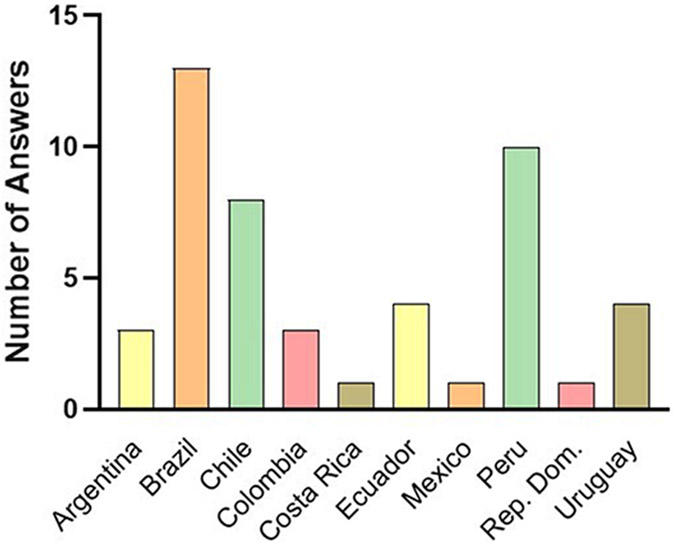
Figure 1.
Figure 1.. Distribution of survey responses from the 48 participants by country.
Figure 2.
Figure 2.. Biomarkers used, purposes and funding.
(A) Using, interested and uninterested respondents by type of biomarker. (B) Purpose of the use of biomarkers in LAC. (C) Funding sources for biomarker studies in LAC.
Figure 3.
Figure 3.. Biomarker characterization in LAC.
(A) Neuroimaging. (B) CSF biomarkers. (C) Peripheral fluids. (D) Genetic biomarkers.
Figure 4.
Figure 4.. Years of experience in the use of biomarkers of respondents by country and per biomarkers.
Figure 5.
Figure 5.. Barriers to perform biomarkers studies in LAC.
(A) Barriers to perform biomarkers studies. (B) Possible barriers to perform biomarkers studies for uninterested respondents.

References

    1. Baez S, Ibanez A. Dementia in Latin America: An Emergent Silent Tsunami. Front Aging Neurosci. 2016;8:253. - PMC - PubMed
    1. Parra MA, Baez S, Allegri R, Nitrini R, Lopera F, Slachevsky A, et al. Dementia in Latin America: Assessing the present and envisioning the future. Neurology. 2018;90:222–31. - PMC - PubMed
    1. Parra MA, Baez S, Sedeno L, Gonzalez Campo C, Santamaria-Garcia H, Aprahamian I, et al. Dementia in Latin America: Paving the way toward a regional action plan. Alzheimers Dement. 2021;17:295–313. - PMC - PubMed
    1. Nitrini R, Barbosa MT, Dozzi Brucki SM, Yassuda MS, Caramelli P. Current trends and challenges on dementia management and research in Latin America. J Glob Health. 2020;10:010362. - PMC - PubMed
    1. Manes F. The huge burden of dementia in Latin America. Lancet Neurol. 2016;15:29. - PubMed

Publication types