


Developing a Provincial Surveillance and Support System for Childhood Cancer Survivors: Multiphase User-Centered Design Study
- PMID: 36099013
- PMCID: PMC9516377
- DOI: 10.2196/37606
Developing a Provincial Surveillance and Support System for Childhood Cancer Survivors: Multiphase User-Centered Design Study
Abstract
Background: Survivors of childhood cancer are at lifelong risk of morbidity (such as new cancers or heart failure) and premature mortality due to their cancer treatment. These are termed late effects. Therefore, they require lifelong, risk-tailored surveillance. However, most adult survivors of childhood cancer do not complete recommended surveillance tests such as mammograms or echocardiograms.
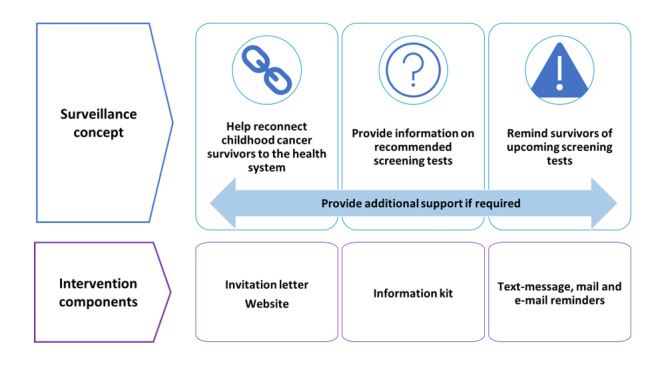
Objective: In partnership with survivors, family physicians, and health system partners, we are designing a provincial support system for high-priority tests informed by principles of implementation science, behavioral science, and design thinking.
Methods: Our multiphase process was structured as follows. Step 1 consisted of a qualitative study to explore intervention components essential to accessing surveillance tests. Step 2 comprised a workshop with childhood cancer survivors, family physicians, and health system stakeholders that used the Step 1 findings and "personas" (a series of fictional but data-informed characters) to develop and tailor the intervention for different survivor groups. Step 3 consisted of intervention prototype development, and Step 4 involved iterative user testing.
Results: The qualitative study of 30 survivors and 7 family physicians found a high desire for information on surveillance for late effects. Respondents indicated that the intervention should help patients book appointments when they are due in addition to providing personalized information. Insights from the workshop included the importance of partnering with both family physicians and survivorship clinics and providing emotional support for survivors who may experience distress upon learning of their risk for late effects. In our user-testing process, prototypes went through iterations that incorporated feedback from users regarding acceptability, usability, and functionality. We sought to address the needs of survivors and physicians while balancing the capacity and infrastructure available for a lifelong intervention via our health system partners.
Conclusions: In partnership with childhood cancer survivors, family physicians, and health system partners, we elucidated the barriers and enablers to accessing guideline-recommended surveillance tests and designed a multifaceted solution that will support survivors and their family physicians. The next step is to evaluate the intervention in a pragmatic randomized controlled trial.
Keywords: cancer; cancer screening; cancer survivor; cancer treatment; childhood cancer survivor; design; echocardiogram; late effects; mammogram; morbidity; mortality; surveillance.
©Jennifer Shuldiner, Nida Shah, Catherine Reis, Ian Chalmers, Noah Ivers, Paul Nathan. Originally published in JMIR Human Factors (https://humanfactors.jmir.org), 13.09.2022.
Conflict of interest statement
Conflicts of Interest: None declared.
Figures


References
-
- Hudson MM, Ness KK, Gurney JG, Mulrooney DA, Chemaitilly W, Krull KR, Green DM, Armstrong GT, Nottage KA, Jones KE, Sklar CA, Srivastava DK, Robison LL. Clinical ascertainment of health outcomes among adults treated for childhood cancer. JAMA. 2013 Jun 12;309(22):2371–81. doi: 10.1001/jama.2013.6296. http://europepmc.org/abstract/MED/23757085 1696100 - DOI - PMC - PubMed
-
- Landier W, Bhatia S, Eshelman DA, Forte KJ, Sweeney T, Hester AL, Darling J, Armstrong FD, Blatt J, Constine LS, Freeman CR, Friedman DL, Green DM, Marina N, Meadows AT, Neglia JP, Oeffinger KC, Robison LL, Ruccione KS, Sklar CA, Hudson MM. Development of risk-based guidelines for pediatric cancer survivors: the Children's Oncology Group Long-Term Follow-Up Guidelines from the Children's Oncology Group Late Effects Committee and Nursing Discipline. J Clin Oncol. 2004 Dec 15;22(24):4979–90. doi: 10.1200/JCO.2004.11.032.JCO.2004.11.032 - DOI - PubMed
-
- Long-term follow-up guidelines for survivors of childhood, adolescent, and young adult cancers. Children's Oncology Group. 2018. [2018-11-17]. http://survivorshipguidelines.org/pdf/2018/COG_LTFU_Guidelines_v5.pdf .
-
- Yan AP, Chen Y, Hudson MM, Gibson TM, Neglia JP, Oeffinger KC, Leisenring WM, Ness KK, Ford J, Henderson TO, Robison LL, Armstrong GT, Yasui Y, Nathan PC. Impact of survivorship care plans (SCPs) on adherence to surveillance for second malignant neoplasms (SMNs) and cardiac dysfunction in the Childhood Cancer Survivor Study (CCSS) JCO. 2018 May 20;36(15_suppl):10560–10560. doi: 10.1200/jco.2018.36.15_suppl.10560. - DOI - PMC - PubMed
-
- Yan AP, Chen Y, Henderson TO, Oeffinger KC, Hudson MM, Gibson TM, Neglia JP, Leisenring WM, Ness KK, Ford JS, Robison LL, Armstrong GT, Yasui Y, Nathan PC. Adherence to surveillance for second malignant neoplasms and cardiac dysfunction in childhood cancer survivors: a childhood cancer survivor study. J Clin Oncol. 2020 May 20;38(15):1711–1722. doi: 10.1200/jco.19.01825. - DOI - PMC - PubMed
LinkOut - more resources
Full Text Sources
