


Humoral Immunogenicity After Vaccination Against SARS-CoV-2 Infection in Inflammatory Bowel Disease Patients Under Immunosuppressive Therapy: Should We Prioritize an Additional Booster Injection?
- PMID: 36099059
- PMCID: PMC9494374
- DOI: 10.1093/ibd/izac187
Humoral Immunogenicity After Vaccination Against SARS-CoV-2 Infection in Inflammatory Bowel Disease Patients Under Immunosuppressive Therapy: Should We Prioritize an Additional Booster Injection?
Abstract
Background: Severe acute respiratory syndrome coronavirus 2 (SARS-CoV-2) infection may lead to the development of the novel coronavirus disease (coronavirus disease 2019 [COVID-19]). Scarce data are available regarding safety and efficacy of SARS-CoV-2 vaccination in inflammatory bowel disease (IBD) patients, which may present differences between subgroups. Lower humoral immunological response could require additional booster injections.
Methods: This is a prospective study including adult patients with IBD after complete vaccination against SARS-CoV-2 infection with BioNTech vaccine. Patients with previous SARS-CoV-2 infection were excluded. A control group with healthy individuals matched for age and sex was also analyzed. Blood samples were collected 30 days after complete vaccination to quantify immunoglobulin G (IgG) antibody titers against SARS-CoV-2 in both groups.
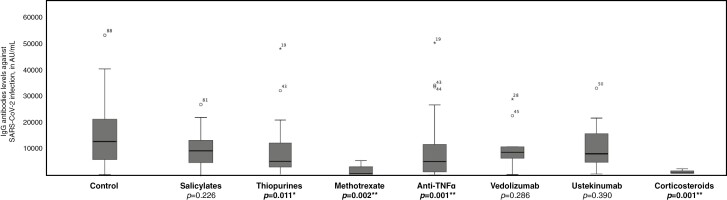
Results: The final sample included 81 IBD and 32 non-IBD patients, 55 (48.7%) of them women, with a mean age of 40.2 ± 13.0 years. From IBD patients, 58 (71.6%) had Crohn's disease and 23 (28.4%) had ulcerative colitis. IBD patients had significantly lower median anti-SARS-CoV-2 IgG levels when compared with the control group (6479 [interquartile range (IQR) 1830-11883, 10 053] AU/mL vs 13 061 [IQR 2826-21427, 15 539] AU/mL; P = .003). Regarding IBD medication, significant lower levels of SARS-CoV-2 IgG antibodies when compared with control subjects were observed in patients treated with thiopurines (5423 [IQR 3109-13369, 10 260] AU/mL; P = .011), methotrexate (834 [IQR 507-3467, 4155] AU/mL; P = .002), anti-tumor necrosis factor α agents (5065 [IQR 1033-11669, 10 636] AU/mL; P = .001), and corticosteroids (548 AU/mL; P = .001). The incidence of SARS-CoV-2 infection after vaccination was also significantly higher in patients treated with these agents.
Conclusions: IBD patients treated with immunomodulators, anti-tumor necrosis factor α agents and corticosteroids presented significantly lower anti-SARS-CoV-2 IgG levels following complete vaccination when compared with healthy control subjects. These findings support the benefit of additional booster injections in this population.
Keywords: SARS-CoV-2; inflammatory bowel disease; vaccination.
Plain language summary
This is a prospective study quantifying antibody titers against severe acute respiratory syndrome coronavirus 2 after complete vaccination in adult patients with inflammatory bowel disease. Immunomodulators, infliximab, and corticosteroid treatment were associated with lower antibody levels. This could support the benefit of an additional booster injection in this population.
© The Author(s) 2022. Published by Oxford University Press on behalf of Crohn’s & Colitis Foundation. All rights reserved. For permissions, please e-mail: journals.permissions@oup.com.
Figures
References
-
- WHO Coronavirus (COVID-19) Dashboard. Accessed. January 3, 2022. https://covid19.who.int/
MeSH terms
Substances
LinkOut - more resources
Full Text Sources
Medical
Miscellaneous
