Evaluation of CD4+:CD8+ Ratio in Patients With Cervical Cancer and the Levels of Inflammatory Markers
- PMID: 36099148
- PMCID: PMC9463885
- DOI: 10.21873/invivo.12975
Evaluation of CD4+:CD8+ Ratio in Patients With Cervical Cancer and the Levels of Inflammatory Markers
Abstract
Background/aim: Cervical cancer remains a major public health concern. The ratio of CD4+:CD8+ T-cells is used to evaluate the immune system function. This study aimed to explore the CD4+:CD8+ T-cell ratio in relation to the glycemic status, inflammatory markers, vitamin D, and vitamin B12 in patients with early diagnosed cervical cancer.
Patients and methods: This is a cross-sectional study. Blood samples were collected for flow cytometry analysis. Information regarding Papanicolaou (Pap) smears and colposcopy investigations were collected from 152 women with type 2 diabetes admitted to East Jeddah Hospital, Jeddah, Saudi Arabia, between January 2018 and January 2021.
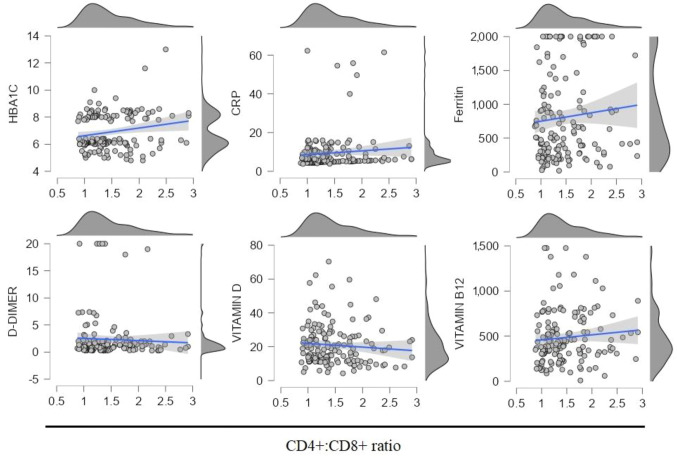
Results: Patients with early cervical carcinoma and a higher CD4+:CD8+ ratio (>1.2) had a higher C-reactive protein (CRP) level than those with a lower CD4+:CD8+ ratio (Mean±SD=13.75±13.3 vs. 10.85±8.1; p-value=0.034). Patients with early cervical carcinoma, diabetes, and higher CD4+:CD8+ ratio (>1.2) had a higher blood HbA1c percent than those with a lower CD4+:CD8+ ratio.
Conclusion: A high CD4+:CD8+ T-cells ratio was associated with an increased HbA1c% and CRP levels in women with diabetes diagnosed with early cervical carcinoma, which can induce inflammation in early diagnosed patients with cervical cancer.
Keywords: C-Reactive protein; Cervical cancer; diabetic women; early cervical carcinoma.
Copyright © 2022, International Institute of Anticancer Research (Dr. George J. Delinasios), All rights reserved.
Conflict of interest statement
The Authors declare no conflicts of interest in relation to this study.
Figures
References
-
- de Sanjose S, Quint WG, Alemany L, Geraets DT, Klaustermeier JE, Lloveras B, Tous S, Felix A, Bravo LE, Shin HR, Vallejos CS, de Ruiz PA, Lima MA, Guimera N, Clavero O, Alejo M, Llombart-Bosch A, Cheng-Yang C, Tatti SA, Kasamatsu E, Iljazovic E, Odida M, Prado R, Seoud M, Grce M, Usubutun A, Jain A, Suarez GA, Lombardi LE, Banjo A, Menéndez C, Domingo EJ, Velasco J, Nessa A, Chichareon SC, Qiao YL, Lerma E, Garland SM, Sasagawa T, Ferrera A, Hammouda D, Mariani L, Pelayo A, Steiner I, Oliva E, Meijer CJ, Al-Jassar WF, Cruz E, Wright TC, Puras A, Llave CL, Tzardi M, Agorastos T, Garcia-Barriola V, Clavel C, Ordi J, Andújar M, Castellsagué X, Sánchez GI, Nowakowski AM, Bornstein J, Muñoz N, Bosch FX, Retrospective International Survey and HPV Time Trends Study Group Human papillomavirus genotype attribution in invasive cervical cancer: a retrospective cross-sectional worldwide study. Lancet Oncol. 2010;11(11):1048–1056. doi: 10.1016/S1470-2045(10)70230-8. - DOI - PubMed
-
- Shah W, Yan X, Jing L, Zhou Y, Chen H, Wang Y. A reversed CD4/CD8 ratio of tumor-infiltrating lymphocytes and a high percentage of CD4(+)FOXP3(+) regulatory T cells are significantly associated with clinical outcome in squamous cell carcinoma of the cervix. Cell Mol Immunol. 2011;8(1):59–66. doi: 10.1038/cmi.2010.56. - DOI - PMC - PubMed
MeSH terms
Substances
LinkOut - more resources
Full Text Sources
Medical
Research Materials
Miscellaneous