


Transcranial direct current stimulation leads to faster acquisition of motor skills, but effects are not maintained at retention
- PMID: 36099260
- PMCID: PMC9469971
- DOI: 10.1371/journal.pone.0269851
Transcranial direct current stimulation leads to faster acquisition of motor skills, but effects are not maintained at retention
Abstract
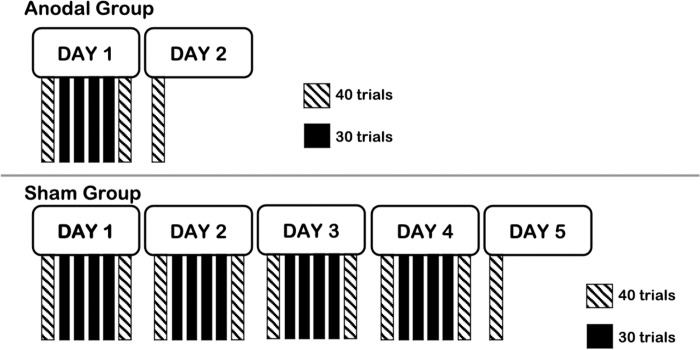
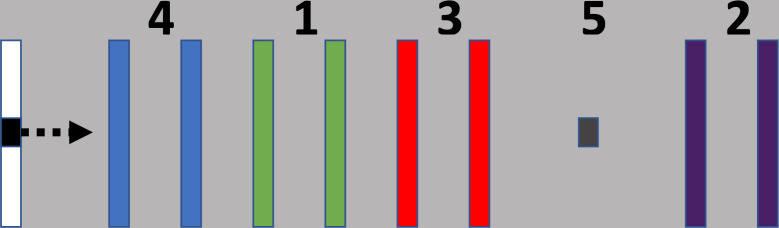
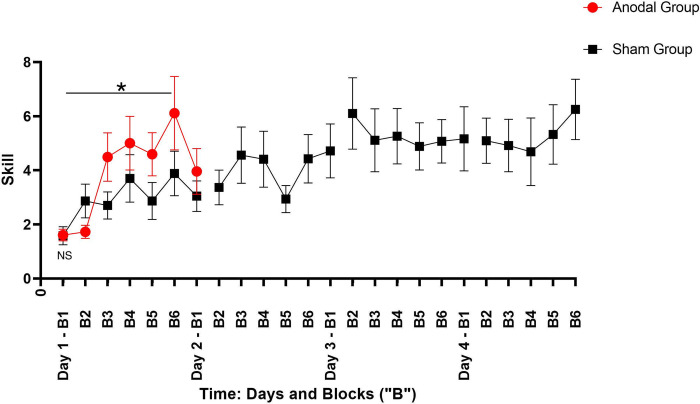
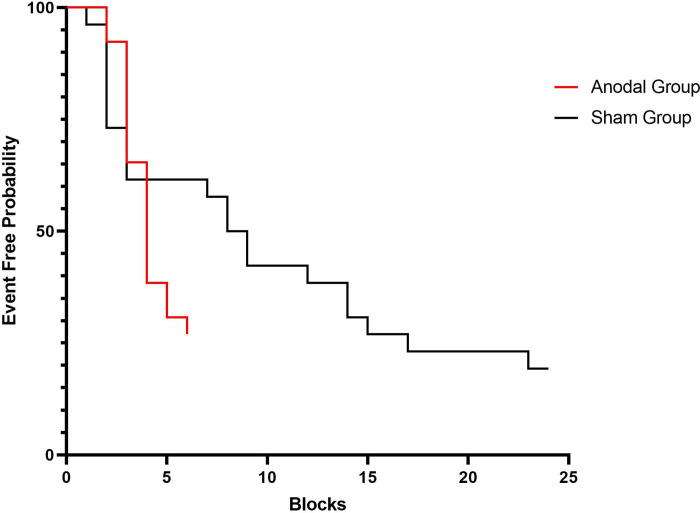
Practice is required to improve one's shooting technique in basketball or to play a musical instrument well. Learning these motor skills may be further enhanced by transcranial direct current stimulation (tDCS). We aimed to investigate whether tDCS leads to faster attainment of a motor skill, and to confirm prior work showing it improves skill acquisition and retention performance. Fifty-two participants were tested; half received tDCS with the anode on primary motor cortex and cathode on the contralateral forehead while concurrently practicing a sequential visuomotor isometric pinch force task on Day 1, while the other half received sham tDCS during practice. On Day 2, retention of the skill was tested. Results from a Kaplan-Meier survival analysis showed that participants in the anodal group attained a pre-defined target level of skill faster than participants in the sham group (χ2 = 9.117, p = 0.003). Results from a nonparametric rank-based regression analysis showed that the rate of improvement was greater in the anodal versus sham group during skill acquisition (F(1,249) = 5.90, p = 0.016), but there was no main effect of group or time. There was no main effect of group or time, or group by time interaction when comparing performance at the end of acquisition to retention. These findings suggest anodal tDCS improves performance more quickly during skill acquisition but does not have additional benefits on motor learning after a period of rest.
Conflict of interest statement
The authors have declared that no competing interests exist.
Figures
References
-
- Schmidt R, Lee T. Motor control and learning. 5th Editio. Motor control and learning. Human Kinetics; 2011.
-
- Antal A, Alekseichuk I, Bikson M, Brockmöller J, Brunoni AR, Chen R, et al. Low intensity transcranial electric stimulation: Safety, ethical, legal regulatory and application guidelines. Clin Neurophysiol [Internet]. 2017;128(9):1774–809. Available from: http://www.ncbi.nlm.nih.gov/pubmed/28709880. doi: 10.1016/j.clinph.2017.06.001 - DOI - PMC - PubMed
-
- Thair H, Holloway AL, Newport R, Smith AD. Transcranial Direct Current Stimulation (tDCS): A Beginner’s Guide for Design and Implementation. Front Neurosci [Internet]. 2017. Nov 22;11. Available from: http://journal.frontiersin.org/article/10.3389/fnins.2017.00641/full. doi: 10.3389/fnins.2017.00641 - DOI - PMC - PubMed
-
- Ammann C, Spampinato D, Márquez-Ruiz J. Modulating Motor Learning through Transcranial Direct-Current Stimulation: An Integrative View. Front Psychol [Internet]. 2016. Dec 23;7. Available from: http://journal.frontiersin.org/article/10.3389/fpsyg.2016.01981/full. - DOI - PMC - PubMed
Publication types
MeSH terms
LinkOut - more resources
Full Text Sources
