


Evidence from "big data" for the default-mode hypothesis of ADHD: a mega-analysis of multiple large samples
- PMID: 36100657
- PMCID: PMC9751118
- DOI: 10.1038/s41386-022-01408-z
Evidence from "big data" for the default-mode hypothesis of ADHD: a mega-analysis of multiple large samples
Abstract
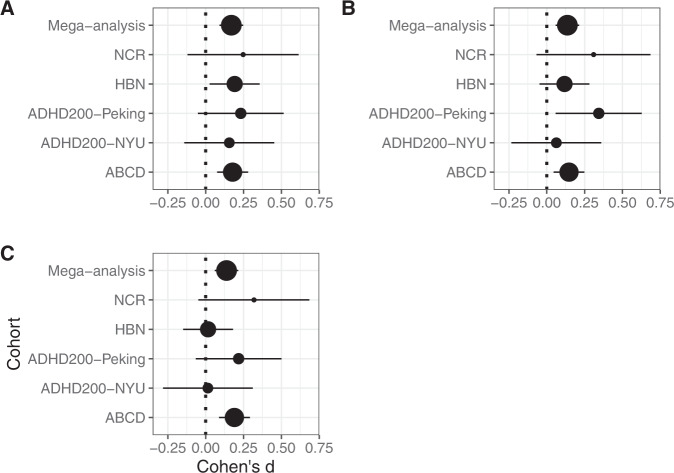
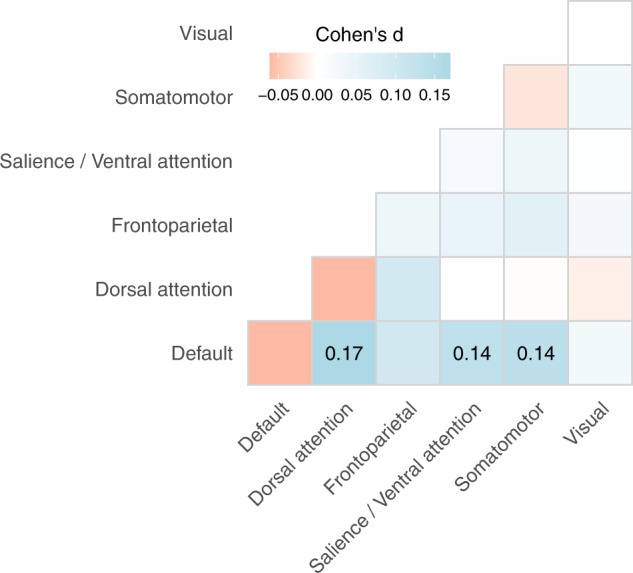
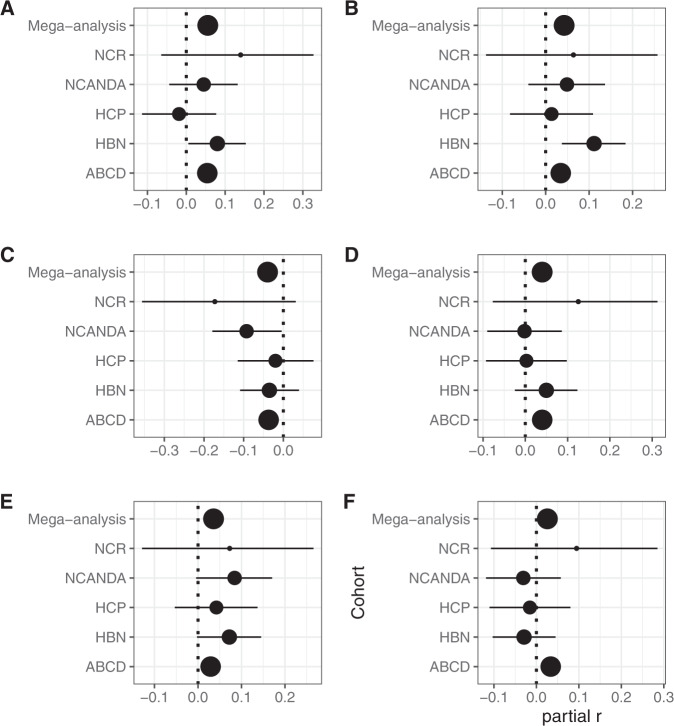
We sought to identify resting-state characteristics related to attention deficit/hyperactivity disorder, both as a categorical diagnosis and as a trait feature, using large-scale samples which were processed according to a standardized pipeline. In categorical analyses, we considered 1301 subjects with diagnosed ADHD, contrasted against 1301 unaffected controls (total N = 2602; 1710 males (65.72%); mean age = 10.86 years, sd = 2.05). Cases and controls were 1:1 nearest neighbor matched on in-scanner motion and key demographic variables and drawn from multiple large cohorts. Associations between ADHD-traits and resting-state connectivity were also assessed in a large multi-cohort sample (N = 10,113). ADHD diagnosis was associated with less anticorrelation between the default mode and salience/ventral attention (B = 0.009, t = 3.45, p-FDR = 0.004, d = 0.14, 95% CI = 0.004, 0.014), somatomotor (B = 0.008, t = 3.49, p-FDR = 0.004, d = 0.14, 95% CI = 0.004, 0.013), and dorsal attention networks (B = 0.01, t = 4.28, p-FDR < 0.001, d = 0.17, 95% CI = 0.006, 0.015). These results were robust to sensitivity analyses considering comorbid internalizing problems, externalizing problems and psychostimulant medication. Similar findings were observed when examining ADHD traits, with the largest effect size observed for connectivity between the default mode network and the dorsal attention network (B = 0.0006, t = 5.57, p-FDR < 0.001, partial-r = 0.06, 95% CI = 0.0004, 0.0008). We report significant ADHD-related differences in interactions between the default mode network and task-positive networks, in line with default mode interference models of ADHD. Effect sizes (Cohen's d and partial-r, estimated from the mega-analytic models) were small, indicating subtle group differences. The overlap between the affected brain networks in the clinical and general population samples supports the notion of brain phenotypes operating along an ADHD continuum.
© 2022. This is a U.S. Government work and not under copyright protection in the US; foreign copyright protection may apply.
Conflict of interest statement
The authors declare no competing interests.
Figures
References
-
- Association AP. Diagnostic and statistical manual of mental disorders (DSM-5®). American Psychiatric Pub; 2013. - PubMed
Publication types
MeSH terms
Grants and funding
- U24 DA041147/DA/NIDA NIH HHS/United States
- U01 DA051039/DA/NIDA NIH HHS/United States
- U01 AA021696/AA/NIAAA NIH HHS/United States
- U01 DA051018/DA/NIDA NIH HHS/United States
- U01 AA021681/AA/NIAAA NIH HHS/United States
- U24 DA041123/DA/NIDA NIH HHS/United States
- U01 AA021695/AA/NIAAA NIH HHS/United States
- U01 AA021692/AA/NIAAA NIH HHS/United States
- U01 DA051037/DA/NIDA NIH HHS/United States
- U01 DA051016/DA/NIDA NIH HHS/United States
- U01 DA041148/DA/NIDA NIH HHS/United States
- U01 DA041174/DA/NIDA NIH HHS/United States
- U01 DA041120/DA/NIDA NIH HHS/United States
- U24 AA021697/AA/NIAAA NIH HHS/United States
- U01 DA041093/DA/NIDA NIH HHS/United States
- U01 MH109589/MH/NIMH NIH HHS/United States
- U01 AA021691/AA/NIAAA NIH HHS/United States
- U01 DA051038/DA/NIDA NIH HHS/United States
- ZIA HG200378/ImNIH/Intramural NIH HHS/United States
- U01 DA041134/DA/NIDA NIH HHS/United States
- U01 DA041022/DA/NIDA NIH HHS/United States
- U01 DA041156/DA/NIDA NIH HHS/United States
- U01 DA050987/DA/NIDA NIH HHS/United States
- U01 DA041025/DA/NIDA NIH HHS/United States
- U01 DA050989/DA/NIDA NIH HHS/United States
- U01 DA041089/DA/NIDA NIH HHS/United States
- U01 DA050988/DA/NIDA NIH HHS/United States
- U01 AA021690/AA/NIAAA NIH HHS/United States
- U01 DA041106/DA/NIDA NIH HHS/United States
- U24 AA021695/AA/NIAAA NIH HHS/United States
- U01 DA041117/DA/NIDA NIH HHS/United States
- U01 DA041028/DA/NIDA NIH HHS/United States
- U01 DA041048/DA/NIDA NIH HHS/United States
- R01 MH083246/MH/NIMH NIH HHS/United States
- U01 AA021697/AA/NIAAA NIH HHS/United States
LinkOut - more resources
Full Text Sources
Medical
