. 2022 Jul 2;11(7):1004.
doi: 10.3390/biology11071004.

What Is behind the Correlation Analysis of Diarrheagenic E. coli Pathotypes?

Affiliations

What Is behind the Correlation Analysis of Diarrheagenic E. coli Pathotypes?

Mahmoud M Bendary et al. Biology (Basel). .

Abstract

The treatment failure recorded among patients and animals infected with diarrheagenic Escherichia coli (DEC) was increased due to the presence of specific virulence markers among these strains. These markers were used to classify DEC into several pathotypes. We analyzed the correlations between DEC pathotypes and antimicrobial resistances, the existence of virulence genes, serotypes, and hosts. The ETEC pathotype was detected with a high prevalence rate (25%). Moreover, the ETEC and EPEC pathotypes were highly associated with human infections in contrast to the EIEC and EAEC phenotypes, which were commonly recognized among animal isolates. Interestingly, the antimicrobial resistance was affected by E. coli pathotypes. With the exception of EIEC and STEC, imipenem represented the most effective antibiotic against the other pathotypes. There were fixed correlations between the DEC pathotypes and the presence of virulence markers and hosts; meanwhile, their correlation with serotypes was variable. Additionally, the vast majority of our isolates were highly diverse, based on both phenotypic and ERIC molecular typing techniques. Our promising results gave a clear indication for the heterogeneity and weak clonality of DEC pathotypes in Egypt, which can be utilized in the evaluation of the current therapeutic protocols and infection control guidelines.

Keywords: E. coli; clonality; correlation; hosts; pathotypes.


Conflict of interest statement

The authors declare no conflict of interest.

Figures

Figure 1
Figure 1
Occurrence and distribution of DEC pathotypes among human and animal hosts. EAEC: enteroaggregative E. coli, ETEC: enterotoxigenic E. coli, EPEC: enteropathogenic E. coli, EIEC: enteroinvasive E. coli, STEC: shiga-toxin-producing E. coli.
Figure 2
Figure 2
Frequency of resistance to antimicrobials, serotypes, and virulence markers of DEC pathotypes. TZP: piperacillin/tazobactam, C: chloramphenicol, TE: tetracycline, AMP: ampicillin, CN: gentamycin, E: erythromycin, ATM: aztreonam, SXT: sulfamethoxazole/trimethoprim, AMC: amoxicillin/clavulanic acid, IPM: imipenem, CIP: ciprofloxacin, FOX: cefoxitin, CPM: cefepime, CPZ: cefoperazone, EAEC: enteroaggregative E. coli, ETEC: enterotoxigenic E. coli, EPEC: enteropathogenic E. coli, EIEC: enteroinvasive E. coli, STEC: shiga-toxin-producing E. coli.
Figure 3
Figure 3
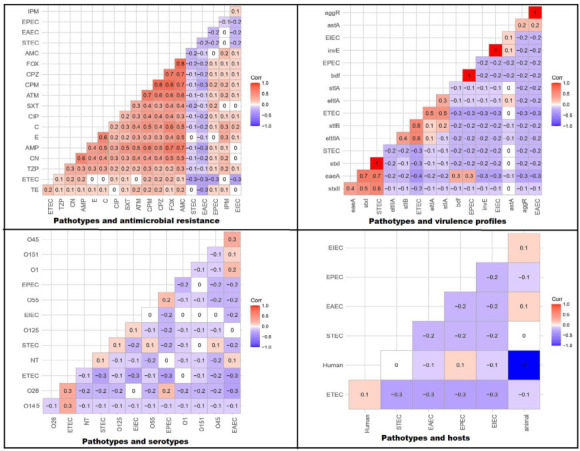
Correlation coefficient (r) between diarrheagenic E. coli pathotypes and antimicrobial resistance, virulence gene existence, serotypes, and host types. Red and blue colors specify positive and negative correlations, respectively. The color key denotes the correlation coefficient (R). The darker red and blue colors indicate stronger positive (R = 0.5:1) and negative (R = −0.5:−1) correlations, respectively. TZP: piperacillin/tazobactam, TE: tetracycline, AMP: ampicillin, IPM: imipenem, CN: gentamycin, E: erythromycin, ATM: aztreonam, CIP: ciprofloxacin, C: chloramphenicol, SXT: sulfamethoxazole/trimethoprim, AMC: amoxicillin/clavulanic acid, FOX: cefoxitin, CPM: cefepime, CPZ: cefoperazone, EAEC: enteroaggregative E. coli, ETEC: enterotoxigenic E. coli, EPEC: enteropathogenic E. coli, EIEC: enteroinvasive E. coli, STEC: shiga-toxin-producing E. coli.
Figure 4
Figure 4
Heat map and hierarchical clustering of diarrheagenic E. coli pathotypes according to the occurrence of serotypes, antimicrobial resistances, and virulence genes. Blue and red colors indicate the sensitivity and resistance to a certain antimicrobial and to the absence and presence of a particular serotype and virulence gene, respectively. The code numbers on the right side of the heat map denote the numbers of diarrheagenic E. coli pathotypes from equine (E), cow (C), and human (H) sources. TZP: piperacillin/tazobactam, C: chloramphenicol, TE: tetracycline, AMP: ampicillin, CN: gentamycin, E: erythromycin, ATM: aztreonam, SXT: sulfamethoxazole/trimethoprim, AMC: amoxicillin/clavulanic acid, IPM: imipenem, CIP: ciprofloxacin, FOX: cefoxitin, CPM: cefepime, CPZ: cefoperazone, EAEC: enteroaggregative E. coli, ETEC: enterotoxigenic E. coli, EPEC: enteropathogenic E. coli, EIEC: enteroinvasive E. coli, STEC: shiga-toxin-producing E. coli.
Figure 5
Figure 5
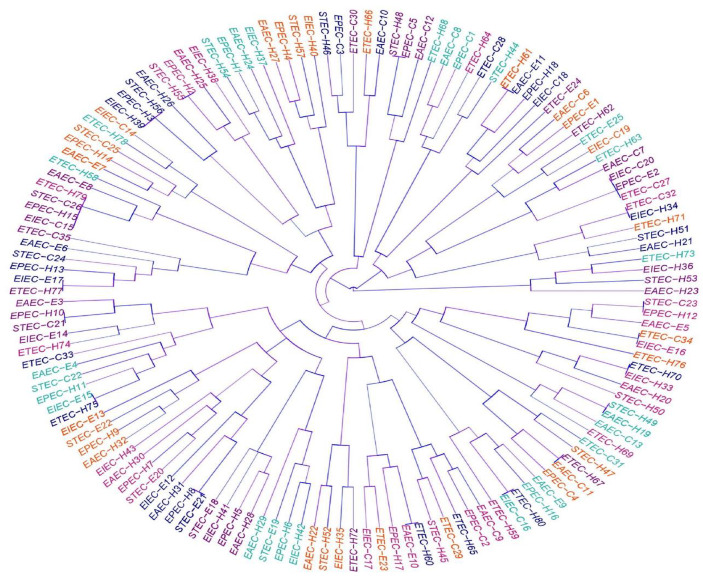
Dendrogram showing the relatedness of diarrheagenic E. coli pathotypes isolated from equine (E), cow (C), and human (H) origins, as determined by ERIC-PCR fingerprinting. EAEC: enteroaggregative E. coli, ETEC: enterotoxigenic E. coli, EPEC: enteropathogenic E. coli, EIEC: enteroinvasive E. coli, STEC: shiga-toxin-producing E. coli.
Figure 6
Figure 6
Heat map and hierarchical clustering of diarrheagenic E. coli pathotypes, according to the generated ERIC-PCR amplicon size (bp) profiles. Blue and red colors indicate the absence and presence of particular ERIC-PCR bands, respectively. The code numbers on the right side of the heat map denote the numbers of diarrheagenic E. coli pathotypes from equine (E), cow (C), and human (H) sources. TZP: piperacillin/tazobactam, C: chloramphenicol, TE: tetracycline, AMP: ampicillin, CN: gentamycin, E: erythromycin, ATM: aztreonam, SXT: sulfamethoxazole/trimethoprim, AMC: amoxicillin/clavulanic acid, IPM: imipenem, CIP: ciprofloxacin, FOX: cefoxitin, CPM: cefepime, CPZ: cefoperazone, EAEC: enteroaggregative E. coli, ETEC: enterotoxigenic E. coli, EPEC: enteropathogenic E. coli, EIEC: enteroinvasive E. coli, STEC: shiga-toxin-producing E. coli.

References

    1. Allocati N., Masulli M., Alexeyev M.F., Di-Ilio C. Escherichia coli in Europe: An overview. Int. J. Environ. Res. Public Health. 2013;10:6235–6254. doi: 10.3390/ijerph10126235. - DOI - PMC - PubMed
    1. Croxen M.A., Law R.J., Scholz R., Keeney K.M., Wlodarska M., Finlay B.B. Recent advances in understanding enteric pathogenic Escherichia coli. Clin. Microbiol. Rev. 2013;26:822–880. doi: 10.1128/CMR.00022-13. - DOI - PMC - PubMed
    1. Elfaky M.A., Abdel-Hamid M.I., Khalifa E., Alshareef W.A., Mosbah R.A., Elazab S.T., Ghoneim M.M., Al-Sanea M.M., Bendary M.M. Innovative next-generation therapies in combating multi-drug-resistant and multi-virulent Escherichia coli isolates: Insights from in vitro, in vivo, and molecular docking studies. Appl. Microbiol. Biotechnol. 2022;106:1691–1703. doi: 10.1007/s00253-022-11781-w. - DOI - PubMed
    1. Mosallam F.M., Helmy E.A., Bendary M.M., El-Batal I.A. Potency of a novel synthesized Ag- eugenol nanoemulsion for treating some bacterial and fungal pathogens. J. Mater. Res. 2021;36:1524–1537. doi: 10.1557/s43578-021-00226-1. - DOI
    1. Jang J., Hur H.G., Sadowsky M.J., Byappanahalli M.N., Yan T., Ishii S. Environmental Escherichia coli: Ecology and public health implications—A review. J. Appl. Microbiol. 2017;123:570–581. doi: 10.1111/jam.13468. - DOI - PubMed