


Increases in Depression, Self-Harm, and Suicide Among U.S. Adolescents After 2012 and Links to Technology Use: Possible Mechanisms
- PMID: 36101887
- PMCID: PMC9176070
- DOI: 10.1176/appi.prcp.20190015
Increases in Depression, Self-Harm, and Suicide Among U.S. Adolescents After 2012 and Links to Technology Use: Possible Mechanisms
Abstract
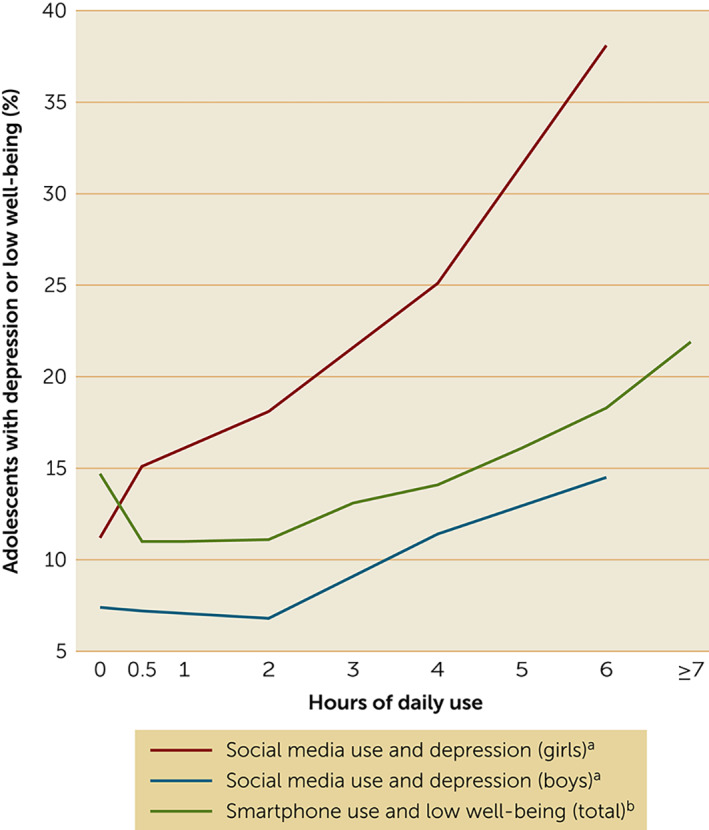
Objective: Increases in depression among adolescents have been concurrent with increases in digital media use. In this article, recent trends in mental health among U.S. adolescents and young adults are discussed and theories about their possible connection with concurrent increases in digital media use are presented.
Methods: Large studies of trends in mental health in the 2000s and 2010s are described and possible mechanisms for the trends are discussed based on existing literature.
Results: After remaining stable during the early 2000s, the prevalence of mental health issues among U.S. adolescents and young adults began to rise in the early 2010s. These trends included sharp increases in depression, anxiety, loneliness, self-harm, suicidal ideation, suicide attempts, and suicide, with increases more pronounced among girls and young women. There is a growing consensus that these trends may be connected to the rise in technology use. Increased digital media and smartphone use may influence mental health via several mechanisms, including displacement of time spent in in-person social interactions, individually and across the generation, as adolescent cultural norms evolve; disruption of in-person social interactions; interference with sleep time and quality; cyberbullying and toxic online environments; and online contagion and information about self-harm.
Conclusions: U.S. adolescents and young adults are in the midst of a mental health crisis, particularly among girls and young women. The rise of digital media may have played a role in this problem via several mechanisms.
Keywords: depression; digital media; self‐harm; social media; suicide.
© 2020 The Authors. Psychiatric Research and Clinical Practice published by Wiley Periodicals LLC. on behalf of the American Psychiatric Association.
Figures

References
-
- Anderssen E: Why are today's teenagers feeling so anxious? The Globe and Mail, January 21, 2013. https://www.theglobeandmail.com/life/health-and-fitness/health/condition.... Accessed Feb 28, 2020.
-
- Novotney A: Students under pressure: college and university counseling centers are examining how best to serve the growing number of students seeking their services. Monitor on Psychology 2014; 45:36
-
- Lauriello S: The real reason record numbers of college students are seeking mental health treatment. Health.com. https://www.health.com/condition/depression/anxiety-depression-college-u.... Accessed January 25, 2019.
-
- Collishaw S: Annual research review: secular trends in child and adolescent mental health. J Child Psychol Psychiatry 2015; 56: 370–393 - PubMed
-
- Duffy, ME , Twenge, JM , Joiner, TE : Trends in mood and anxiety symptoms and suicide‐related outcomes among US undergraduates, 2007–2018: evidence from two national surveys. Journal of Adolescent Health 2019; 65:590–598 - PubMed
LinkOut - more resources
Full Text Sources