. 2023 Apr 3;62(4):1417-1425.
doi: 10.1093/rheumatology/keac500.

Comparative effectiveness of guselkumab in psoriatic arthritis: updates to a systematic literature review and network meta-analysis

Affiliations

Comparative effectiveness of guselkumab in psoriatic arthritis: updates to a systematic literature review and network meta-analysis

Philip J Mease et al. Rheumatology (Oxford). .

Abstract

Objective: The IL-23 p19-subunit inhibitor guselkumab has been previously compared with other targeted therapies for PsA through network meta-analysis (NMA). The objective of this NMA update was to include new guselkumab COSMOS trial data, and two key comparators: the IL-23 inhibitor risankizumab and the Janus kinase (JAK) inhibitor upadacitinib.

Material and methods: A systematic literature review was conducted to identify randomized controlled trials up to February 2021. A hand-search identified newer agents up to July 2021. Bayesian NMAs were performed to compare treatments on ACR response, Psoriasis Area and Severity Index (PASI) response, modified van der Heijde-Sharp (vdH-S) score, and serious adverse events (SAEs).

Results: For ACR 20, guselkumab 100 mg every 8 weeks (Q8W) and every 4 weeks (Q4W) were comparable (i.e. overlap in credible intervals) to most other agents, including risankizumab, upadacitinib, subcutaneous TNF inhibitors and most IL-17A inhibitors. For PASI 90, guselkumab Q8W and Q4W were better than multiple agents, including subcutaneous TNF and JAK inhibitors. For vdH-S, guselkumab Q8W was similar to risankizumab, while guselkumab Q4W was better; both doses were comparable to most other agents. Most agents had comparable SAEs.

Conclusions: Guselkumab demonstrates better skin efficacy than most other targeted PsA therapies, including upadacitinib. For vdH-S, both guselkumab doses are comparable to most treatments, with both doses ranking higher than most, including upadacitinib and risankizumab. Both guselkumab doses demonstrate comparable ACR responses to most other agents, including upadacitinib and risankizumab, and rank favourably in the network for SAEs.

Keywords: ACR response; Comparative effectiveness research; PsA; Psoriasis Area and Severity Index (PASI) response; guselkumab; modified van der Heijde–Sharp (vdH-S) score; network meta-analysis; serious adverse events; systematic literature review.


Figures

Figure 1.
Figure 1.
PRISMA flow diagram of study selection for systematic literature review and hand-search. NCT: National Clinical Trial
Figure 2.
Figure 2.
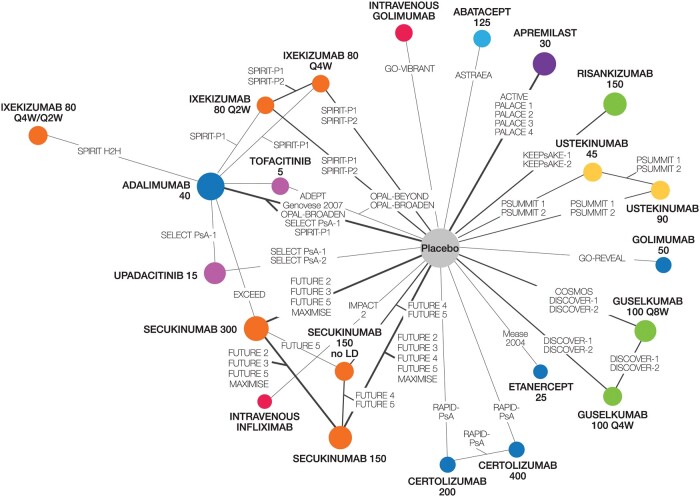
Evidence network for multi-ACR. The network includes all treatments and doses that are approved by either the FDA or EMA. Treatment nodes are sized to reflect the proportionate number of patients randomized to each treatment in the network. Thickness of lines between nodes corresponds to the number of RCTs connecting treatments. Colours show inhibitor class: light blue: cytotoxic T lymphocyte-associated antigen 4; yellow: interleukin-12/23; orange: interleukin-17A; green: interleukin-23; pink: Janus kinase; purple: phosphodiesterase-4; red: intravenous TNF; dark blue: subcutaneous TNF. EMA: European Medicines Agency; FDA: Food and Drug Administration; LD: loading dose; Q2W: every 2 weeks; Q4W: every 4 weeks; Q8W: every 8 weeks; RCT: randomized controlled trial
Figure 3.
Figure 3.
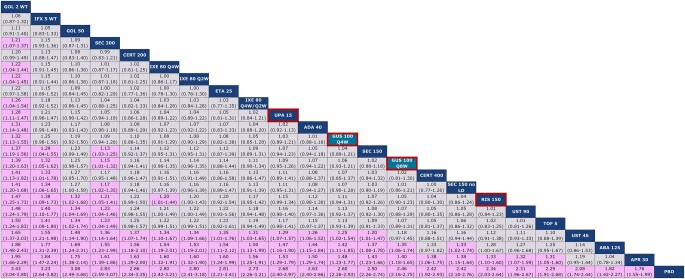
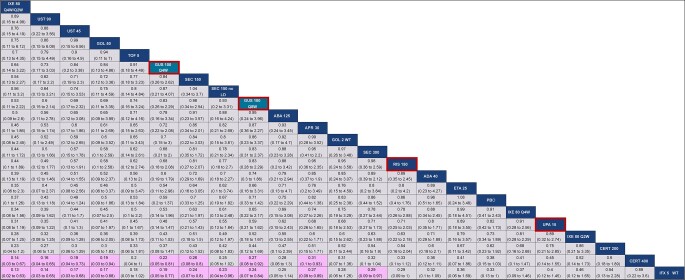
Baseline risk-adjusted random effects league table for multi-ACR 20 response. Interventions are ordered from top-left to bottom-right in order of decreasing mean rank. For each pairwise comparison, the row treatment serves as the reference group. Pairwise comparisons from the baseline-risk adjusted, random effects NMA model are shown in terms of RRs and 95% CrIs. A RR >1 favours the treatment in a given column. RRs with CrIs that do not span unity are shown with a purple background. Both guselkumab doses are shaded in teal and outlined in red, while risankizumab and upadacitinib are outlined in red. ABA: abatacept; ADA: adalimumab; APR: apremilast; CERT: certolizumab; Crl: credible interval; ETA: etanercept; GOL: golimumab; GUS: guselkumab; IFX: infliximab; IXE: ixekizumab; LD: loading dose; NMA: network meta-analysis; PBO: placebo; Q2W: every 2 weeks; Q4W: every 4 weeks; Q8W: every 8 weeks; RIS: risankizumab; RR: relative risk; SEC: secukinumab; TOF: tofacitinib; UPA: upadacitinib; UST: ustekinumab; WT: weight-based (i.e. intravenous)
Figure 4.
Figure 4.
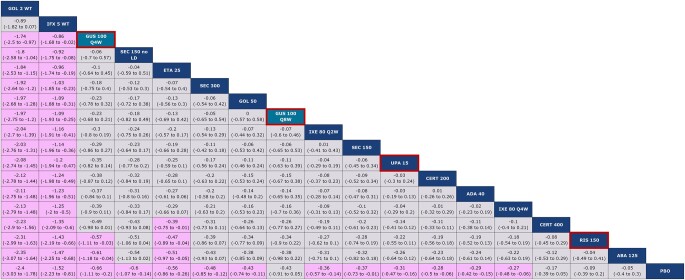
Unadjusted fixed effect league table for vdH-S score. Interventions are ordered from top-left to bottom-right in order of decreasing mean rank. For each pairwise comparison, the row treatment serves as the reference group. Pairwise comparisons from the unadjusted, fixed effect NMA model are shown in terms of MDs and 95% CrIs. A MD <0 favours the treatment in a given column. MDs with CrIs that do not span zero are shown with a purple background. Both guselkumab doses are shaded in teal and outlined in red, while risankizumab and upadacitinib are outlined in red. ABA: abatacept; ADA: adalimumab; CERT: certolizumab; Crl: credible interval; ETA: etanercept; GOL: golimumab; GUS: guselkumab; IFX: infliximab; IXE: ixekizumab; LD: loading dose; MD: mean difference; NMA: network meta-analysis; PBO: placebo; Q2W: every 2 weeks; Q4W: every 4 weeks; Q8W: every 8 weeks; RIS: risankizumab; SEC: secukinumab; UPA: upadacitinib; vdH-S: van der Heijde–Sharp; WT: weight-based (i.e. intravenous)
Figure 5.
Figure 5.
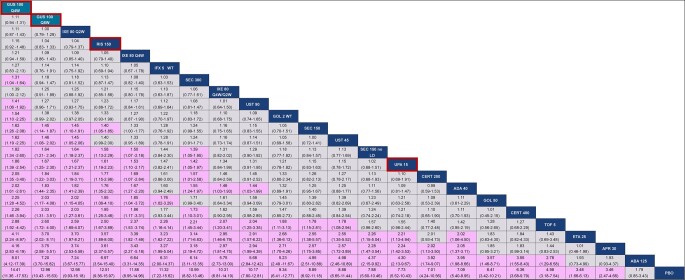
Baseline risk-adjusted random effects league table for multi-PASI 90 response. Interventions are ordered from top-left to bottom-right in order of decreasing mean rank. For each pairwise comparison, the row treatment serves as the reference group. Pairwise comparisons from the baseline risk-adjusted, random effects NMA model are shown in terms of RRs and 95% CrIs. A RR >1 favours the treatment in a given column. RRs with CrIs that do not span unity are shown with a purple background. Both guselkumab doses are shaded in teal and outlined in red, while risankizumab and upadacitinib are outlined in red. ABA: abatacept; ADA: adalimumab; APR: apremilast; CERT: certolizumab; Crl: credible interval; ETA: etanercept; GOL: golimumab; GUS: guselkumab; IFX: infliximab; IXE: ixekizumab; LD: loading dose; NMA: network meta-analysis; PASI: Psoriasis Area and Severity Index; PBO: placebo; Q2W: every 2 weeks; Q4W: every 4 weeks; Q8W: every 8 eight weeks; RIS: risankizumab; RR: relative risk; SEC: secukinumab; TOF: tofacitinib; UPA: upadacitinib; UST: ustekinumab; WT: weight-based (i.e. intravenous)
Figure 6.
Figure 6.
Baseline risk-adjusted random effects league table for SAEs. Interventions are ordered from top-left to bottom-right in order of decreasing mean rank. For each pairwise comparison, the row treatment serves as the reference group. Pairwise comparisons from the baseline-risk adjusted, random effects NMA model are shown in terms of RRs and 95% CrIs. A RR <1 favours the treatment in a given column. RRs with CrIs that do not span unity are shown with a purple background. Both guselkumab doses are shaded in teal and outlined in red, while risankizumab and upadacitinib are outlined in red. ABA: abatacept; ADA: adalimumab; APR: apremilast; CERT: certolizumab; Crl: credible interval; ETA: etanercept; GOL: golimumab; GUS: guselkumab; IFX: infliximab; IXE: ixekizumab; LD: loading dose; NMA: network meta-analysis; PBO: placebo; Q2W: every 2 weeks; Q4W: every 4 weeks; Q8W: every 8 weeks; RIS: risankizumab; RR: relative risk; SAEs: serious adverse events; SEC: secukinumab; TOF: tofacitinib; UPA: upadacitinib; UST: ustekinumab; WT: weight-based (i.e. intravenous)

References

    1. Wervers K, Luime JJ, Tchetverikov I. et al. Influence of disease manifestations on health-related quality of life in early psoriatic arthritis. J Rheumatol 2018;45:1526–31. - PubMed
    1. McInnes IB, Behrens F, Mease PJ. et al.; EXCEED Study Group. Secukinumab versus adalimumab for treatment of active psoriatic arthritis (EXCEED): a double-blind, parallel-group, randomised, active-controlled, phase 3b trial. Lancet 2020;395:1496–505. - PubMed
    1. Mease PJ, Smolen JS, Behrens F. et al.; SPIRIT H2H study group. A head-to-head comparison of the efficacy and safety of ixekizumab and adalimumab in biological-naïve patients with active psoriatic arthritis: 24-week results of a randomized, open-label, blinded-assessor trial. Ann Rheum Dis 2020;79:123–31. - PMC - PubMed
    1. Marzo-Ortega H, Packham J, Pujades-Rodriguez M.. ‘Too much of a good thing’: can network meta-analysis guide treatment decision-making in psoriatic arthritis? Rheumatology (Oxford) 2021;60:3042–4. - PubMed
    1. Catalá-López F, Tobías A, Cameron C, Moher D, Hutton B.. Network meta-analysis for comparing treatment effects of multiple interventions: an introduction. Rheumatol Int 2014;34:1489–96. - PubMed

Publication types