Review
. 2022 Nov;23(6):823-840.
doi: 10.1007/s40257-022-00726-8. Epub 2022 Sep 14.

Cutaneous Leishmaniasis: A 2022 Updated Narrative Review into Diagnosis and Management Developments

Affiliations
Review

Cutaneous Leishmaniasis: A 2022 Updated Narrative Review into Diagnosis and Management Developments

Henry J C de Vries et al. Am J Clin Dermatol. 2022 Nov.

Abstract

This review is an update of an earlier narrative review published in 2015 on developments in the clinical management of cutaneous leishmaniasis (CL) including diagnosis, treatment, prevention and control measurements. CL is a vector-borne infection caused by the protozoan parasite Leishmania. The vector is the female sandfly. Globally, CL affects 12 million cases and annually 2 million new cases occur. CL is endemic in almost 100 countries and the total risk population is approximately 350 million people. WHO lists CL an emerging and uncontrolled disease and a neglected tropical disease. Local experience-based evidence remains the mainstay for the management of CL. Whereas intralesional therapeutic options are the first treatment option for most CL patients, those with mucocutaneous and disseminated involvement require a systemic therapeutic approach. Moreover, different Leishmania species can vary in their treatment outcomes. Therefore, species determination is critical for optimal CL clinical management. New DNA techniques allow for relatively easy Leishmania species determination, yet they are not easily implemented in resource-limited settings. There is a desperate need for novel, less toxic, and less painful treatment options, especially for children with CL. Yet, the large and well conducted studies required to provide the necessary evidence are lacking. To further control and potentially eliminate CL, we urgently need to improve vector control, and diagnostics, and we require efficient and safe vaccines. Alas, since CL primarily affects poor people, biotechnical companies dedicate little investment into the research programs that could lead to diagnostic, pharmaceutical, and vaccine innovations.


Conflict of interest statement

HJCdV and HDS have no conflicts of interest to declare.

Figures
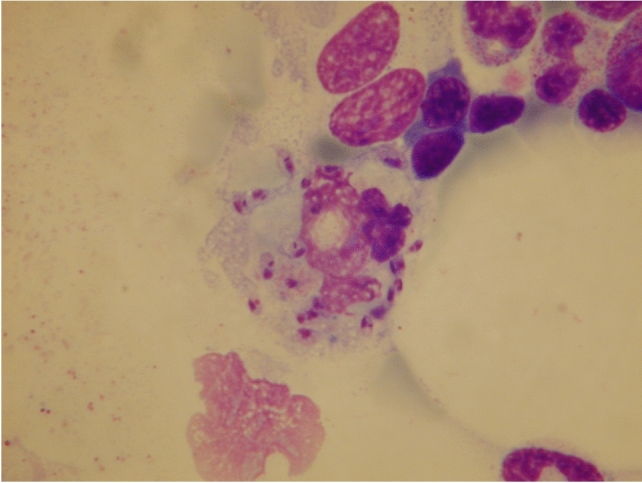
Fig. 1
Fig. 1
Leishmaniasis amastigotes. Amastigotes appear in skin biopsies as round or oval structures with characteristic nuclei and kinetoplasts, about 2–4 μm in diameter
Fig. 2
Fig. 2
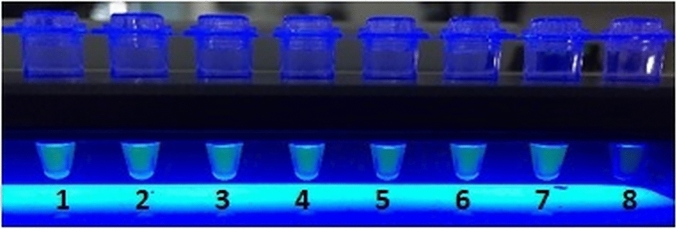
Loop-mediated isothermal reaction (LAMP) molecular diagnostics. Many molecular diagnostic techniques require adequate infrastructure and technically skilled operators, making these tests less suitable for resource-restricted laboratories in disease endemic countries. LAMP is an isothermal diagnostic platform that partly circumvents these requirements. The picture shows visualization of LAMP results under UV light. Positive samples (1–7) show turbidity, whereas the negative sample (8) has remained transparent
Fig. 3
Fig. 3
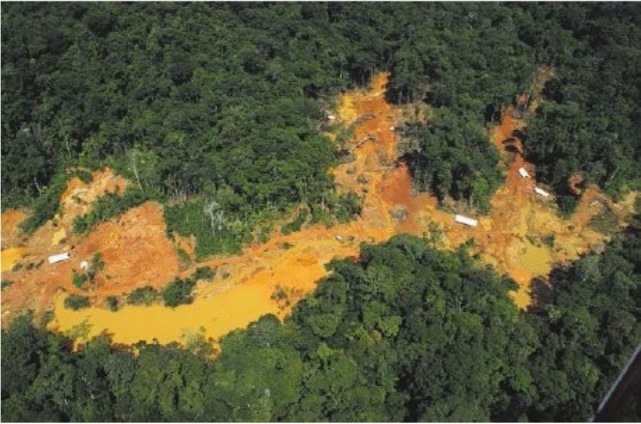
Deforestation in Godo-olo, district Sipaliwini (Suriname). Human interference can cause leishmaniasis outbreaks due to the disruption of the natural reservoir-vector transmission cycle of Leishmania parasites and the introduction of an immune-naïve labor force in the deforested area. Collection Ramdas, S., 2009
Fig. 4
Fig. 4
Various manifestations of cutaneous leishmaniasis. a A cutaneous leishmaniasis ulcer with a satellite lesion on the lower arm. b Same patient as in a, healed after treatment with cryotherapy and intralesional antimonials. c Non-ulcerative cutaneous leishmaniasis lesion on the elbow. Multibacillary leprosy was considered but disproved in this patient. d Crusty cutaneous leishmaniasis ulcer with lymphangitis on the upper leg. e Typical cutaneous leishmaniasis lesion as often seen in children with Leishmania infantum contracted in North Africa. f Chiclero ulcer, typically affecting the ear with cartilage destruction. g Disseminated cutaneous lesions in a patient with mucocutaneous leishmaniasis caused by L. guyanensis. h Intralesional treatment of cutaneous leishmaniasis with antimonials. Photo credits: Department of Dermatology, Amsterdam UMC, Amsterdam, The Netherlands
Fig. 5
Fig. 5
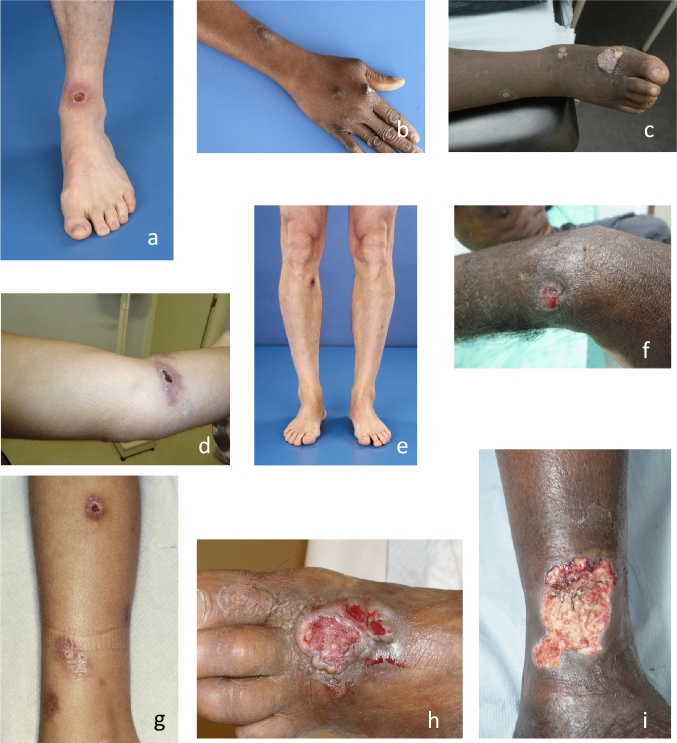
Skin diseases that can mimic the clinical picture of cutaneous leishmaniasis. a Buruli ulcer caused by Mycobacterium ulcerans on the lower leg. b Atypical mycobacterial infection on the hand with lymphangitis caused by M. marinum infection. c Hyperkeratotic lesions caused by deep mycosis of the lower leg with lymphangitis in an immunosuppressed patient. d Ulcerative lesion caused by sporotrichosis with a satellite lesion on the arm. e Rickettsiosis on the lower leg with an eschar. f Ulcerative lesion in a patient with multibacillary leprosy. g Ulcerative lesions in a patient with necrobiosis lipoidica in a sporotrichoid dissimination pattern. h Squamous cell carcinoma on the dorsal foot. i Pyoderma gangrenosum ulcer with ragged margins and yellow necrosis on the lower leg. Photo credits: Department of Dermatology, Amsterdam UMC, Amsterdam, The Netherlands

References

    1. Control of Neglected Tropical Diseases. World Health Organization. Geneva: WHO; 2020. http://www.who.int/neglected_diseases/diseases/en/#. Accessed 14 Dec 2020.
    1. McGwire BS, Satoskar AR. Leishmaniasis: clinical syndromes and treatment. QJM Mon J Assoc Physicians. 2014;107(1):7–14. doi: 10.1093/qjmed/hct116. - DOI - PMC - PubMed
    1. Leihmaniasis Geneva: WHO. https://www.who.int/news-room/fact-sheets/detail/leishmaniasis. Accessed Sep 7 2022.
    1. Sunyoto T, Verdonck K, El Safi S, Potet J, Picado A, Boelaert M. Uncharted territory of the epidemiological burden of cutaneous leishmaniasis in sub-Saharan Africa—a systematic review. PLoS Negl Trop Dis. 2018;12(10):e0006914. doi: 10.1371/journal.pntd.0006914. - DOI - PMC - PubMed
    1. Bailey MS, Lockwood DN. Cutaneous leishmaniasis. Clin Dermatol. 2007;25(2):203–211. doi: 10.1016/j.clindermatol.2006.05.008. - DOI - PubMed

Substances

LinkOut - more resources