Oral anticoagulants, time in therapeutic range and renal function over time in real-life patients with atrial fibrillation and chronic kidney disease
- PMID: 36104096
- PMCID: PMC9476150
- DOI: 10.1136/openhrt-2022-002043
Oral anticoagulants, time in therapeutic range and renal function over time in real-life patients with atrial fibrillation and chronic kidney disease
Abstract
Aims: To describe the use of warfarin and direct oral anticoagulants (DOACs) in patients with atrial fibrillation (AF) and chronic kidney disease (CKD), to evaluate changes in renal function over time and predictors of rapid decline, and to describe time in therapeutic range (TTR) and predictors of poor TTR among patients on warfarin.
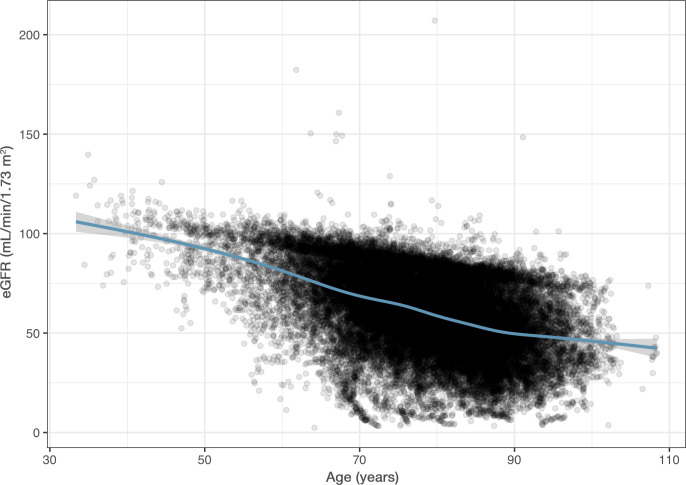
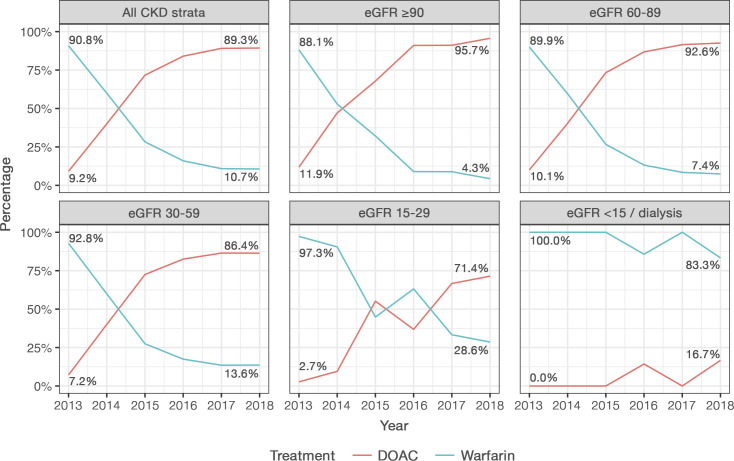
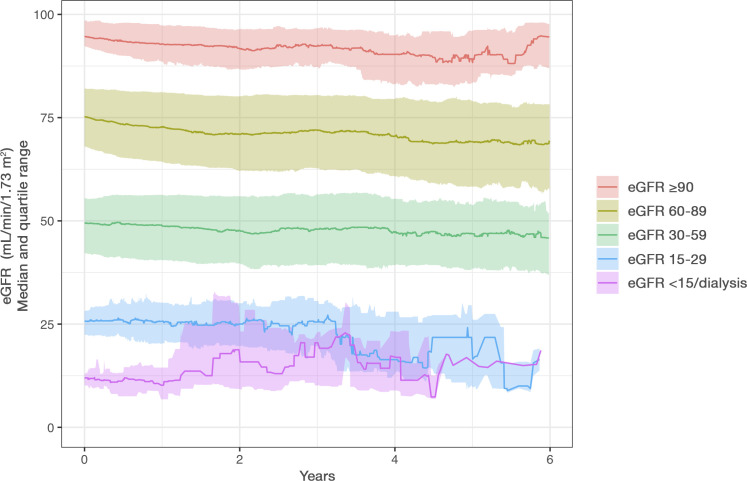
Methods and results: Using data from AuriculA, the Swedish oral anticoagulation registry, patients with AF on warfarin or DOAC were identified between 2013 and 2018 (N=6567). Estimated glomerular filtration rate (eGFR) was calculated and categorised into normal (≥90 mL/min/1.73 m2), mild CKD (60-89 mL/min/1.73 m2), moderate CKD (30-59 mL/min/1.73 m2), severe CKD (15-29 mL/min/1.73 m2) and end-stage CKD (<15 mL/min/1.73 m2)/dialysis. TTR was estimated using international normalised ratio (INR) measurements. Predictors of eGFR decline over time and of poor TTR were estimated using regression analysis. Between 2013 and 2018, use of DOAC increased from 9.2% to 89.3%, with a corresponding decline in warfarin. A similar trend was observed in patients with mild to moderate CKD, while DOAC over warfarin increased slower among patients with severe to end-stage CKD/dialysis. In patients treated with warfarin, the median TTR was 77.1%. Worse TTR was observed among patients with severe CKD (70.0%) and end-stage CKD/dialysis (67.5%). A gradual annual decline in eGFR was observed (-1.1 mL/min/1.73 m2), with a more rapid decline among patients with older age, female sex, diabetes mellitus and/or heart failure.
Conclusion: In patients with AF, use of DOAC has steadily increased across different CKD stages, but not in patients with severe to end-stage CKD/dialysis despite these patients having poor INR control. Patients with AF have a gradual decline in renal function, with a more rapid decline among a subgroup of patients.
Keywords: arrhythmias, cardiac; atrial fibrillation; pharmacology, clinical.
© Author(s) (or their employer(s)) 2022. Re-use permitted under CC BY. Published by BMJ.
Conflict of interest statement
Competing interests: GB reports institutional research grants from Pfizer, expert committee and consulting fees to his institution from Bayer, and honoraria for lectures and scientific advice from AstraZeneca, Boehringer Ingelheim, Novo Nordisk, Pfizer and Sanofi. AM is an employee of Pfizer. HR and AL have nothing to declare. CC reports speaker fees or advisory board from Bristol Myers Squibb, Bayer, Novartis and AstraZeneca, and personal fees from event adjudication for Uppsala Clinical Research Center. CH reports institutional research grants from Pfizer, GlaxoSmithKline, AstraZeneca and Bristol Myers Squibb, advisory board from AstraZeneca, Bayer, Boehringer Ingelheim, Novo Nordisk and Coala Life, and personal fees from event adjudication for Uppsala Clinical Research Center.
Figures

References
-
- Hindricks G, Potpara T, Dagres N, et al. 2020 ESC guidelines for the diagnosis and management of atrial fibrillation developed in collaboration with the European Association of Cardio-Thoracic Surgery (EACTS): the task force for the diagnosis and management of atrial fibrillation of the European. Eur Heart J 2020;42:373–498. 10.1093/eurheartj/ehaa612 - DOI - PubMed
-
- January CT, Wann LS, Calkins H, et al. 2019 AHA/ACC/HRS focused update of the 2014 AHA/ACC/HRS guideline for the management of patients with atrial fibrillation: a report of the American College of Cardiology/American Heart Association Task Force on Clinical Practice Guidelines and the Heart Rhythm Society in collaboration with the Society of Thoracic Surgeons. Circulation 2019;140:e125–51. 10.1161/CIR.0000000000000665 - DOI - PubMed
Publication types
MeSH terms
Substances
LinkOut - more resources
Full Text Sources
Medical
Research Materials
Miscellaneous