. 2022 Sep 14;12(1):384.
doi: 10.1038/s41398-022-02149-9.

Maternal immune activation induces autism-like changes in behavior, neuroinflammatory profile and gut microbiota in mouse offspring of both sexes

Affiliations

Maternal immune activation induces autism-like changes in behavior, neuroinflammatory profile and gut microbiota in mouse offspring of both sexes

Anna Maria Tartaglione et al. Transl Psychiatry. .

Abstract

Autism Spectrum Disorder (ASD) is a sex-biased neurodevelopmental disorder with a male to female prevalence of 4:1, characterized by persistent deficits in social communication and interaction and restricted-repetitive patterns of behavior, interests or activities. Microbiota alterations as well as signs of neuroinflammation have been also reported in ASD. The involvement of immune dysregulation in ASD is further supported by evidence suggesting that maternal immune activation (MIA), especially during early pregnancy, may be a risk factor for ASD. The present study was aimed at characterizing the effects of MIA on behavior, gut microbiota and neuroinflammation in the mouse offspring also considering the impact of MIA in the two sexes. MIA offspring exhibited significant ASD-like behavioral alterations (i.e., deficits in sociability and sensorimotor gating, perseverative behaviors). The analysis of microbiota revealed changes in specific microbial taxa that recapitulated those seen in ASD children. In addition, molecular analyses indicated sex-related differences in the neuroinflammatory responses triggered by MIA, with a more prominent effect in the cerebellum. Our data suggest that both sexes should be included in the experimental designs of preclinical studies in order to identify those mechanisms that confer different vulnerability to ASD to males and females.


Conflict of interest statement

The authors declare no competing interests.

Figures
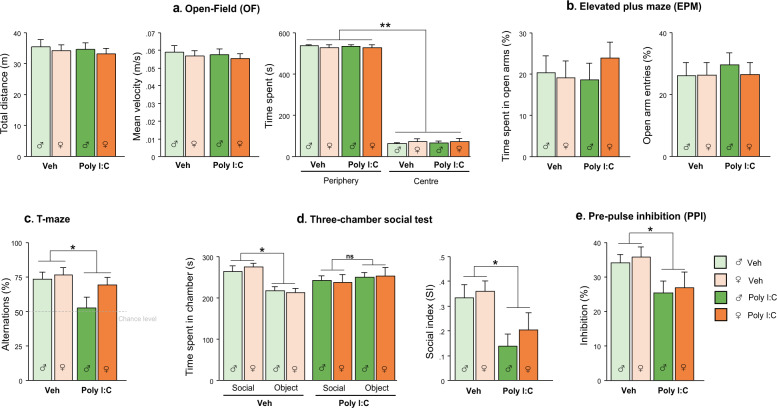
Fig. 1
Fig. 1. Behavioral effects of MIA in juvenile/adult offspring.
MiA offspring of both sexes did not show alterations in locomotor activity (a) and anxiety-like behavior (a, b). MIA significantly affected spontaneous alternation (c), social discrimination (d) and sensorimotor gating (e) in both males and females (n = 12 M/12 F per group). Data are shown as means ± S.E.M. Two-way ANOVA with post-hoc Tukey’s test, *p < 0.05; **p < 0.01; ns = p > 0.05.
Fig. 2
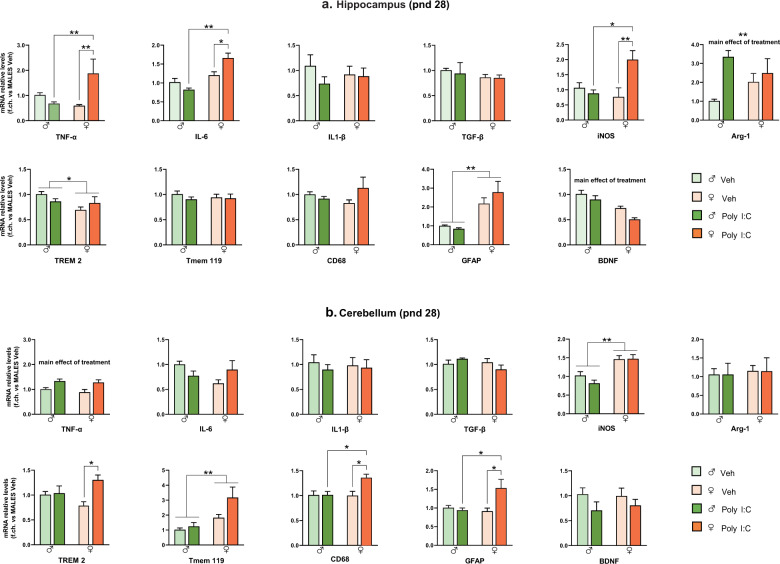
Fig. 2. MIA effect on neuroinflammatory profile of offspring at pnd 28.
mRNA levels in hippocampus (a) and cerebellum (b) were evaluated by RT-PCR using the 2−ΔΔCt method, normalized to the housekeeping gene β-actin, and relative to Veh males (n = 6 M/6 F per group). Data are expressed as means ± S.E.M. Two-way ANOVA with post-hoc Tukey’s test, *p < 0.05; **p < 0.01.
Fig. 3
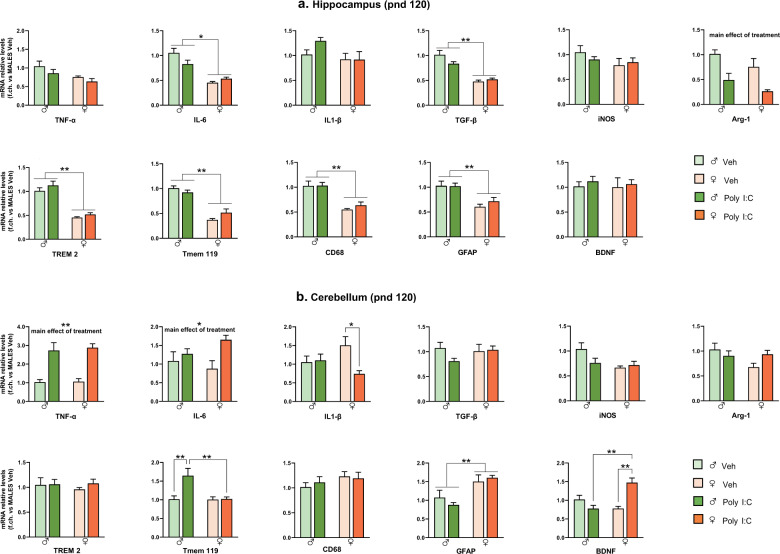
Fig. 3. MIA effect on neuroinflammatory profile of PND 120 offspring.
mRNA levels in hippocampus (a) and cerebellum (b) were evaluated by RT-PCR using the 2−ΔΔCt method, normalized to the housekeeping gene β-actin, and relative to Veh males (n = 6 M/6 F per group). Data are expressed as means ± S.E.M. Two-way ANOVA with post-hoc Tukey’s test, *p < 0.05; **p < 0.01.
Fig. 4
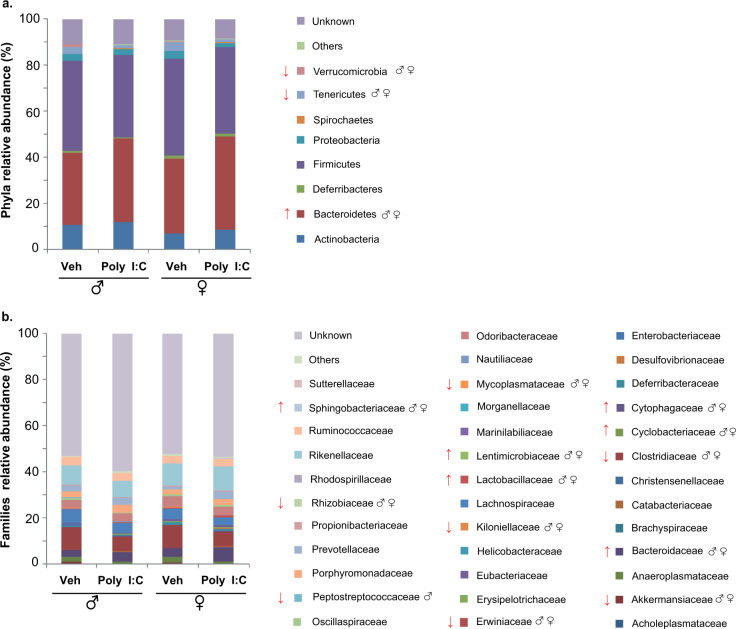
Fig. 4. Microbiota changes induced by MIA in male and female offspring at pnd 28.
Mean relative abundance (%) of gut bacteria at phyla (a) and families (b) levels; ↑ significant increase, ↓ significant decrease. Two-way ANOVA with post-hoc Tukey’s test.
Fig. 5
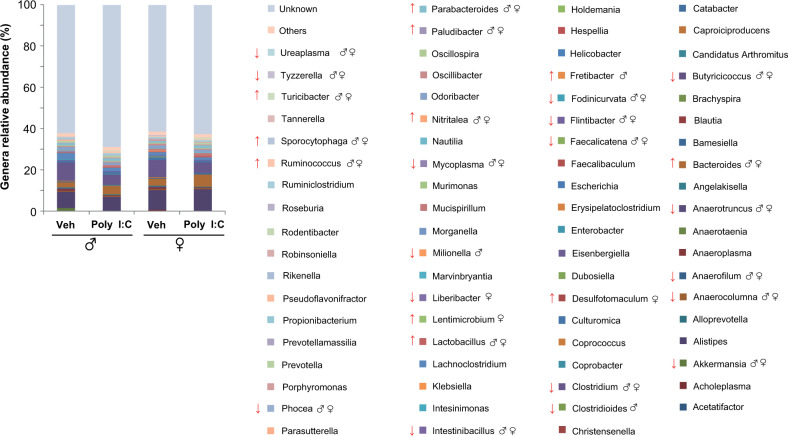
Fig. 5. Microbiota changes induced by MIA in male and female offspring at pnd 28.
Mean relative abundance (%) of gut bacteria at genera level; ↑ significant increase, ↓ significant decrease. Two-way ANOVA with post-hoc Tukey’s test.

References

    1. Association AP. Diagnostic and statistical manual of mental disorders. 5th ed. USA: CBS; 2013.

    1. Matta SM, Hill-Yardin EL, Crack PJ. The influence of neuroinflammation in autism spectrum disorder. Brain Behav Immun. 2019;79:75–90. doi: 10.1016/j.bbi.2019.04.037. - DOI - PubMed
    1. Onore C, Careaga M, Ashwood P. The role of immune dysfunction in the pathophysiology of autism. Brain Behav Immun. 2012;26:383–92. doi: 10.1016/j.bbi.2011.08.007. - DOI - PMC - PubMed
    1. Vargas DL, et al. Neuroglial activation and neuroinflammation in the brain of patients with autism. Ann Neurol. 2005;57:67–81. doi: 10.1002/ana.20315. - DOI - PubMed
    1. Edmonson C, Ziats MN, Rennert OM. Altered glial marker expression in autistic post-mortem prefrontal cortex and cerebellum. Mol Autism. 2014;5:3. doi: 10.1186/2040-2392-5-3. - DOI - PMC - PubMed

Publication types