


Evaluation of cardiovascular diseases risk calculators for CVDs prevention and management: scoping review
- PMID: 36104666
- PMCID: PMC9471025
- DOI: 10.1186/s12889-022-13944-w
Evaluation of cardiovascular diseases risk calculators for CVDs prevention and management: scoping review
Abstract
Background: Cardiovascular diseases (CVDs) are the leading cause of morbidity and mortality globally. This review aimed to summarise evidence on the key features, usability and benefits of CVD risk calculators using digital platforms for CVDs prevention and management in populations.
Methods: We used search engines and thematic analyses to conduct a scoping review. As the reporting guideline for this review, we used Preferred Reporting Items for Systematic Reviews and Meta-Analyses extension for Scoping Reviews (PRISMA-ScR).
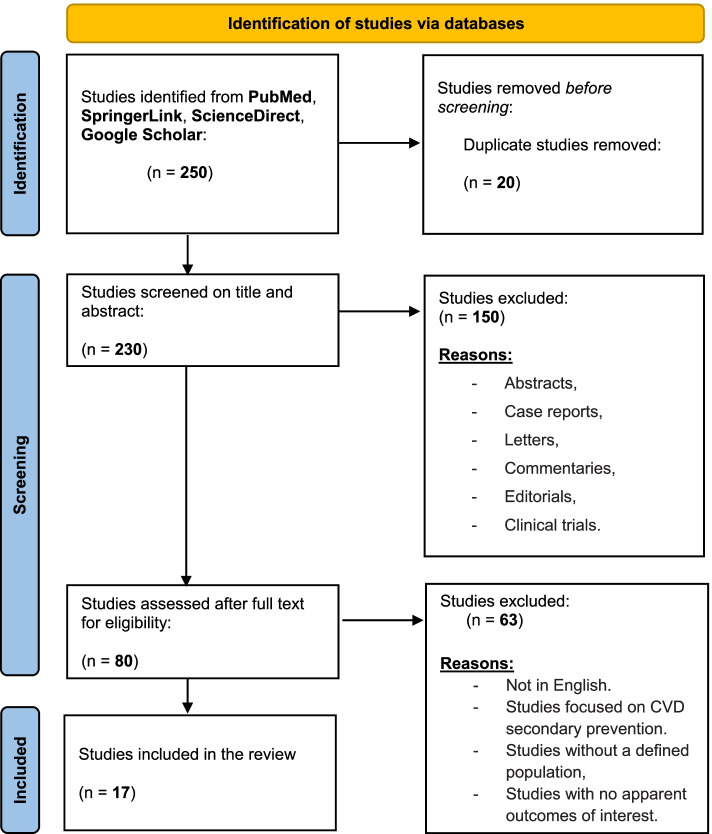
Results: A total of 17 studies meeting eligibility criteria were included in the analysis, from which about 70% of the studies have prognostic level I (n = 8) and level II (n = 4) evidence. The review found that various guidelines are recommending different algorithms for CVD risk prediction. The QRISK® was the most accurate CVD risk calculator for several study populations, whereas World Health Organization/International Society of Hypertension (WHO/ISH) risk scores were the least accurate. The key features of CVD risk calculators are variables, predictive accuracy, discrimination index, applicability, understandability, and cost-effectiveness.
Conclusion: For the selected risk prediction tool, development and validation research must be done, which considers a mix of stroke-specific risk and CVD risk to establish its usability in the local community and advantages to the particular health-care environment. To get healthcare professionals more involved in preventing and treating CVDs, each healthcare setting should use an online CVD risk assessment tool that is more useful, accurate, and easy to use, based on the population and health system.
Keywords: CVD risk; Cardiovascular diseases; Digital health; Population health; Risk assessment; Risk calculator.
© 2022. The Author(s).
Conflict of interest statement
The authors have no conflict of interest to declare concerning this article's authorship.
Figures
References
-
- Nelson S, Whitsel L, Khavjou O, Phelps D, Leib A. Projections of cardiovascular disease prevalence and costs. RTI Int, Res Triangle Park NC, USA, Tech Rep. 2016;214680(001.001).
-
- Sjögren B, Bigert C, Gustavsson P. Chapter 16 - Cardiovascular Disease. In: Nordberg GF, Fowler BA, Nordberg MBT-H on the T of M (Fourth E, editors. San Diego: Academic Press; 2015. p. 313–31. Available from: https://www.sciencedirect.com/science/article/pii/B9780444594532000160
-
- World Health Organization. Prevention of cardiovascular disease: guidelines for assessment and management of total cardiovascular risk. Geneva: World Health Organization press; 2007.
Publication types
MeSH terms
LinkOut - more resources
Full Text Sources
Medical
Research Materials
