


Human amniotic membrane products for patients with diabetic foot ulcers. do they help? a systematic review and meta-analysis
- PMID: 36104736
- PMCID: PMC9472416
- DOI: 10.1186/s13047-022-00575-y
Human amniotic membrane products for patients with diabetic foot ulcers. do they help? a systematic review and meta-analysis
Abstract
Background: Diabetic foot ulcer (DFU) is one of the most serious diabetic complications. DFU is an open wound that usually occurs in the foot sole due to poor blood glucose control, peripheral neuropathy, and poor circulation. The human amniotic allograft membrane is a biological wound dressing derived from the amniotic membrane. It contains amino acids, nutrients, cytokines, and growth factors that make the growth process easier.
Objective: To compare dehydrated human amnion and chorion allograft (DHACA) plus the standard of wound care (SOC) with the SOC alone.
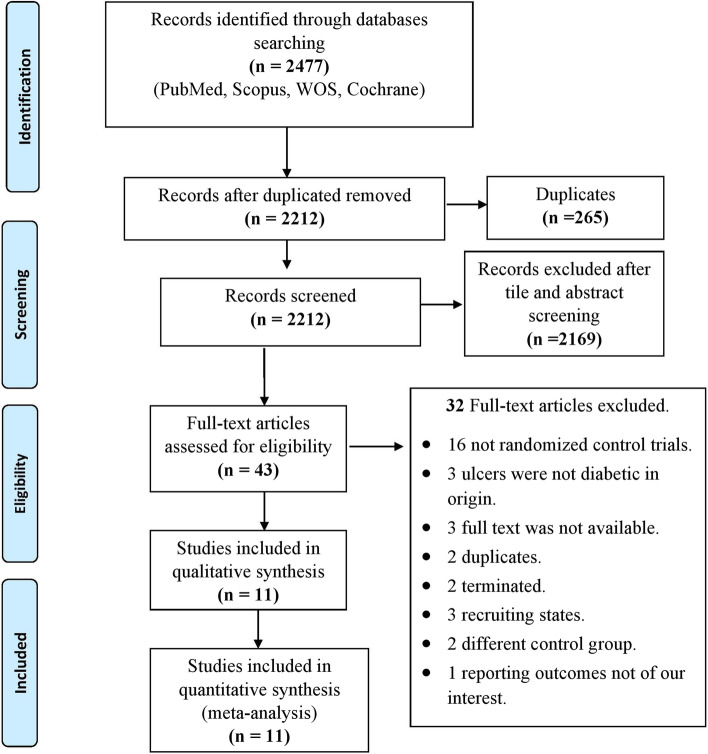
Methods: We searched for randomized clinical trials (RCTs) on PubMed, Scopus, Cochrane, and Web of Science till April 2021 using relevant keywords. All search results were screened for eligibility. We extracted the data from the included trials and pooled them as mean difference (MD) or risk ratio (RR) with the 95% confidence interval (CI) using Review Manager software (ver. 5.4).
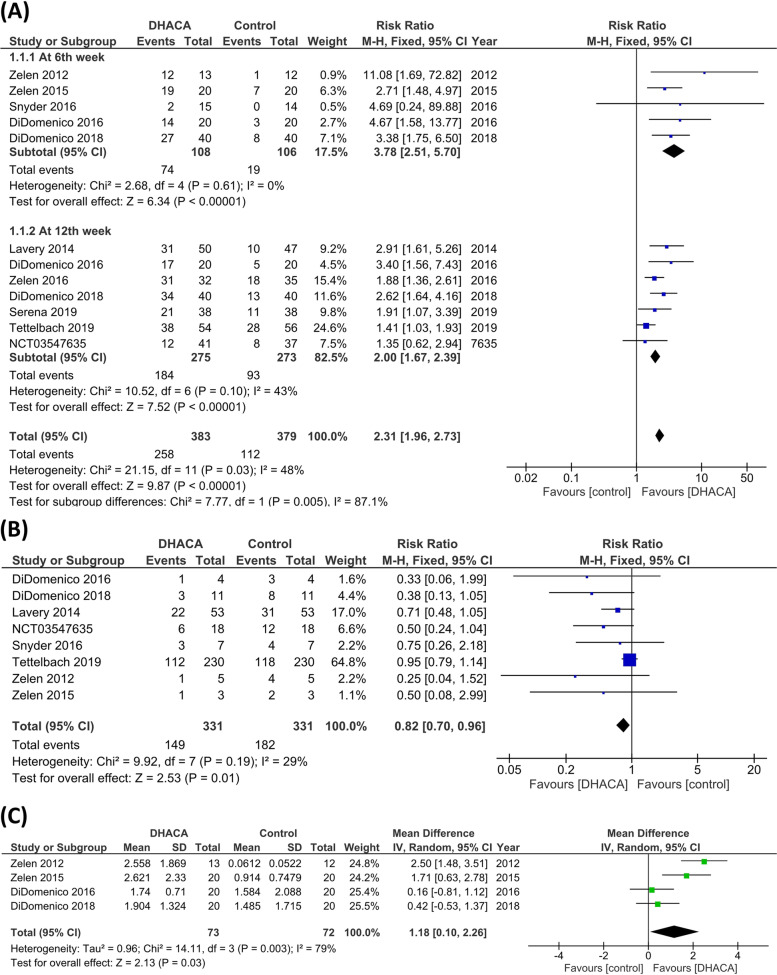
Results: The pooled effect estimate from 11 RCTs showed that DHACA was superior to SOC regarding the complete wound healing in both 6th and 12th week (RR = 3.78; 95% CI: [2.51, 5.70]; P < 0.00001) and (RR = 2.00; 95% CI: [1.67, 2.39], P < 0.00001 respectively). Also, the analysis favored the DHACA regarding the mean time to heal in the 12th-week (MD = -12.07, 95%CI: [-19.23, -4.91], P = 0.001). The wound size reduction was better with DHACA (MD = 1.18, 95%CI: [-0,10, 2.26], P = 0.03).
Conclusion: Using DHACA with SOC is safer and more effective than using SOC alone for DFU patients.
Keywords: AmnioBand; Amniotic allograft; Diabetic foot ulcer; EpiFix; Grafix; Human amnion membrane.
© 2022. The Author(s).
Conflict of interest statement
None to declare.
Figures
References
-
- Saeedi P, Petersohn I, Salpea P, Malanda B, Karuranga S, Unwin N, et al. Global and regional diabetes prevalence estimates for 2019 and projections for 2030 and 2045: Results from the International Diabetes Federation Diabetes Atlas, 9th edition. Diabetes Res Clin Pract. 2019;157:107843. - PubMed
Publication types
MeSH terms
LinkOut - more resources
Full Text Sources
Medical
Miscellaneous
