. 2022;111(7):2181-2198.
doi: 10.1007/s00531-022-02228-8. Epub 2022 Jul 16.

Collision with Gondwana or with Baltica? Ordovician magmatic arc volcanism in the Marmarosh Massif (Eastern Carpathians, Ukraine)

Affiliations

Collision with Gondwana or with Baltica? Ordovician magmatic arc volcanism in the Marmarosh Massif (Eastern Carpathians, Ukraine)

Aleksandra Gawęda et al. Int J Earth Sci. 2022.

Abstract

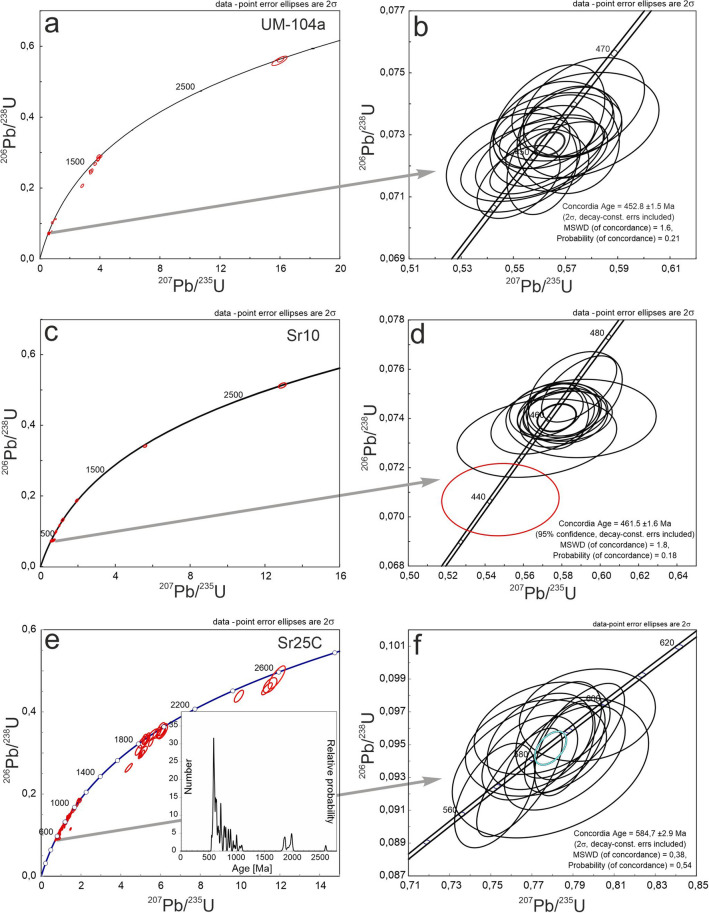
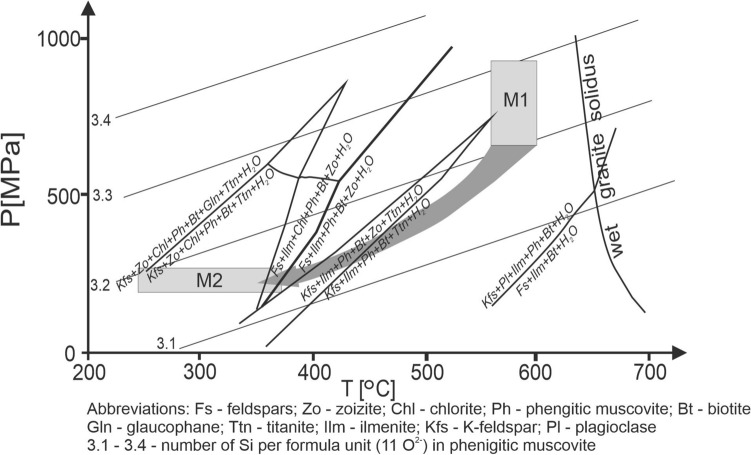
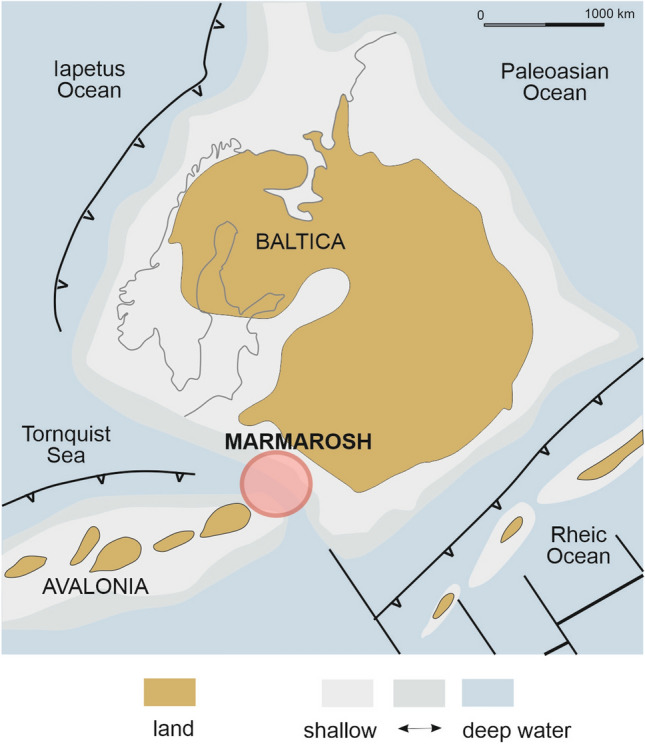
The pre-Alpine Marmarosh Massif is a tectonically complex unit of the crystalline basement within the Eastern Outer Carpathians. In the eastern (Ukrainian) segment of this massif, two units have been identified-the Bilyi Potok Nappe and the Dilove Nappe. Petrological investigations coupled with zircon U-Pb dating were performed on metavolcanic rocks (porphyroids) and their phyllite host rocks, sampled from three locations within the Dilove Nappe. The geochemical characteristics of the meta-rhyodacite porphyroids revealed a volcanic arc affinity of the protolith, with U-Pb zircon ages of 452.8 ± 1.5 Ma and 461.5 ± 1.6 Ma and zircon saturation temperatures in the range of 823-892 °C. The phyllite host rocks (meta-tuff) yield a U-Pb zircon maximum estimate for the eruption age at 584.7 ± 2.9 Ma. Peak amphibolite-facies metamorphism (M1) was estimated at the pressure of 600-900 MPa with a temperature range of 560-600 °C. Retrogression (M2), possibly related to Alpine nappe stacking and shearing, is assumed to have taken place at 200-250 MPa and 384-222 °C. The volcanic arc is interpreted as an early Caledonian arc that was subsequently accreted to the margin of Baltica during the closure of the easternmost Tornquist Ocean rather than Cenerian (early Paleozoic) orogenic events on the margin of East Gondwana.

Supplementary information: The online version contains supplementary material available at 10.1007/s00531-022-02228-8.

Keywords: Caledonian volcanism; East Carpathians; Tornquist ocean; Ukraine.


Figures

Fig. 1
Fig. 1
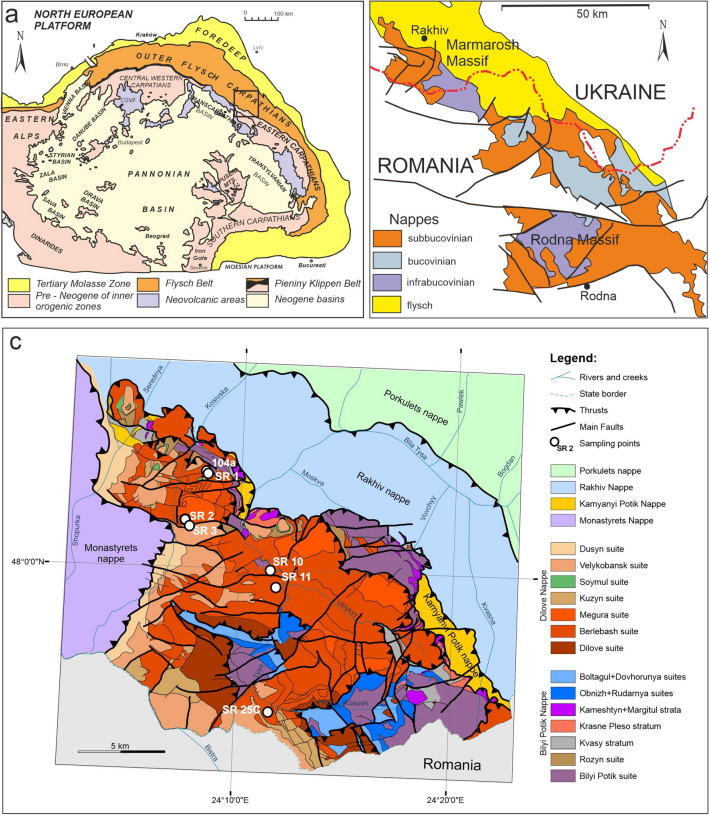
a Simplified geological map of the Carpathian Chain. b The location of the Marmarosh massif and its relationship to the Rodna Horst (modified after Balintoni and Balica 2013). c Geological map of the Ukrainian part of the Marmarosh Massif with the sampling localities indicated (modified after Matskiv et al. 2006)
Fig. 2
Fig. 2
Textures and microtextures of metavolcanic rock from the Marmarosh Massif. a field photograph showing the sampling locality for U104a and SR1 samples (J.Golonka, A. Gawęda and A.Waśkowska as the scales) with insert of the rock surface; b and c deformed quartz (Qtz) porphycrysts within a fine-grained matrix in samples 104a (b) and SR10 (c) (crossed polars); d deformed muscovite-rich (Ms1) domains in sample SR10 (crossed polars); e rotated Kfs porphyrocryst from sample SR1 within a matrix rich in MS1 muscovite (crossed polars); f domain rich in dispersed epidote (Ep) (crossed polars); g tourmaline (Tur) crystal within a domain rich in muscovite and chloritized (Chl) biotite (Bt; plane polars); h tectonic fissure filled by calcite (Cc), cutting the main foliation (sample 104a, crossed polars); i macrophotograph of the folded SR25C phyllite sample; j microphotograph of the folded mica/chlorite-rich and quartz/feldspar-rich domains in phyllite (sample SR25C, crossed polars); k axial part of crenulation with chlorite nest in phyllite (sample SR25C)
Fig. 3
Fig. 3
BSE images of the rock textures: a aggregate composed of rutile (Rt), titanite (Ttn) and K-feldspar (Kfs), with a foliated matrix of albite (Ab), muscovite (Ms) and titanite (Ttn), SR1 porphyroid; b foliation defined by biotite (Bt), muscovite (Ms) and quartz (Qtz), cut by a calcite (Cc) veinlet, 104a porphyroid; c strongly crenulated and interleaved chlorite and muscovite with deformed apatite (Ap), SR25C phyllitic meta-tuff; d Intergrowths of rutile and titanite (Rt + Ttn) inside a chlorite (Chl) and muscovite domain; note Ms1 is discordant to Chl + Ms2 intergrowths, SR25C phyllitic meta-tuff
Fig. 4
Fig. 4
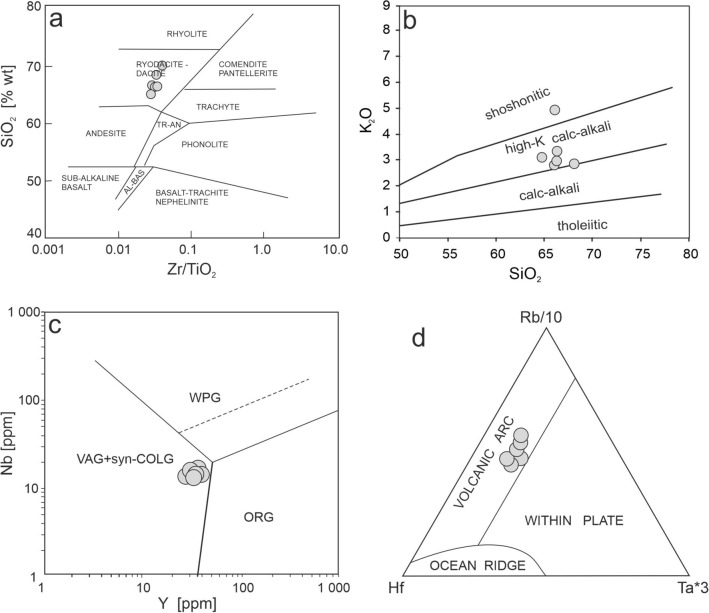
Classification of the porphyroid samples (grey circles) and meta-tuff sample (dark circle) in: a classification diagram after Winchester and Floyd (1977); b K2O versus SiO2 classification diagram after Peccerillo and Taylor (1976); c discrimination diagram of Pearce et al. (1984): VAG volcanic arc granites, syn-COLG syn-collisional granites, WPG within-plate granites, ORG ocean ridge granites; d) discrimination diagram after Harris et al. (1986)
Fig. 5
Fig. 5
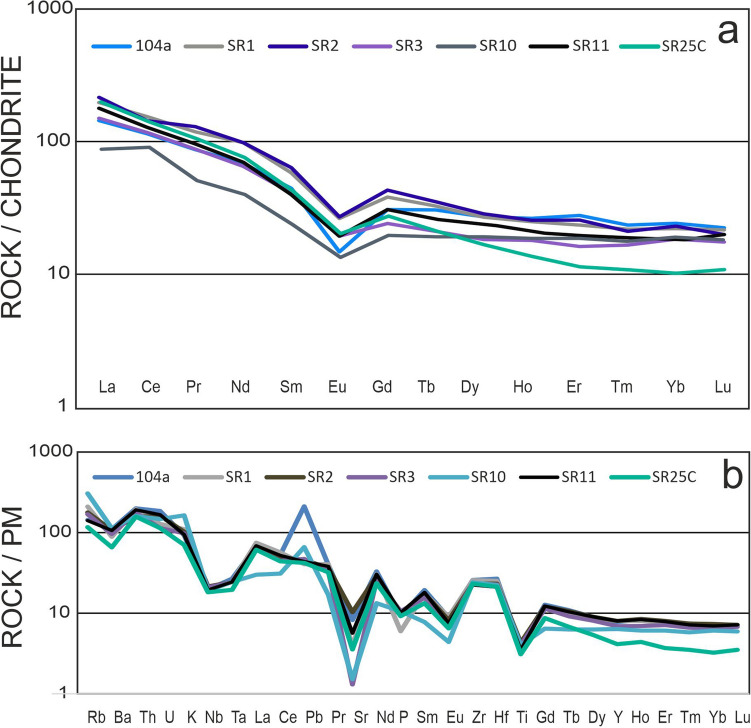
Chondrite (C1) normalized REE patterns (a) and primitive-mantle normalized multi-element patterns (b) of the analysed porphyroid samples and meta-tuff (SR25C) samples from the Marmarosh Massif. Normalization values after McDonough and Sun (1995)
Fig. 6
Fig. 6
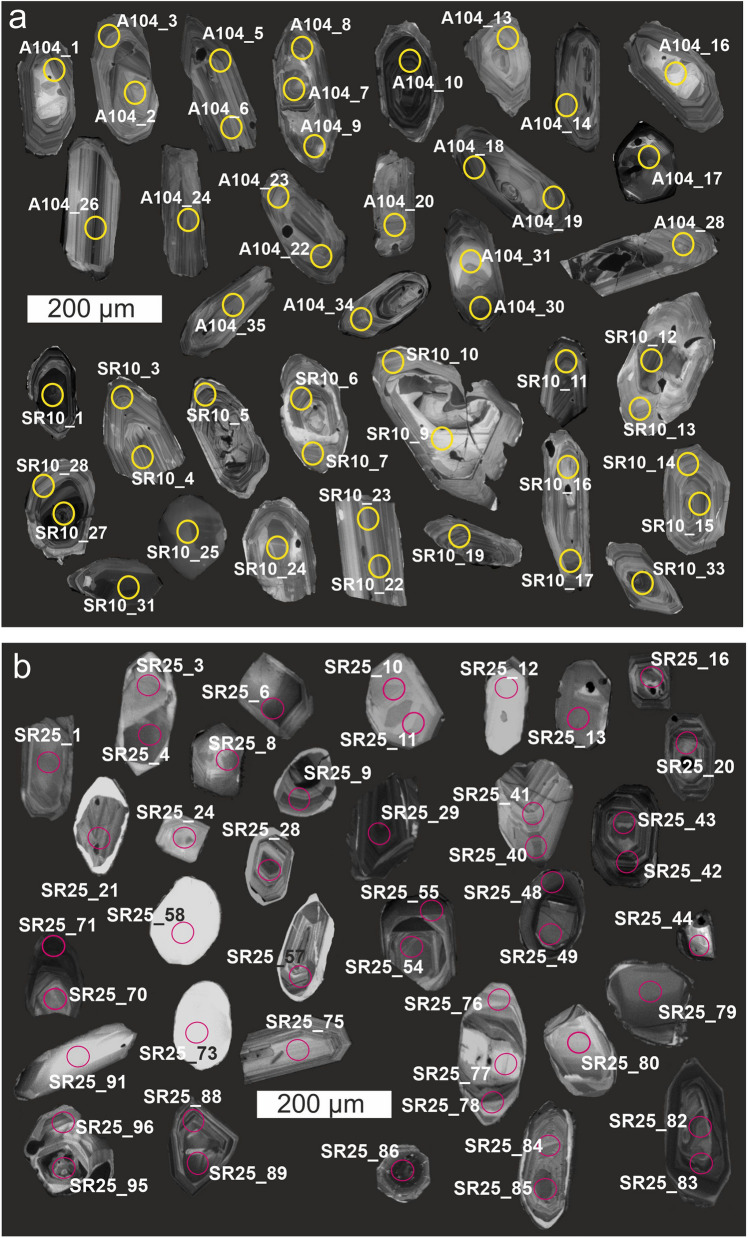
Cathodoluminescence (CL) images of selected (concordant) zircon crystals from (a) the meta-volcanic porphyroids (a) and (b) the meta-tuff (SR25C) from the Marmarosh Massif. Analytical spots are marked as circles
Fig. 7
Fig. 7
Concordia plots of LA-ICP-MS U–Pb zircon analytical results from the meta-volcanic rocks from Marmarosh Massif: a and b porphyroid sample 104a; c and d porphyroid sample SR10; e and f sample SR25C
Fig. 8
Fig. 8
P–T path of the metamorphic evolution of the metavolcanic rocks from the Marmarosh Massif with the stability fields of the main mineral assemblages indicated. See the main text for discussion
Fig. 9
Fig. 9
Palaeogeographic map of Baltica, Eastern Avalonia and adjacent areas during the Late Ordovician (c. 452 Ma). Modified after Golonka et al. (2019)

References

    1. Bailey SW (1980) Structures of layer silicates: in crystal structures of clay minerals and their X-ray identification. In: Brindley GW, Brown G (Eds) Mineralogical Society, London, pp 1–123
    1. Baldwin JA, Powell R, Brown M, Fuck RA. Modelling of mineral equilibria in ultrahigh- temperature metamorphic rocks from the Anapolis-Itaucu Complex, central Brazil. J Metamorph Geol. 2005;23:511–531. doi: 10.1111/j.1525-1314.2005.00591.x. - DOI
    1. Balintoni I, Balica C. Carpathian peri-Gondwanan terranes in the East Carpathians (Romania): a testimony of an Ordovician, North-African orogeny. Gondwana Res. 2013;23:1053–1070. doi: 10.1016/j.gr.2012.07.013. - DOI
    1. Balintoni I, Balica C, Ducea MN, Chen F, Hann H-P, Şabliovschi V. Late Cambrian-early ordovician gondwanan terranes in the Romanian carpathians: a zircon U-Pb provenance study. Gondwana Res. 2009;16:119–133. doi: 10.1016/j.gr.2009.01.007. - DOI
    1. Balintoni I, Balica C, Seghedi A, Ducea MN. Avalonian and Cadomian terranes in North Dobrogea, Romania. Precambrian Res. 2010;182:217–229. doi: 10.1016/j.precamres.2010.08.010. - DOI

LinkOut - more resources