


A series of unfortunate bladder events: An illustrative case series of a diverse cohort of bladder perforations
- PMID: 36105837
- PMCID: PMC9465360
- DOI: 10.1016/j.radcr.2022.08.010
A series of unfortunate bladder events: An illustrative case series of a diverse cohort of bladder perforations
Abstract
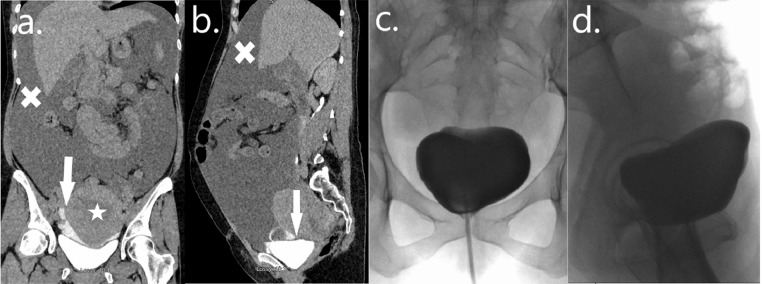
Bladder perforation is a potentially life-threatening condition, typically occurring after genitourinary trauma. The vast majority of cases are secondary to blunt abdominal trauma resulting in pelvic fractures, with motor vehicle accidents the commonest cause. There are however a wide range of underlying causes, including iatrogenic injuries and spontaneous perforations. This case series of 4 unusual cases of bladder perforations presenting to a single center under the same consultant within a 3-month period aims to highlight the diverse nature of patients who can present with bladder perforations and the different management options available.
Keywords: Bladder injury; Bladder perforation; Extraperitoneal; Intraperitoneal; Trauma.
© 2022 The Authors. Published by Elsevier Inc. on behalf of University of Washington.
Figures



References
-
- Bryk DJ, Zhao LC. Guideline of guidelines: a review of urological trauma guidelines. BJU Int. 2016;117(2):226–234. - PubMed
-
- Pereira BM, de Campos CC, Calderan TR, Reis LO, Fraga GP. Bladder injuries after external trauma: 20 years experience report in a population-based cross-sectional view. World J Urol. 2013;31(4):913–917. - PubMed
-
- Matlock KA, Tyroch AH, Kronfol ZN, McLean SF, Pirela-Cruz MA. Blunt traumatic bladder rupture: a 10-year perspective. Am Surg. 2013;79(6):589–593. - PubMed
-
- Urry RJ, Clarke DL, Bruce JL, Laing GL. The incidence, spectrum and outcomes of traumatic bladder injuries within the Pietermaritzburg Metropolitan Trauma Service. Injury. 2016;47(5):1057–1063. - PubMed
-
- Wirth GJ, Peter R, Poletti PA, Iselin CE. Advances in the management of blunt traumatic bladder rupture: experience with 36 cases. BJU Int. 2010;106(9):1344–1349. - PubMed
Publication types
LinkOut - more resources
Full Text Sources
