Controlled Clinical Trial
. 2022 Sep 1;5(9):e2231798.
doi: 10.1001/jamanetworkopen.2022.31798.

Acceptance of Different Self-sampling Methods for Semiweekly SARS-CoV-2 Testing in Asymptomatic Children and Childcare Workers at German Day Care Centers: A Nonrandomized Controlled Trial

Collaborators, Affiliations
Controlled Clinical Trial

Acceptance of Different Self-sampling Methods for Semiweekly SARS-CoV-2 Testing in Asymptomatic Children and Childcare Workers at German Day Care Centers: A Nonrandomized Controlled Trial

Geraldine Engels et al. JAMA Netw Open. .

Erratum in

  • Error in Figure 3.
    [No authors listed] [No authors listed] JAMA Netw Open. 2022 Oct 3;5(10):e2240161. doi: 10.1001/jamanetworkopen.2022.40161. JAMA Netw Open. 2022. PMID: 36223122 Free PMC article. No abstract available.

Abstract

Importance: Closure of day care centers (DCCs) to contain the COVID-19 pandemic has been associated with negative effects on children's health and well-being.

Objective: To investigate the acceptance of self-sampling methods for continuous SARS-CoV-2 surveillance among asymptomatic children and childcare workers (CCWs) in DCCs.

Design, setting, and participants: This nonrandomized pilot study included children and CCWs at 9 DCCs in Wuerzburg, Germany, from May to July 2021.

Interventions: Twice weekly testing for SARS-CoV-2 was conducted by self-sampled mouth-rinsing fluid (saliva sampling [SAL], with subsequent pooled polymerase chain reaction test) plus nasal rapid antigen self-test (RAgT) (group 1), SAL only (group 2), or RAgT only (group 3) in children and CCWs.

Main outcomes and measures: Main outcomes were rates for initial acceptance and successful (≥60% of scheduled samples) long-term participation. The probability of SARS-CoV-2 introduction into DCCs was modeled as a function of age-adjusted background incidence and DCC size.

Results: Of 836 eligible children, 452 (54.1%; 95% CI, 50.7%-57.4%) participated (median [IQR] age: 4 [3-5] years; 213 [47.1%] girls), including 215 (47.6%) in group 1, 172 (38.1%) in group 2, and 65 (14.4%) in group 3. Of 190 CCWs, 139 (73.2%; 95% CI, 66.4%-79.0%) participated (median [IQR] age: 30 [25-46] years; 128 [92.1%] women), including 96 (69.1%) in group 1, 29 (20.9%) in group 2, and 14 (10.1%) in group 3. Overall, SARS-CoV-2 PCR tests on 5306 SAL samples and 2896 RAgTs were performed in children, with 1 asymptomatic child detected by PCR from SAL. Successful long-term participation was highest in group 2 (SAL only; children: 111 of 172 [64.5%]; CCWs: 18 of 29 [62.1%]). Weekly participation rates in children ranged from 54.0% to 83.8% for SAL and from 44.6% to 61.4% for RAgT. Participation rates decreased during the study course (P < .001). The probability of SARS-CoV-2 introduction into a DCC with 50 children was estimated to reach at most 5% for an age-adjusted SARS-CoV-2 incidence below 143.

Conclusions and relevance: Self-sampling for continuous SARS-CoV-2 testing was well accepted, with SAL being the preferred method. Given the high number of negative tests, thresholds for initiating continuous testing should be established based on age-adjusted SARS-CoV-2 incidence rates.

Trial registration: German Registry for Clinical Trials Identifier: DRKS00025546.


Conflict of interest statement

Conflict of Interest Disclosures: Dr Streng reported receiving grants from GlaxoSmithKline, Janssen-Cilag, Pfizer Pharma, Sanofi Pasteur, and MSD paid to the institution outside the submitted work. Dr Weißbrich reported receiving grants from the Federal Ministry for Education and Science grants during the conduct of the study. Dr Romanos reported receiving grants from Bundesministerium für Bildung und Forschung during the conduct of the study. Dr Heuschmann reported receiving grants from German Ministry of Research and Education, the European Union, the German Parkinson Society, University Hospital Würzburg, Robert Koch Institute, German Heart Foundation, Federal Joint Committee within the Innovationfond, German Research Foundation, Bavarian State (Ministry for Science and the Arts), German Cancer Aid, Charité–Universitätsmedizin Berlin (supported by an unrestricted research grant from Bayer), University Göttingen (supported by an unrestricted research grant from Boehringer-Ingelheim), and grants from University Hospital Heidelberg (supported by an unrestricted research grant from Bayer, BMS, Boehringer-Ingelheim, and Daiichi Sankyo) outside the submitted work. Dr Gágyor reported receiving personal fees from Federal Ministry of Education and Research Germany during the conduct of the study. Dr Liese reported receiving grants from GlaxoSmithKline, Janssen-Cilag, Pfizer, MSD, and Sanofi Pasteur outside the submitted work. Dr Kurzai reported receiving grants from Federal Ministry for Education and Research, Free State of Bavaria, Germany COVID research funds, and the Bavarian Ministry of Health via the Bavarian Office for Health and Food Safety and receiving nonfinancial support from the city of Wuerzburg in the form of vehicles to transport equipment and personnel during the conduct of the study and receiving grants from the Federal Ministry for Education and Research and Bavarian Ministry of Health via the Bavarian Office for Science and Arts outside the submitted work and participating in SARS-CoV-2 expert panels of the city and county of Wuerzburg. No other disclosures were reported.

Figures

Figure 1.
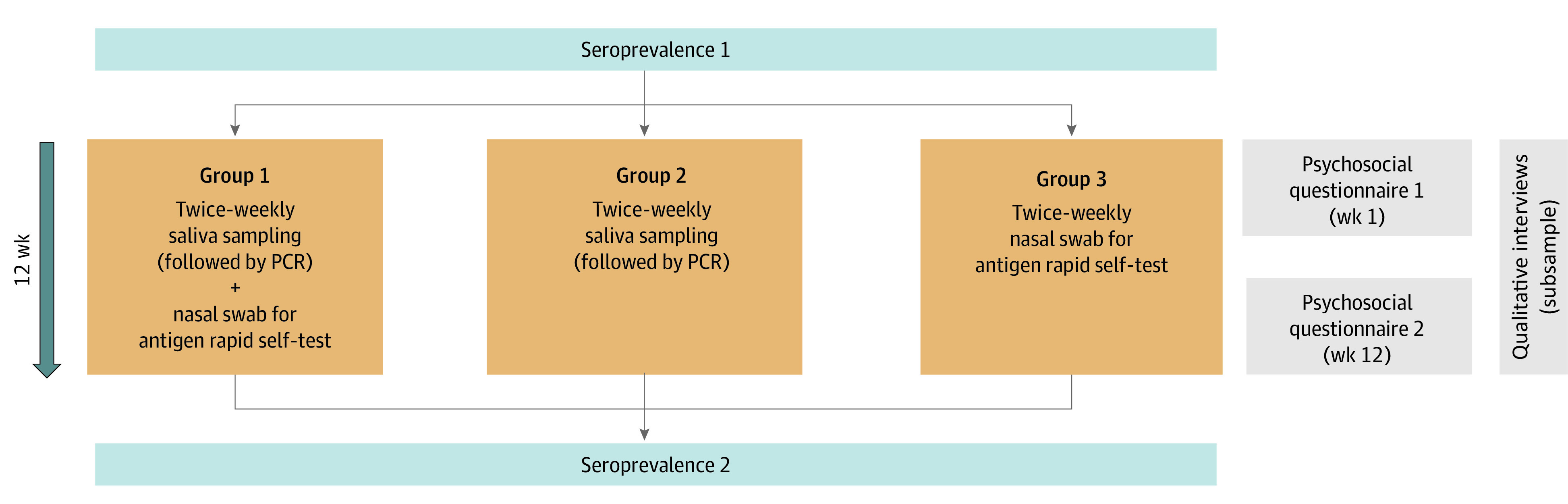
Figure 1.. Overview of the Study Design
After informed consent by parents and childcare workers, asymptomatic day care center–attending children and childcare workers participated in twice weekly self-sampling of respiratory secretions scheduled for a 12-week observation period (May to July 2021). Participants could initially choose between 3 study groups, including self-sampling of mouth-rinsing fluid (saliva sampling), followed by pooled polymerase chain reaction (PCR) testing and/or rapid antigen self-testing. (For children, this was performed by their parents.) Before and after the period of continuous testing, SARS-CoV-2 seroprevalence status of children and childcare workers was determined by finger-prick testing, and parents and childcare workers answered psychosocial questionnaires. In addition, qualitative interviews on participants’ attitudes in a subsample of parents and childcare workers were conducted.
Figure 2.
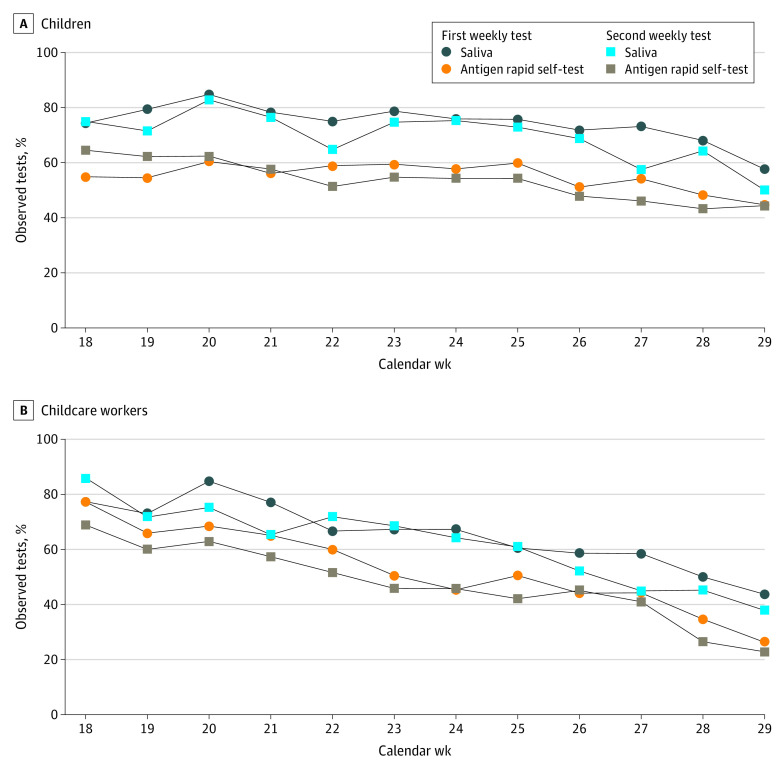
Figure 2.. Rates of Respiratory Self-sampling by Saliva Testing or Rapid Antigen Self-testing in Children and Childcare Workers Over Time
Data from children and childcare workers using the same sampling method were pooled for this presentation regardless of study group. Data were stratified by the first and second test per week, with the first test performed on Monday or Tuesday and the second test on Thursday or Friday. Participation rates are presented by showing all observed tests as a percentage of all expected tests for the respective test day (ie, excluding holidays, sick days). Study weeks 1 to 4, 5 to 8, and 9 to 12 correspond to calendar weeks 18 to 21, 22 to 25, and 26 to 29. Cochrane-Armitage trend tests for both groups were P < .001.
Figure 3.
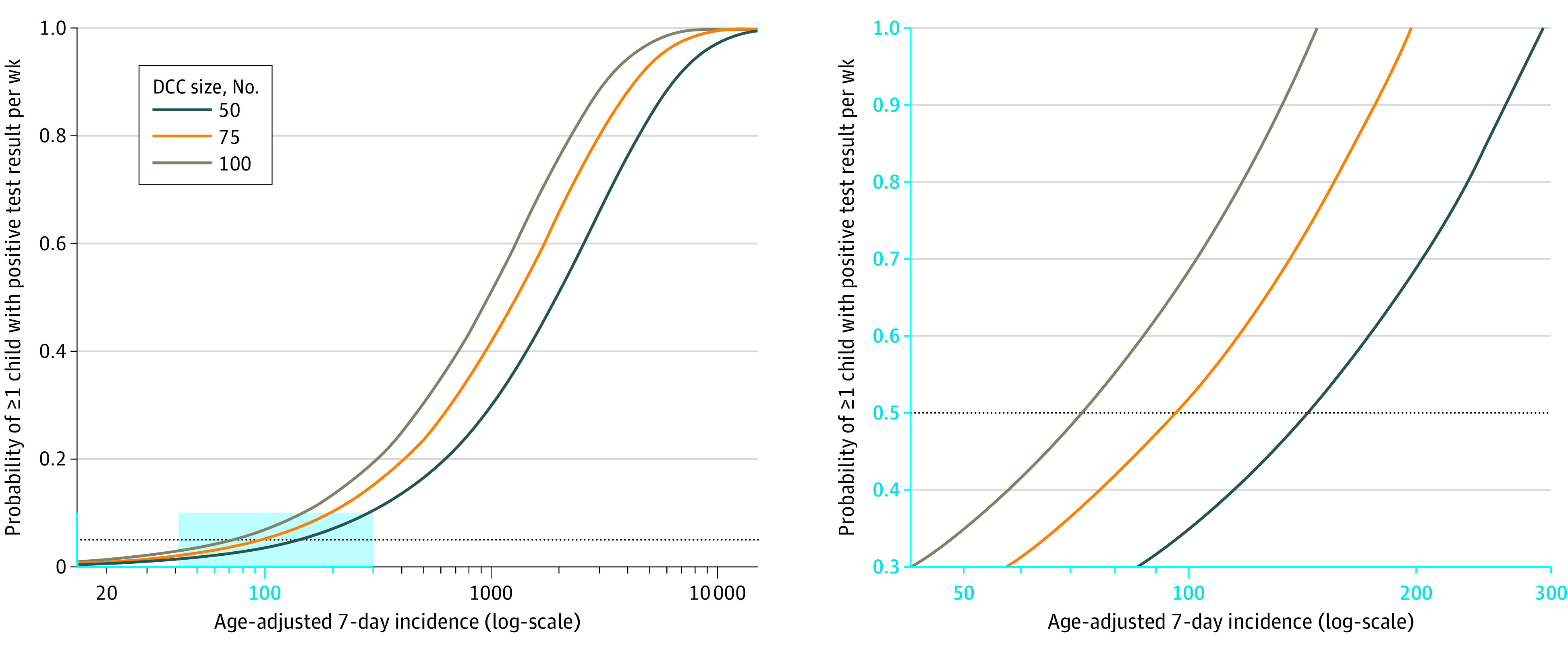
Figure 3.. Modeling the Probability of SARS-CoV-2 Introduction Into a Day Care Center (DCC)
For the probability of at least 1 child with SARS-CoV-2 (ie, primary case) entering the DCC within 1 week to remain below or at a maximum level of 5%, the age-adjusted incidence must be less than 143, 95, and 71 for DCC sizes of 50, 75, and 100, respectively. The right panel shows the blue rectangle in the left panel in more detail.

References

    1. Sorg A, Hufnagel M, Doenhardt M, et al. Risk of hospitalization, severe disease, and mortality due to COVID-19 and PIMS-TS in children with SARS-CoV-2 infection in Germany. medRxiv. Preprint posted online November 30, 2021. doi: 10.1101/2021.11.30.21267048 - DOI
    1. Wang L, Berger NA, Kaelber DC, Davis PB, Volkow ND, Xu R. COVID infection severity in children under 5 years old before and after Omicron emergence in the US. medRxiv. Preprint posted online January 13, 2022. doi: 10.1101/2022.01.12.22269179 - DOI
    1. Walger P, Heininger U, Knuf M, et al. Kinder und Jugendliche in der Covid-19-Pandemie: Schulen und Kitas sollen wieder geöffnet werden. Der Schutz von Lehrern, Erziehern, Betreuern und Eltern und die allgemeinen Hygieneregeln stehen dem nicht entgegen. Accessed August 15, 2022. https://dgpi.de/stellungnahme-schulen-und-kitas-sollen-wieder-geoeffnet-...
    1. Haag L, Blankenburg J, Unrath M, et al. Prevalence and transmission of severe acute respiratory syndrome coronavirus type 2 in childcare facilities: a longitudinal study. J Pediatr. 2021;237:136-142. doi: 10.1016/j.jpeds.2021.07.054 - DOI - PMC - PubMed
    1. Lachassinne E, de Pontual L, Caseris M, et al. ; COVIDOCRECHE collaborators . SARS-CoV-2 transmission among children and staff in daycare centres during a nationwide lockdown in France: a cross-sectional, multicentre, seroprevalence study. Lancet Child Adolesc Health. 2021;5(4):256-264. doi: 10.1016/S2352-4642(21)00024-9 - DOI - PMC - PubMed

Publication types