


Comment
doi: 10.1038/s42003-022-03905-9.
Finding the potency in planarians
Affiliations
- PMID: 36109651
- PMCID: PMC9477812
- DOI: 10.1038/s42003-022-03905-9
Item in Clipboard
Comment
Finding the potency in planarians
Commun Biol.
.
Abstract
Planarian flatworms are well-known for their regenerative ability, which is dependent on a large population of adult stem cells, called neoblasts, at least some of which are pluripotent. Here, two recent studies are compared that have begun to address this fundamental question of whether all or only some neoblasts are pluripotent.
Conflict of interest statement
The author declares no competing interests.
Figures
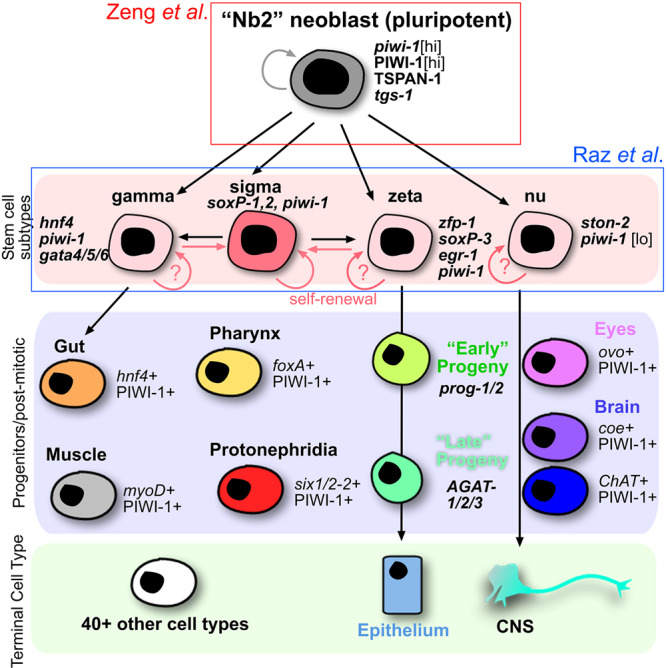
At the top of the stem cell hierarchy in planarians must sit a pluripotent stem cell. Zeng et al. (red box) show support that this cell expresses tgs-1 and can be prospectively isolated by TSPAN-1 protein expression. Below the pluripotent neoblast may sit various molecular subtypes of neoblasts thus far described in planarians. Relatively little is known about the self-renewal or potency of any cell types at the stem cell subtype level, but the sigma class is likely to contain some pluripotent stem cells and is colored darker than the other cells. Raz et al. (blue box) demonstrate that the cNeoblast may not exist in the hierarchy, and that stem cell subtypes may have the ability to retain pluripotency and switch between stem cell types. Raz et al. also show that as stem cells exit the cell cycle, their commitment to a progenitor state and lineage is likely to occur. Some progenitor cells for specific tissues and lineages have been found and others are not yet associated with a given lineage (no connecting lines).
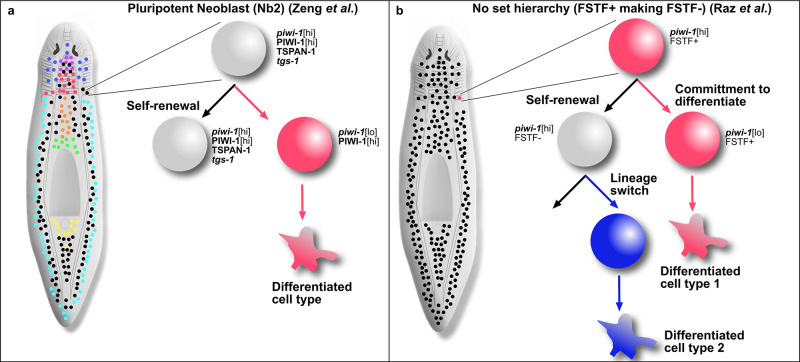
a Zeng et al., suggest that the Nb2 in silico cluster of neoblasts is the pluripotent population in planarians, which can be prospectively purified by TSPAN-1 protein expression and transplanted into hosts devoid of stem cells. Nb2 cells are distributed throughout the body axis (black dots) and specialized subtypes of neoblasts (various colored dots) are made from them in a traditional hierarchy. b Raz et al., show that although neoblasts can express factors that make them appear specialized (pink dot; FSTF+), they in fact can give rise to pluripotent-looking neoblasts (black dots; FSTF−), which then make different lineages as well (blue). In this case, a neoblast may appear specialized (pink dot), but it can readily switch back to pluripotent state (black dots). It is a combination of cell cycle stage and down-regulating piwi-1 transcript the authors propose leads to true lineage commitment.
Comment on
-
Prospectively Isolated Tetraspanin+ Neoblasts Are Adult Pluripotent Stem Cells Underlying Planaria Regeneration.Cell. 2018 Jun 14;173(7):1593-1608.e20. doi: 10.1016/j.cell.2018.05.006. Cell. 2018. PMID: 29906446 Free PMC article.
-
Planarian stem cells specify fate yet retain potency during the cell cycle.Cell Stem Cell. 2021 Jul 1;28(7):1307-1322.e5. doi: 10.1016/j.stem.2021.03.021. Epub 2021 Apr 20. Cell Stem Cell. 2021. PMID: 33882291 Free PMC article.
References
-
- Zhu, S. J. & Pearson, B. J. (Neo)blast from the past: new insights into planarian stem cell lineages. Curr. Opin. Genet. Dev.40, 74–80 (2016). - PubMed
Publication types
MeSH terms
LinkOut - more resources
Full Text Sources
