


Risk factors associated with severe disease in respiratory syncytial virus infected children under 5 years of age
- PMID: 36110112
- PMCID: PMC9468371
- DOI: 10.3389/fped.2022.1004739
Risk factors associated with severe disease in respiratory syncytial virus infected children under 5 years of age
Abstract
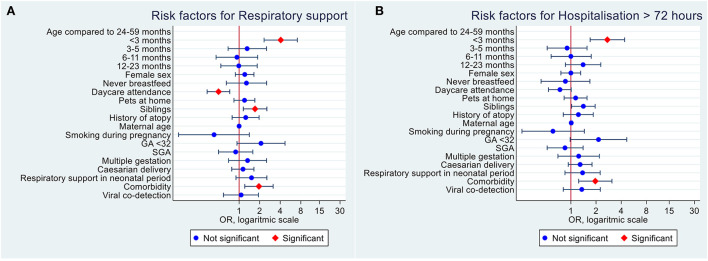
Objective: To evaluate risk factors for severe disease in children under 59 months of age hospitalized with respiratory syncytial virus (RSV) infection.
Study design: We prospectively enrolled 1,096 cases of laboratory confirmed RSV infection during three consecutive RSV seasons in 2015-2018. Potential risk factors for severe disease were retrieved through patient questionnaires and linkage to national health registries. Need for respiratory support (invasive ventilation, bi-level positive airway pressure, or continuous positive airway pressure), and length of stay exceeding 72 h were used as measures of disease severity. Associations were investigated using multivariable logistic regression analyses. Multiple imputation was used to avoid bias and inference induced by missing data.
Results: Risk factors associated with a need for respiratory support included age younger than 3 months of age [aOR: 6.73 (95% CI 2.71-16.7)], having siblings [aOR: 1.65 (95% CI 1.05-2.59)] and comorbidity [aOR: 2.40 (95% CI 1.35-4.24)]. The length of hospital stay >72 h was significantly associated with being younger than 3 months of age [aOR: 3.52 (95% CI 1.65-7.54)], having siblings [aOR: 1.45 (95% CI 1.01-2.08)], and comorbidity [aOR: 2.18 (95% CI 1.31-3.61)]. Sub-group analysis of children younger than 6 months of age confirmed the association between both young age and having siblings and the need for respiratory support.
Conclusion: In a large cohort of children <59 months hospitalized with RSV infection, young age, comorbidity, and having siblings were associated with more severe disease.
Keywords: disease severity analysis; pediatric infection; respiratory infection; respiratory syncytial virus (RSV); risk factor (RF).
Copyright © 2022 Havdal, Bøås, Bekkevold, Bakken Kran, Rojahn, Størdal, Debes, Døllner, Nordbø, Barstad, Haarr, Fernández, Nakstad, Inchley and Flem.
Conflict of interest statement
EF was currently employed by Merck & Co., Inc., Kenilworth, New Jersey. The work for the current study was conducted by EF under the previous affiliation. The remaining authors declare that the research was conducted in the absence of any commercial or financial relationships that could be construed as a potential conflict of interest.
Figures
References
-
- Shi T, McAllister DA, O'Brien KL, Simoes EAF, Madhi SA, Gessner BD, et al. Global, regional, and national disease burden estimates of acute lower respiratory infections due to respiratory syncytial virus in young children in 2015: a systematic review and modelling study. Lancet. (2017) 390:946–58. 10.1016/S0140-6736(17)30938-8 - DOI - PMC - PubMed
-
- Li Y, Wang X, Blau DM, Caballero MT, Feikin DR, Gill CJ, et al. Global, regional, and national disease burden estimates of acute lower respiratory infections due to respiratory syncytial virus in children younger than 5 years in 2019: a systematic analysis. Lancet. (2022) 399:2047–64. 10.1016/S0140-6736(22)00478-0 - DOI - PMC - PubMed
LinkOut - more resources
Full Text Sources
