


The clinical impact of serum 1,5-anhydro-D-glucitol levels on coronary artery calcification and adverse outcomes assessed by coronary optical coherence tomography in diabetic patients
- PMID: 36110416
- PMCID: PMC9468365
- DOI: 10.3389/fcvm.2022.997649
The clinical impact of serum 1,5-anhydro-D-glucitol levels on coronary artery calcification and adverse outcomes assessed by coronary optical coherence tomography in diabetic patients
Abstract
Background: Serum 1,5-anhydro-D-glucitol (1,5-AG) is a novel biomarker for short-term glycemic status and postprandial hyperglycemia. The association between serum 1,5-AG levels and coronary artery calcification (CAC) through a quantitative assessment using optical coherence tomography (OCT) is unclear. We aimed to evaluate this association using OCT in patients with diabetes mellitus (DM).
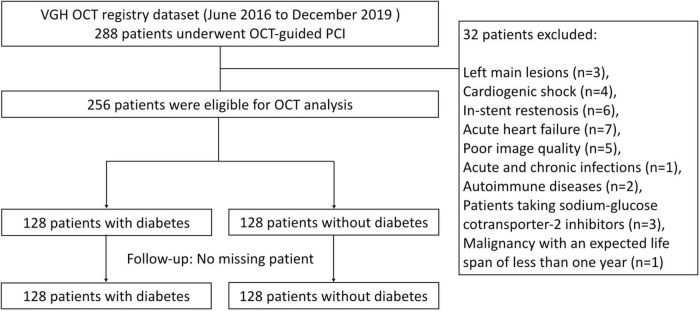
Methods: From June 2016 to December 2019, we prospectively enrolled 256 patients who underwent OCT-guided percutaneous coronary intervention (PCI). Half of the patients had diabetes. Patients were followed up for a mean period of 1.8 ± 0.8 years (median: 2.2 years). The relative calcium index and relative lipid core index measured by quantitative OCT analysis were used to evaluate the intra-plaque calcium and lipid levels of culprit plaques. We also analyzed the correlation between serum 1,5-AG levels and long-term major adverse cardiovascular events.
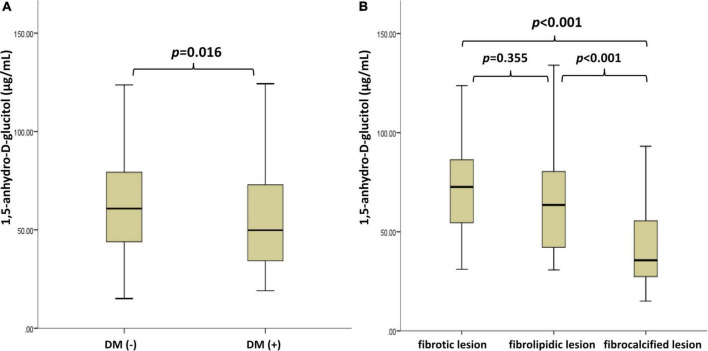
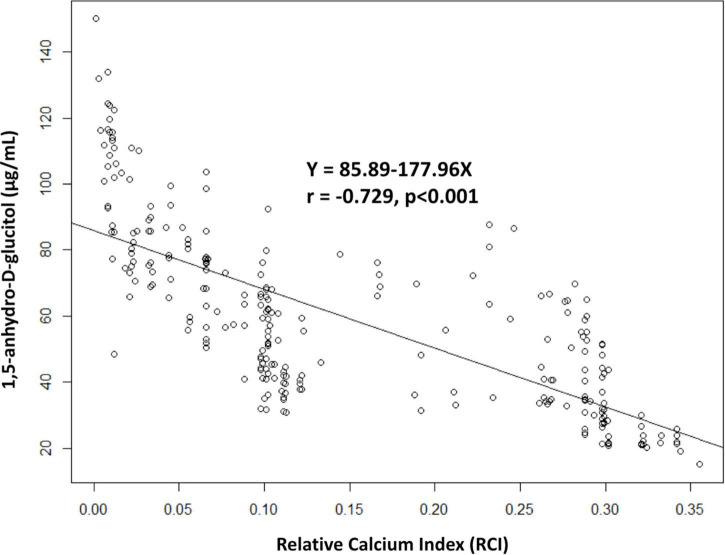
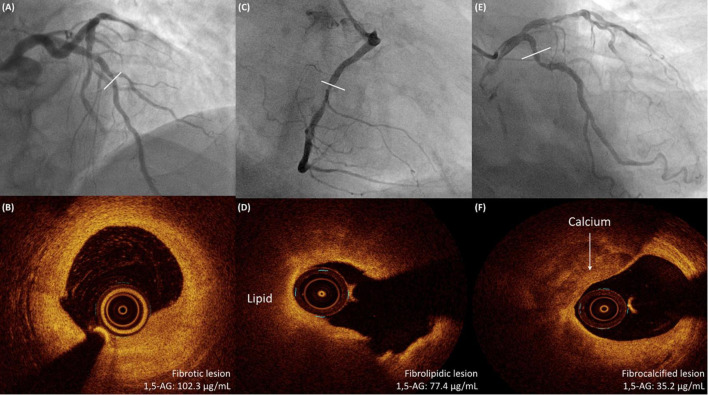
Results: Serum 1,5-AG levels were significantly lower in diabetic patients than in non-diabetic patients (DM vs. non-DM: 55.6 ± 27.9 μg/mL vs. 63.7 ± 26.1 μg/mL, p = 0.016), and lower in fibrocalcified lesions than in fibrotic or fibrolipidic lesions (fibrocalcified vs. fibrotic or fibrolipidic: 42.8 ± 19.1 vs. 72.9 ± 25.2 or 66.4 ± 27.5 μg/mL, p < 0.001, respectively). In addition, we found a significant inverse correlation between serum 1,5-AG levels and relative calcium index (r = -0.729, p < 0.001). In multivariate Cox regression analysis, low serum 1,5-AG level was identified as an independent predictor for major adverse cardiovascular events in diabetic patients (p = 0.043), but not in non-diabetic patients (p = 0.748) after adjusting for age and sex.
Conclusion: This study revealed that low serum 1,5-AG levels were associated with an increased risk of CAC as assessed by OCT, especially in diabetic patients. Low serum 1,5-AG levels may predict future major adverse cardiovascular events in diabetic patients undergoing OCT-guided PCI.
Keywords: 1; 1,5-AG; 5-anhydro-D-glucitol; coronary artery calcification; diabetes mellitus; optical coherence tomography.
Copyright © 2022 Teng, Chen, Tsai, Huang, Chen, Hsueh, Hau and Lu.
Conflict of interest statement
The authors declare that the research was conducted in the absence of any commercial or financial relationships that could be construed as a potential conflict of interest.
Figures
References
-
- Rumberger JA, Simons DB, Fitzpatrick LA, Sheedy PF, Schwartz RS. Coronary artery calcium area by electron-beam computed tomography and coronary atherosclerotic plaque area. A histopathologic correlative study. Circulation. (1995) 92:2157–62. - PubMed
-
- Bourantas CV, Zhang YJ, Garg S, Iqbal J, Valgimigli M, Windecker S, et al. Prognostic implications of coronary calcification in patients with obstructive coronary artery disease treated by percutaneous coronary intervention: a patient-level pooled analysis of 7 contemporary stent trials. Heart. (2014) 100:1158–64. 10.1136/heartjnl-2013-305180 - DOI - PubMed
LinkOut - more resources
Full Text Sources
Miscellaneous
