Rubiscolin‑6 rapidly suppresses the postprandial motility of the gastric antrum and subsequently increases food intake via δ‑opioid receptors in mice
- PMID: 36111502
- PMCID: PMC9494588
- DOI: 10.3892/mmr.2022.12856
Rubiscolin‑6 rapidly suppresses the postprandial motility of the gastric antrum and subsequently increases food intake via δ‑opioid receptors in mice
Abstract
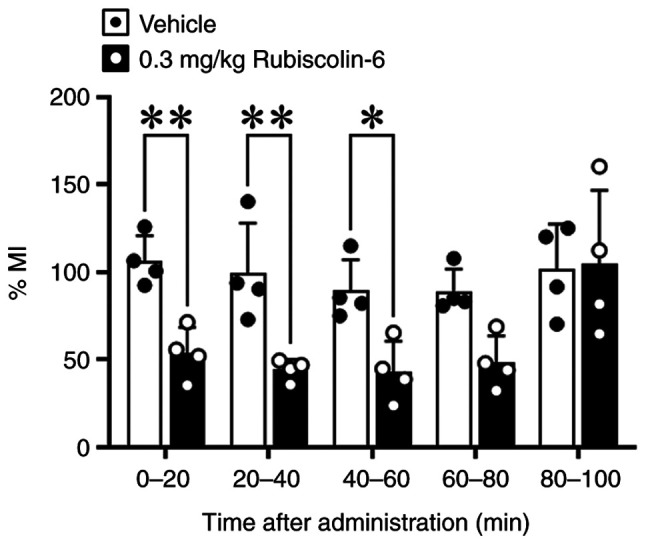
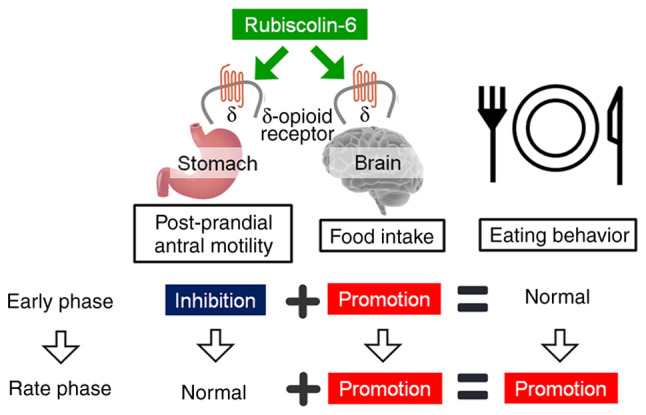
Rubiscolin‑6 is a food‑derived opioid peptide found in Spinacia oleracea that has anti‑nociceptive, memory‑enhancing, anxiolytic‑like and anti‑depressant effects. Rubiscolin‑6 has been reported to have two opposing effects on food intake. Food intake is closely connected to gut motility; however, to the best of our knowledge, the effect of rubiscolin‑6 on gut motility has not been reported. The present study aimed to investigate the effect of rubiscolin‑6 on postprandial motility of the gastric antrum in conscious mice. A catheter was implanted in the gastric antrum of male C57BL/6J mice. Manometric measurements were performed in fasted male mice and chow was then provided to assess motility in the fed state. Rubiscolin‑6, the δ‑opioid receptor antagonist naltrindole, a mixture of rubiscolin‑6 and naltrindole, or vehicle was administered intraperitoneally 30 min after eating. The percentage motor index (%MI) was then calculated. Cumulative food intake was measured in both ad libitum‑fed and overnight‑fasted mice. The %MI was significantly lower in mice treated with rubiscolin‑6 compared with that in the other groups, but normalized by treatment with the rubiscolin‑6/naltrindole mixture. The decrease in %MI induced by rubiscolin‑6 remained for 1 h after administration. Cumulative food intake was significantly higher 4 and 6 h after rubiscolin‑6 administration in ad libitum‑fed mice but was normalized by the rubiscolin‑6/naltrindole mixture. Food intake 30 min after rubiscolin‑6 administration was normal, but was higher in mice treated with the rubiscolin‑6/naltrindole mixture. Thus, rubiscolin‑6 may have a rapid effect to reduce postprandial antral motility and may subsequently increase food intake after this inhibitory effect disappears. These effects were revealed to be mediated through δ‑opioid receptors. The orexigenic effect of rubiscolin‑6 may be applicable to the treatment of anorexia and cachexia.
Keywords: eating behavior; manometric method; postprandial motility; stomach; δ‑opioid receptor agonist.
Conflict of interest statement
The authors declare that they have no competing interests.
Figures


References
-
- Ellis RJ. The most abundant protein in the world. Trends Biochem Sci. 1979;4:241–244. doi: 10.1016/0968-0004(79)90212-3. - DOI
MeSH terms
Substances
LinkOut - more resources
Full Text Sources