. 2022 Nov:46:102604.
doi: 10.1016/j.nano.2022.102604. Epub 2022 Sep 13.

Modular nanoarray vaccine for SARS-CoV-2

Affiliations

Modular nanoarray vaccine for SARS-CoV-2

Karen Zagorski et al. Nanomedicine. 2022 Nov.

Abstract

The current vaccine development strategies for the COVID-19 pandemic utilize whole inactive or attenuated viruses, virus-like particles, recombinant proteins, and antigen-coding DNA and mRNA with various delivery strategies. While highly effective, these vaccine development strategies are time-consuming and often do not provide reliable protection for immunocompromised individuals, young children, and pregnant women. Here, we propose a novel modular vaccine platform to address these shortcomings using chemically synthesized peptides identified based on the validated bioinformatic data about the target. The vaccine is based on the rational design of an immunogen containing two defined B-cell epitopes from the spike glycoprotein of SARS-CoV-2 and the universal T-helper epitope PADRE. The epitopes were conjugated to short DNA probes and combined with a complementary scaffold strand, resulting in sequence-specific self-assembly. The immunogens were then formulated by conjugation to gold nanoparticles by three methods or by co-crystallization with epsilon inulin. BALB/C mice were immunized with each formulation, and the IgG immune responses and virus neutralizing titers were compared. The results demonstrate that this assembly is immunogenic and generates neutralizing antibodies against wildtype SARS-CoV-2 and the Delta variant.

Keywords: Epitope; PADRE; Peptide; SARS-CoV-2; Vaccine; Variants of concerns (VOC).


Conflict of interest statement

Declaration of competing interest Authors declare no competing interests.

Figures

Unlabelled Image
Graphical abstract
Fig. 1
Fig. 1
Schematic representation of immunogen and its validation. Three epitopes as peptides (P1–P3) are assembled on a DNA scaffold containing thiol for coupling with gold. P1 is the universal T helper cell epitope PADRE, P2 is an S-protein-derived peptide (residues 1148–1159), important for cell membrane fusion, and P3 is a peptide located after RBD (residues 553–564), important for receptor recognition (A). Immunogen assembly was validated using spectrophotometric melting by 260 nm absorbance change. The melting curve was taken at a temperature range from 10 to 85 °C (B). Immunogen‑gold formulations generated by different methods were characterized by agarose gel electrophoresis. From top to bottom: free gold nanoparticles, freezing-based conjugation of immunogen (FR), acid-based conjugation (PA), salt-based conjugation (SC) (C).
Fig. 2
Fig. 2
Comparison between conjugation methods characterized on DLS, AFM and Zeta potential. Zeta potential data are shown in grey bars, whereas DLS and AFM data depicted in blue and blue bars, respectively. Error bars are shown in all histograms.
Fig. 3
Fig. 3
IgG immune response against P1 and P2 in mice immunized with GNP-conjugated vaccine candidates. BALB/c mice were immunized with GNP-conjugated vaccine candidates at different time intervals (Day 0, 14, 28, and 61), and blood and spleen were collected as shown in schema (A). High binding 96 well plates were separately coated with P1 and P2 (100 ng/well) overnight at 4 °C. Sera prepared from different time points of immunization were diluted at 1:25 and incubated for 1 h at room temperature. IgG immune response against P1 (B) and P2 (C) was determined using HRP-conjugated goat anti-mouse IgG in the presence of TMB as substrate. *P < 0.05 is considered significant.
Fig. 4
Fig. 4
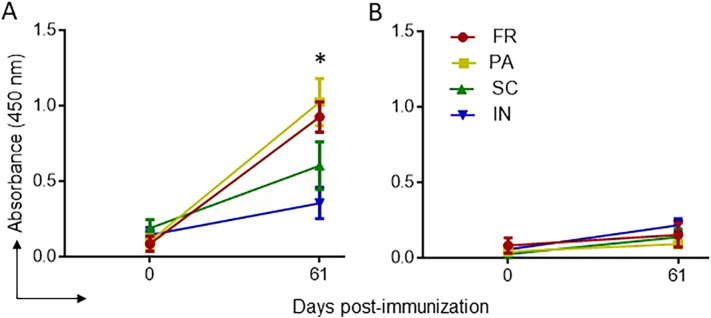
IgG immune response against SARS-CoV-2 whole spike and RBD in mice immunized with GNP-conjugated vaccine candidates. High binding 96 well plates were separately coated with whole spike or RBD (1 μg/ml) overnight at 4 °C. Sera prepared from different time immunization points were diluted at 1:25 and incubated for 1 h at room temperature. IgG immune response against the spike (A) and the RBD (B) was determined, as explained above. *P < 0.05 is considered significant.
Fig. 5
Fig. 5
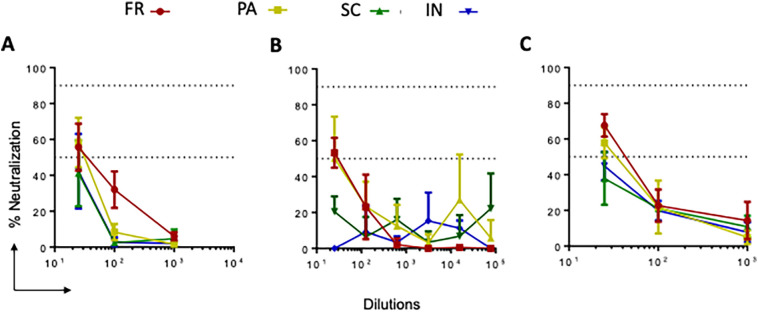
SARS-CoV-2 live virus neutralization ability of sera from mice immunized with GNP-conjugated vaccine candidates. Sera (Day 61) from all groups of immunized mice were evaluated for live virus neutralization ability against SARS-CoV-2 WT, WI, and delta variants. Sera (5× diluted, starting from 1:25) were separately incubated with WT, WI, and delta viruses at 104 PFU for 1 h. Next, the virus-sera mix was added to the cells and incubated for 24 h. Then cells were fixed and permeabilized and stained with the combination of anti-SARS-CoV-2 spike protein antibodies (rabbit mAb) and Alexa Fluor 488 goat anti-rabbit as primary and secondary antibodies, respectively. The nuclei were stained using Hoechst 33342 and plates were read using Operetta Imager. The percent neutralization was calculated based on the differential intensity of the fluorescence.
Fig. 6
Fig. 6
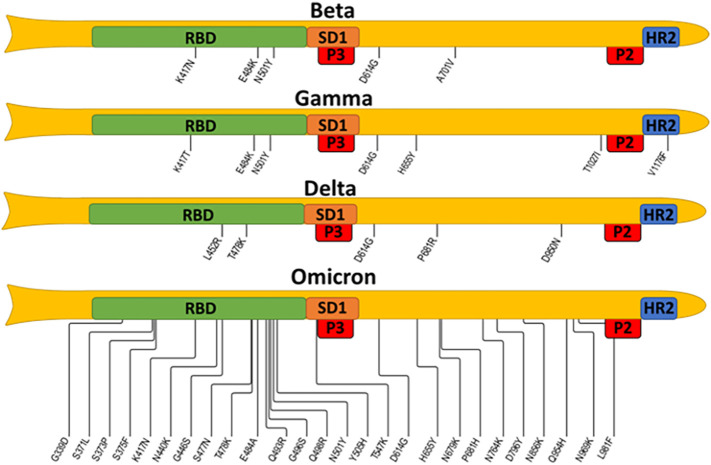
SARS-CoV-2 VOCs map of mutations spanning from RBD to heptad repeat 2 (HR2). The four spike protein variants: beta, gamma, delta, and omicron BA1, are represented schematically; note that the N-terminal domain and mutations localized within are omitted. Selected epitopes are expected to disrupt the activity of the subdomain 1 (SD1) and heptad repeat 2 (HR2), thus blocking viral attachment and cellular entry. The information about mutations is taken from the covdb.stanford.edu database.

References

    1. Self W.H., Tenforde M.W., Rhoads J.P., et al. Comparative effectiveness of Moderna, Pfizer-BioNTech, and Janssen (Johnson & Johnson) vaccines in preventing COVID-19 hospitalizations among adults without immunocompromising conditions — United States, March–August 2021. MMWR Morb Mortal Wkly Rep. 2021;70(38):1337–1343. doi: 10.15585/mmwr.mm7038e1. - DOI - PMC - PubMed
    1. Vuille-Lessard É., Montani M., Bosch J., Semmo N. Autoimmune hepatitis triggered by SARS-CoV-2 vaccination. J Autoimmun. 2021;123 doi: 10.1016/j.jaut.2021.102710. - DOI - PMC - PubMed
    1. Waqar S.H.B., Khan A.A., Memon S. Thrombotic thrombocytopenic purpura: a new menace after COVID bnt162b2 vaccine. Int J Hematol. 2021;114(5):626–629. doi: 10.1007/s12185-021-03190-y. - DOI - PMC - PubMed
    1. Velikova T., Georgiev T. SARS-CoV-2 vaccines and autoimmune diseases amidst the COVID-19 crisis. Rheumatol Int. 2021;41(3):509–518. doi: 10.1007/s00296-021-04792-9. - DOI - PMC - PubMed
    1. Masset C., Kervella D., Kandel-Aznar C., Fantou A., Blancho G., Hamidou M. Relapse of IgG4-related nephritis following mRNA COVID-19 vaccine. Kidney Int. 2021;100(2):465–466. doi: 10.1016/j.kint.2021.06.002. - DOI - PMC - PubMed

Publication types

Supplementary concepts