Review
. 2022 Dec;43(12):3080-3095.
doi: 10.1038/s41401-022-00983-7. Epub 2022 Sep 16.

Multi-compound and drug-combination pharmacokinetic research on Chinese herbal medicines

Affiliations
Review

Multi-compound and drug-combination pharmacokinetic research on Chinese herbal medicines

Chuan Li et al. Acta Pharmacol Sin. 2022 Dec.

Abstract

Traditional medicine has provided a basis for health care and disease treatment to Chinese people for millennia, and herbal medicines are regulated as drug products in China. Chinese herbal medicines have two features. They normally possess very complex chemical composition. This makes the identification of the constituents that are together responsible for the therapeutic action of an herbal medicine challenging, because how to select compounds from an herbal medicine for pharmacodynamic study has been a big hurdle in such identification efforts. To this end, a multi-compound pharmacokinetic approach was established to identify potentially important compounds (bioavailable at the action loci with significant exposure levels after dosing an herbal medicine) and to characterize their pharmacokinetics and disposition. Another feature of Chinese herbal medicines is their typical use as or in combination therapies. Coadministration of complex natural products and conventional synthetic drugs is prevalent worldwide, even though it remains very controversial. Natural product-drug interactions have raised wide concerns about reduced drug efficacy or safety. However, growing evidence shows that incorporating Chinese herbal medicines into synthetic drug-based therapies delivers benefits in the treatment of many multifactorial diseases. To address this issue, a drug-combination pharmacokinetic approach was established to assess drug-drug interaction potential of herbal medicines and degree of pharmacokinetic compatibility for multi-herb combination and herbal medicine-synthetic drug combination therapies. In this review we describe the methodology, techniques, requirements, and applications of multi-compound and drug-combination pharmacokinetic research on Chinese herbal medicines and to discuss further development for these two types of pharmacokinetic research.

Keywords: Chinese herbal medicine; drug-combination pharmacokinetic research; multi-compound pharmacokinetic research; pharmacokinetic compatibility; pharmacokinetics.


Conflict of interest statement

The authors declare no competing interests.

Figures
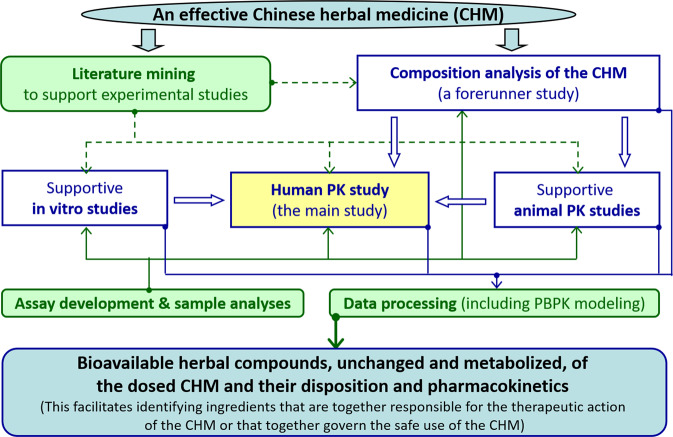
Fig. 1
Fig. 1. An overview of approach to multi-compound pharmacokinetic research on Chinese herbal medicines.
(Reprinted from Li et al., 2021 [30] with permission of Acta Pharm Sin).
Fig. 2
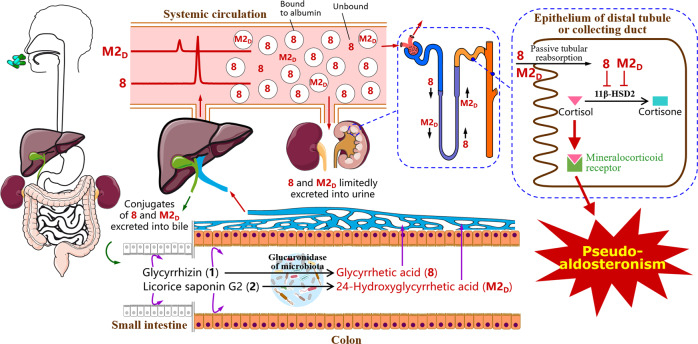
Fig. 2. A schematic overview of pharmacokinetics-based identification of the pseudoaldosterogenic compounds glycyrrhetic acid (8) and 24-hydroxyglycyrrhetic acid (M2D).
The Gancao constituents glycyrrhizin (1) and licorice saponin G2 (2) are metabolically activated by glucuronidase of the colonic microbiota to the metabolites 8 and M2D, respectively, which can access (via passive tubular reabsorption) and inhibit renal 11β-HSD2. (Reprinted from Lan et al., 2021 [47] with permission of Acta Pharmacol Sin).
Fig. 3
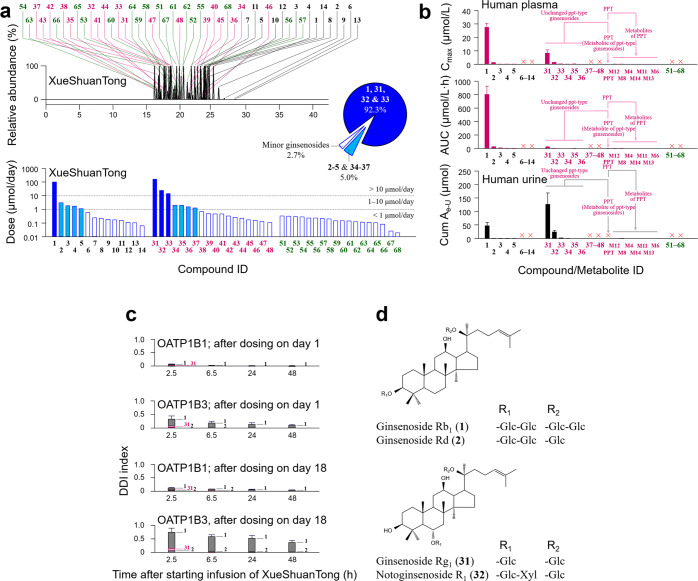
Fig. 3. Chemical composition, circulating compounds, and DDI potential of XueShuanTong.
Ginsenosides present in XueShuanTong (a), their systemic exposure and renal excretion in human volunteers who received a 2.5-h infusion of XueShuanTong at 500 mg/person (b), and estimated total DDI indexes on OATP1B1 and OATP1B3 for a single 2.5-h intravenous infusion of XueShuanTong at 500 mg/person and for repeated doses of XueShuanTong at 500 mg/person every day on day 18 (c). Chemical structures of the major circulating ginsenosides after dosing XueShuanTong are shown in panel (d). The XueshuanTong constituents 114 are ppd-type ginsenosides; 3148 are ppt-type ginsenosides; and 5168 are other type ginsenosides. M4, M6, M8, and M11M14 are metabolites of the ppt-type ginsenosides (see Ref. [42] for more information about these metabolites). 1, ginsenoside Rb1; 2, ginsenoside Rd; 31, ginsenoside Rg1; 32, notoginsenoside R1; PPD, 20(S)-protopanaxadiol; and PPT, 20(S)-protopanaxatriol. Glc glucopyranosyl, Xyl xylopyranosyl. (Reprinted from Pintusophon et al., 2019 [39] with permission of Acta Pharmacol Sin).
Fig. 4
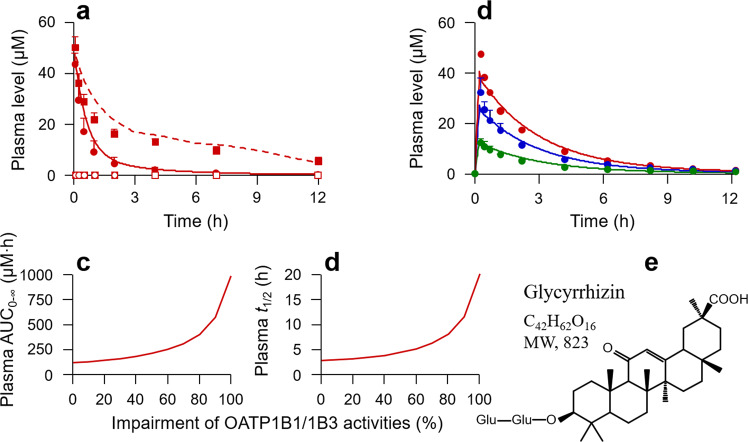
Fig. 4. Potential of intravenous glycyrrhizin as the victim in DDIs.
Observed (dots) and PBPK model-simulated (lines) plasma concentration-time profiles of glycyrrhizin in rifampin-untreated (control) and rifampin-treated rats that intravenously received glycyrrhizin at 2.6 mg/kg (a), such plasma concentration-time profiles in humans who received a 12-min intravenous infusion of glycyrrhizin at 40 (in green), 80 (in blue), and 120 (in red) mg/person (b), and PBPK model-predicted influence of impaired hepatic OATP1B1/1B3 activities on levels of systemic exposure to glycyrrhizin (c and d). Chemical structure and comparative elimination routes of glycyrrhizin are shown in panel (e). The plasma levels of glycyrrhizin were prospectively predicted under a 12-min i.v. infusion of glycyrrhizin at 120 mg/person. The assumption, used as a worst-case estimate, was that the inhibition of OATP1B1/1B3 was constant over time. Sustaining the impairment of OATP1B1/1B3 activities by the inhibitory perpetrator depends on the perpetrator’s inhibition potency and pharmacokinetics (the unbound plasma concentrations and elimination t1/2). The observed human plasma concentration data of glycyrrhizin were digitalized from a publication by Yamamura et al. [148] with permission of Elsevier and APhA. Glu glucuronosyl. (Reprinted from Dong et al., 2018 [37] with permission of John Wiley and Sons).
Fig. 5
Fig. 5
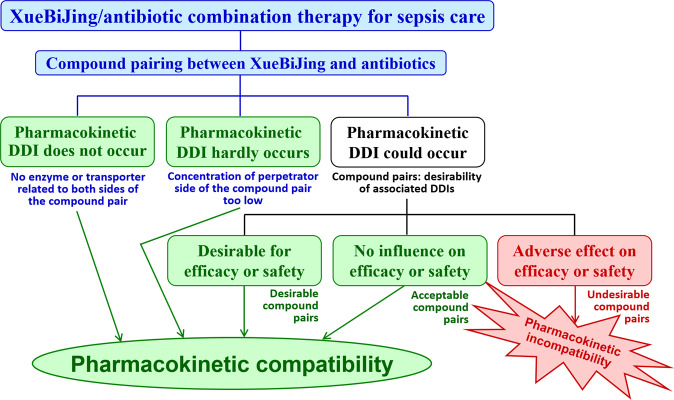
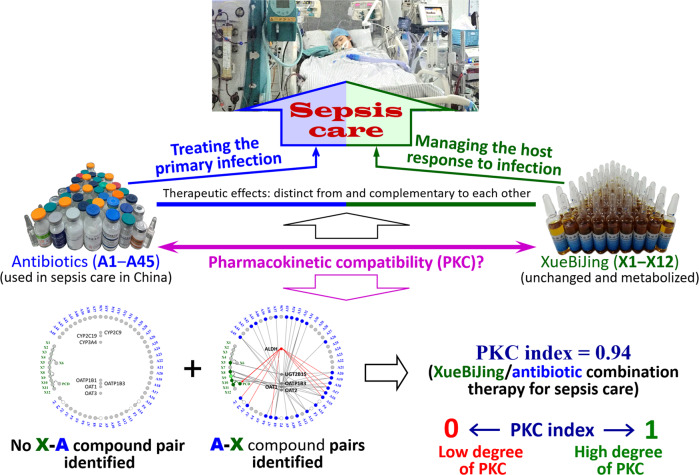
Elements of pharmacokinetic compatibility (PKC) evaluation within combination therapy of XueBiJing and antibiotics for sepsis care.
Fig. 6
Fig. 6. A schematic overview of evaluation of PKC degree of combination therapy of XueBiJing and antibiotics and the high degree of PKC supports concurrent use of the two types of medicines in sepsis care.
A1‒A45, 45 antibiotics commonly used in sepsis care in China (see Ref. [24] for the detailed information); X1X12, 12 major XueBiJing compounds, unchanged and metabolized, that are bioavailable for drug DDIs and bioactive for sepsis care (see Ref. [24] for the detailed information). (Reprinted from Li et al., 2019 [24] with permission of Acta Pharm Sin B).

References

    1. Outline of the main points of prevention and treatment of epidemic diseases with traditional Chinese medicine. Beijing J Tradit Chin Med (Beijing Zhongyiyao). 2014;33:910–2.
    1. Chinese National Health Commission and Chinese State Administration of Traditional Chinese Medicine, Diagnosis and Treatment of Adults with Coronavirus Disease 2019 (COVID-19) (the ninth version), March 15th, 2022 http://www.nhc.gov.cn/yzygj/s7653p/202203/b74ade1ba4494583805a3d2e40093d.... (accessed on 27th March, 2022)
    1. Zhang BL. Traditional Chinese medicine in China’s combating of Covid-19, brimming with cultural confidence. Red Flag Manuscr (Hongqi Wengao) 2021;6:37–40.
    1. Ni LQ, Chen LL, Huang X, Han CP, Xu JR, Zhang H, et al. Combating COVID-19 with integrated traditional Chinese and Western medicine in China. Acta Pharm Sin B. 2020;10:1149–62.. doi: 10.1016/j.apsb.2020.06.009. - DOI - PMC - PubMed
    1. National Medical Products Administration, The notification regarding the implementation of Good Manufacturing Practice of Medical Products (version 2010), https://www.nmpa.gov.cn/xxgk/fgwj/gzwj/gzwjyp/20110225152101646.html. (Accessed 7 June 2022).