. 2022 Nov:142:104879.
doi: 10.1016/j.neubiorev.2022.104879. Epub 2022 Sep 15.

The central extended amygdala guides survival-relevant tradeoffs: Implications for understanding common psychiatric disorders

Affiliations

The central extended amygdala guides survival-relevant tradeoffs: Implications for understanding common psychiatric disorders

Dan Holley et al. Neurosci Biobehav Rev. 2022 Nov.

Abstract

To thrive in challenging environments, individuals must pursue rewards while avoiding threats. Extensive studies in animals and humans have identified the central extended amygdala (EAc)-which includes the central nucleus of the amygdala (Ce) and bed nucleus of the stria terminalis (BST)-as a conserved substrate for defensive behavior. These studies suggest the EAc influences defensive responding and assembles fearful and anxious states. This has led to the proliferation of a view that the EAc is fundamentally a defensive substrate. Yet mechanistic work in animals has implicated the EAc in numerous appetitive and consummatory processes, yielding fresh insights into the microcircuitry of survival- and emotion-relevant response selection. Coupled with the EAc's centrality in a conserved network of brain regions that encode multisensory environmental and interoceptive information, these findings suggest a broader role for the EAc as an arbiter of survival- and emotion-relevant tradeoffs for action selection. Determining how the EAc optimizes these tradeoffs promises to improve our understanding of common psychiatric illnesses such as anxiety, depression, alcohol- and substance-use disorders, and anhedonia.

Keywords: Action selection; Anxiety; BNST; BST; Bed nucleus of the stria terminalis; Ce; CeA; Central nucleus of the amygdala; Consummatory; Defensive behavior; Extended amygdala; Fear; Reward.


Figures

Figure 1.
Figure 1.
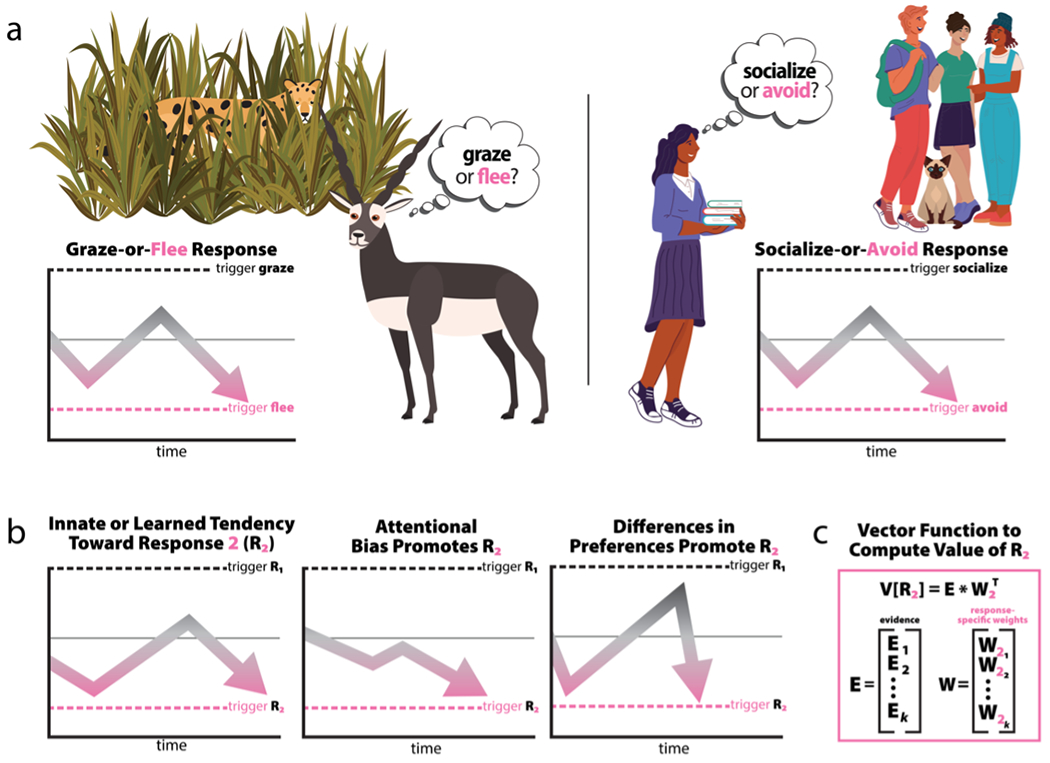
In nature and society, behavior is characterized by risk-vs-reward tradeoffs. a) Adaptive responses are selected from competing options. A hungry gazelle detects a predator and must select between grazing and freezing (left)—neither of which is inherently maladaptive. This selection process can be defined as a function of the value of each response, i.e., f(V[R1], V[R2]). While we are agnostic about the specific computations underlying the tradeoffs inherent to response selection, these choices can be conceptualized with simplified drift-diffusion models (DDM; Ratcliff & McKoon, 2008) in which responses are triggered as accumulating evidence surpasses a decision threshold, represented here as dashed lines bisected by a grey line indicating the indifference point. In humans, the systems that underlie these survival-relevant selection processes can select emotion-relevant responses (right). b) Different underlying processes can trigger the same response. Even with a simplified two-option DDM—which has been useful for characterizing multi-alternative valuation decisions (Krajbich & Rangel, 2011)—different underlying processes can bias individuals toward the same response: an innate or learned tendency toward one response over another (left), an attentional bias that leads to disproportionate accumulation of evidence in favor of one response over another (middle), or differences in the valuation of evidence between responses (right) illustrate sources of bias toward response R2. c) Response selection as a computational process in an n-dimensional feature space. The value of any response (e.g., V[R2]) can be conceptualized as the product of all available evidence (e.g., [E1, E2… Ek]) times the context-specific weight afforded to each piece of evidence (e.g., [W21, W22… W2k]T). In the case of our gazelle, E1 might represent predator proximity, and W22 the gazelle’s sensitivity to predator proximity in the context of escape decisions. Of note, the weights may comprise a sparse matrix; that is, many pieces of evidence may have no (or little) bearing on a specific response.
Figure 2.
Figure 2.
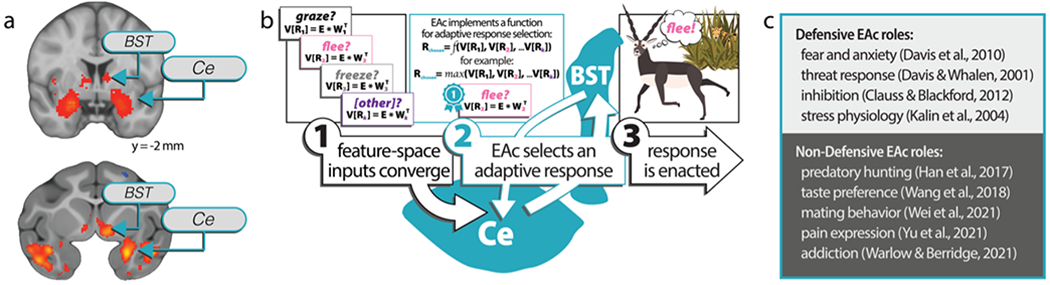
The EAc selects defensive and non-defensive responses. a) Studies of humans and rhesus monkeys implicate the EAc in uncertain threat response. As reported in Shackman and Fox, 2016, a Neurosynth-enabled (Yarkoni et al., 2011) automated meta-analysis of “fear” and “anxiety” neuroimaging studies in humans reveals Ce and BST activation (top), and large-scale (N=592) nonhuman primate neuroimaging studies of response to uncertain threat (Fox et al., 2015a) show that rhesus anxious temperament predicts elevated EAc metabolism during exposure to an uncertain threat represented by an unfamiliar human intruder (bottom). b) Feature-space model of EAc-implemented function for selecting between graze (R1), flee (R2), and freeze (R3) responses based on the weighted valuations of those responses in each context. In this simplified three-choice model, 1) feature-space inputs encoding salient, weighted environmental and interoceptive evidence converge on the EAc; 2) the EAc represents and resolves the feature space through an unknown selection function (shown here as a placeholder function to represent what is almost certainly a more complicated process; see Krajbich & Rangel, 2011) to guide survival-relevant and emotion-relevant tradeoffs for action selection and adaptive physiology; and 3) instructions to enact the winning response are pushed downstream to effector regions capable of triggering changes in physiology, cognition, and behavior. c) An illustrative list of defensive and non-defensive EAc roles highlights the EAc’s involvement in diverse response sets. Of note, we use the terms “defensive” and “non-defensive” to be inclusive of physiological, cognitive, and behavioral changes, as well as the phenomenological states that elicit EAc involvement.
Figure 3.
Figure 3.
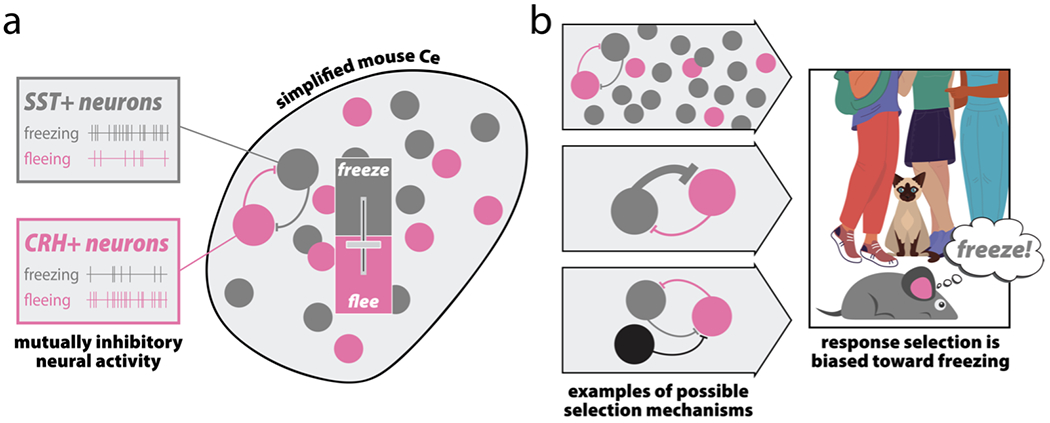
Genetically dissociable microcircuits provide a substrate for response selection through the implementation of a selection function (e.g., f(V[R1], V[R2], …V[Rk]; see Fig. 2B). a) Mutually inhibitory neural activity in the mouse Ce. A competitive inhibitory microcircuit composed of intermingled, competing populations of SST+ and CRH+ neurons select between freezing and fleeing responses, respectively (adapted from Fadok et al., 2017). The activity of either population generates strong inhibitory postsynaptic currents that suppress the other population, thereby serving as a rapid, winner-take-all mechanism for selecting between active and passive threat response. b) Possible mechanisms for response selection. Several distinct mechanisms could dispositionally bias an individual toward passive threat response (i.e., maladaptive freezing), characteristic of behavioral inhibition (Roelofs, 2017; Roelofs, Hagenaars, & Stins, 2010); for example: a preponderance of SST+ neurons (top), disproportionately strong SST+ to CRH+ projections (middle), or the presence of a third population of neurons that co-inhibits CRH+ neurons (bottom). Importantly, while we have highlighted the SST+ and CRH+ microcircuit in the mouse Ce, it is likely that imbalances in other microcircuits—for example, the aforementioned “CeLon”/PKCδ− and “CeLoff”/PKCδ+ microcircuit—could drive similar tendencies. We hypothesize similar alterations in other EAc regions, such as the BST.

References

    1. Aggleton JP (2000). The amygdala: A functional analysis. Oxford University Press, Oxford, UK.

    1. Avery SN, Clauss JA, & Blackford JU (2016). The Human BNST: Functional Role in Anxiety and Addiction. Neuropsychopharmacology, 41(1), 126–141. 10.1038/npp.2015.185 - DOI - PMC - PubMed
    1. Avery SN, Clauss JA, Winder DG, Woodward N, Heckers S, & Blackford JU (2014). BNST neurocircuitry in humans. NeuroImage, 91, 311–323. 10.1016/j.neuroimage.2014.01.017 - DOI - PMC - PubMed
    1. Bachmanov AA, Bosak NP, Lin C, Matsumoto I, Ohmoto M, Reed DR, & Nelson TM (2014). Genetics of Taste Receptors. Current Pharmaceutical Design, 20(16), 2669–2683. - PMC - PubMed
    1. Bandelow B, Michaelis S (2015) Epidemiology of anxiety disorders in the 21st century. Dialogues in Clinical Neuroscience, 17(3), 327–35. - PMC - PubMed

Publication types