


Endoscopic electroincision of challenging benign biliopancreatic strictures
- PMID: 36118628
- PMCID: PMC9473841
- DOI: 10.1055/a-1871-8699
Endoscopic electroincision of challenging benign biliopancreatic strictures
Abstract
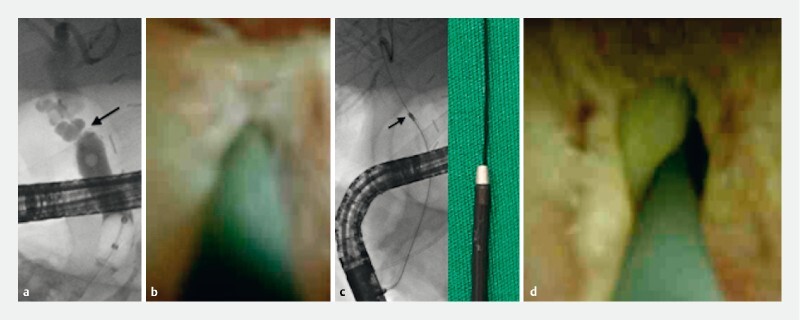
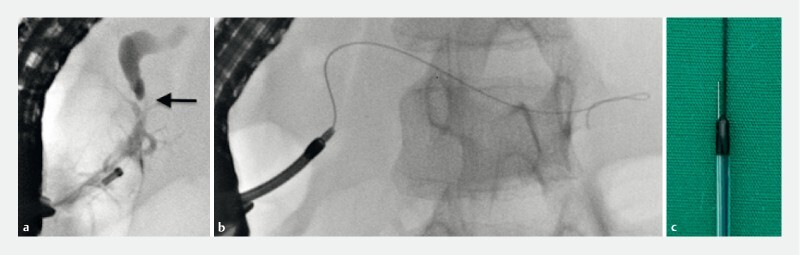
Background and study aims Endoscopic drainage of benign biliary and pancreatic strictures can be challenging, especially when tightness of the stenosis does not allow passage of mechanical and pneumatic dilation catheters. Electroincision of benign biliopancreatic can be considered in selected cases. Patients and methods Three male patients (mean age 33 years, range 9-60) underwent endoscopic retrograde cholangiopancreatography to drain anastomotic biliary stricture (ABS) following orthotopic liver transplantation (n = 2) and pancreatic duct stenosis due to abdominal trauma (n = 1). The biliopancreatic strictures could be passed only with a thin 0.020-inch hydrophilic guidewire. Conventional mechanical and pneumatic dilators failed to pass the strictures due to weakness of the guidewire. Therefore, electrosurgical incision by over-the-wire 6Fr cystotome or needle-knife was attempted using pure cut current. Results The two cases of ABS were approached also by cholangioscopy and the 6Fr cystotome easily passed the strictures, allowing subsequent pneumatic dilatation and insertion of multiple plastic stents. The patient with a pancreatic duct stricture underwent electrosurgical incision using a thin needle knife over-the-wire, resulting in insertion of a 7Fr pancreatic stent. No adverse events occurred; all the patients were discharged within 24 to 48 hours. Conclusions Electrosurgical incision of benign biliopancreatic strictures could be considered in selected patients whom conventional dilation techniques fail.
The Author(s). This is an open access article published by Thieme under the terms of the Creative Commons Attribution-NonDerivative-NonCommercial License, permitting copying and reproduction so long as the original work is given appropriate credit. Contents may not be used for commercial purposes, or adapted, remixed, transformed or built upon. (https://creativecommons.org/licenses/by-nc-nd/4.0/).
Conflict of interest statement
Competing interests Dr. Tringali is a consultant for Boston Scientific and Olympus. Dr. Costamagna receives consulting fees from Cook Medical, Olympus, and Boston Scientific Corp.
Figures
References
-
- Savides T J, Varadarajulu S, Palazzo L et al.EUS 2008 Working Group document: evaluation of EUS-guided hepaticogastrostomy. Gastrointest Endosc. 2009;69:S3–S7. - PubMed
-
- Dumonceau J-M, Tringali A, Papanikolaou I et al.Endoscopic biliary stenting: indications, choice of stents, and results: European Society of Gastrointestinal Endoscopy (ESGE) Clinical Guideline – Updated October 2017. Endoscopy. 2018;50:910–930. - PubMed
-
- Oracz G, Pertkiewicz J, Kierkus J et al.Efficiency of pancreatic duct stenting therapy in children with chronic pancreatitis. Gastrointest Endosc. 2014;80:1022–1029. - PubMed
LinkOut - more resources
Full Text Sources
