


A strategy for rapid discovery of traceable chemical markers in herbal products using MZmine 2 data processing toolbox: A case of Jing Liqueur
- PMID: 36118935
- PMCID: PMC9476759
- DOI: 10.1016/j.chmed.2021.05.004
A strategy for rapid discovery of traceable chemical markers in herbal products using MZmine 2 data processing toolbox: A case of Jing Liqueur
Abstract
Objective: The quality evaluation of herbal products remains a big challenge. Traceable markers are the core concept of the authentication of herbal products. However, the discovery of traceable markers is labor-intensive and time-consuming. The aim of this study is to develop a convenient approach to rapidly screen the traceable markers for herbal product authentication.
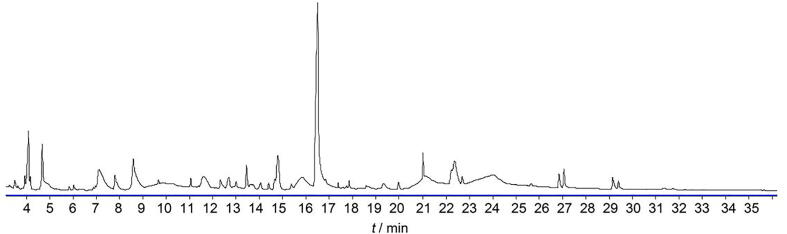
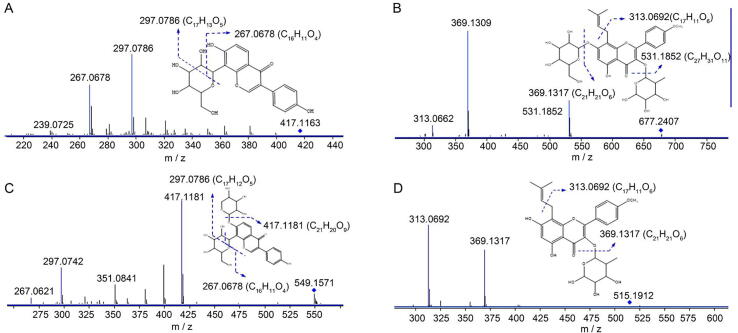
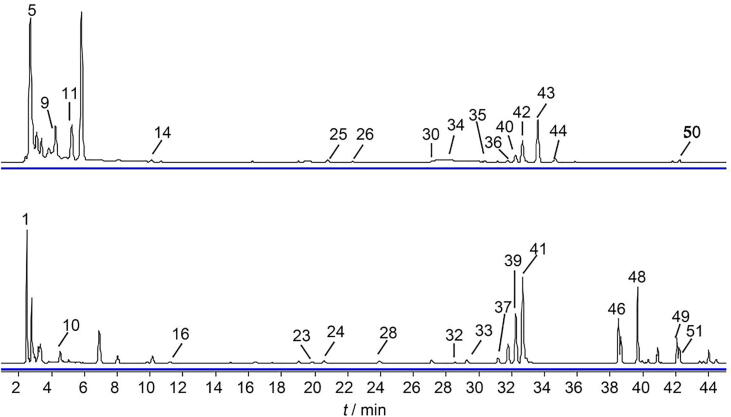
Methods: Commercial Jing Liqueur and its 22 species of herbal ingredients were analyzed using HPLC-QTOF-MS and GC-MS to characterize nonvolatile and volatile chemicals. The acquired data were imported into MZmine 2 software for mass detection, chromatogram building, deconvolution and alignment. The aligned data were exported into a csv file and then traceable markers were selected using the built-in filter function in Excel. Finally, the traceable markers were identified by searching against online databases or publications, some of which were confirmed by reference standards.
Results: A total of 288 chemical features transferred from herbal materials to Jing Liqueur product were rapidly screened out. Among them, 52 markers detected by HPLC-QTOF-MS were annotated, while nine volatile markers detected by GC-MS were annotated. Moreover, 30 of these markers were confirmed by comparing with reference standards. A chemical fingerprint consisting of traceable markers was finally generated to ensure the authentication and quality consistency of Jing Liqueur.
Conclusion: A strategy for rapid discovery of traceable markers in herbal products using MZmine 2 software was developed.
Keywords: GC–MS; HPLC-QTOF-MS; Jing Liqueur; MZmine 2; herbal products; traceable markers.
© 2021 Tianjin Press of Chinese Herbal Medicines. Published by ELSEVIER B.V.
Conflict of interest statement
The authors declare that they have no known competing financial interests or personal relationships that could have appeared to influence the work reported in this paper.
Figures



References
-
- Aparicio-Soto M., Sánchez-Hidalgo M., Rosillo M.Á., Castejón M.L., Alarcón-de-la-Lastra C. Extra virgin olive oil: A key functional food for prevention of immune-inflammatory diseases. Food and Function. 2016;7(11):4492–4505. - PubMed
-
- Cañigueral S., Tschopp R., Ambrosetti L., Vignutelli A., Scaglione F., Petrini O. The development of herbal medicinal products: Quality, safety, and efficacy as key factors. Pharmaceutical Medicine. 2008;22(2):107–118.
-
- Choi H.J., Eun J.S., Kim D.K., Li R.H., Shin T.Y., Park H., et al. Icariside II from Epimedium koreanum inhibits hypoxia-inducible factor-1α in human osteosarcoma cells. European Journal of Pharmacology. 2008;579(1-3):58–65. - PubMed
-
- Fan X.H., Cheng Y.Y., Ye Z.L., Lin R.C., Qian Z.Z. Multiple chromatographic fingerprinting and its application to the quality control of herbal medicines. Analytica Chimica Acta. 2006;555(2):217–224.
-
- Feng S., Shan Y., Lu S., Liu Y., He G. The anti-inflammatory effect of moderate drinking. Liquor-Making Science and Technology. 2013;229:121–124.
LinkOut - more resources
Full Text Sources
Miscellaneous
