


COVID-19 vaccine type-dependent differences in immunogenicity and inflammatory response: BNT162b2 and ChAdOx1 nCoV-19
- PMID: 36119092
- PMCID: PMC9480614
- DOI: 10.3389/fimmu.2022.975363
COVID-19 vaccine type-dependent differences in immunogenicity and inflammatory response: BNT162b2 and ChAdOx1 nCoV-19
Abstract
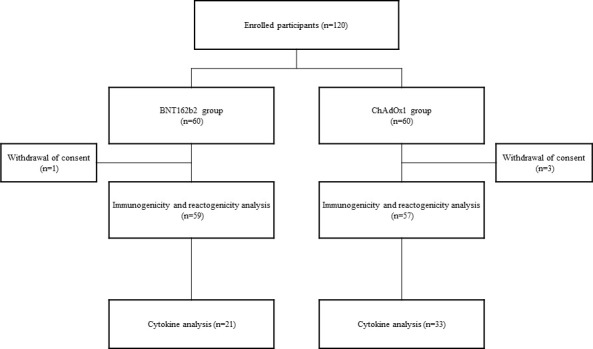
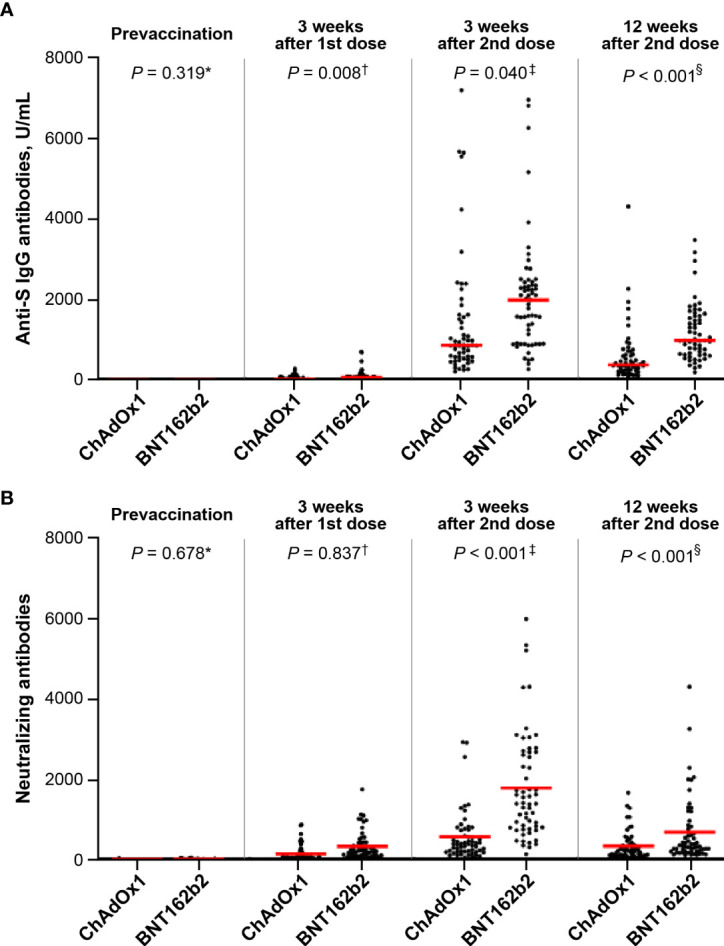
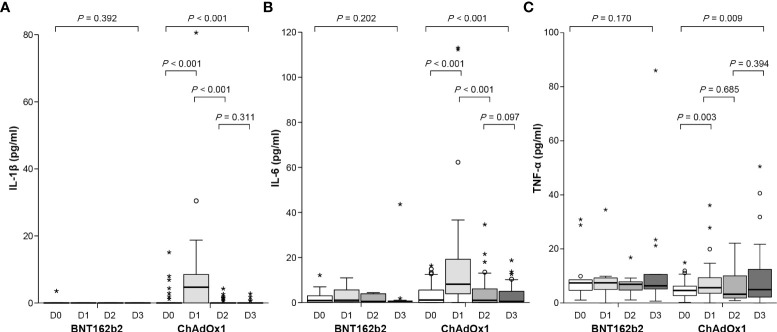
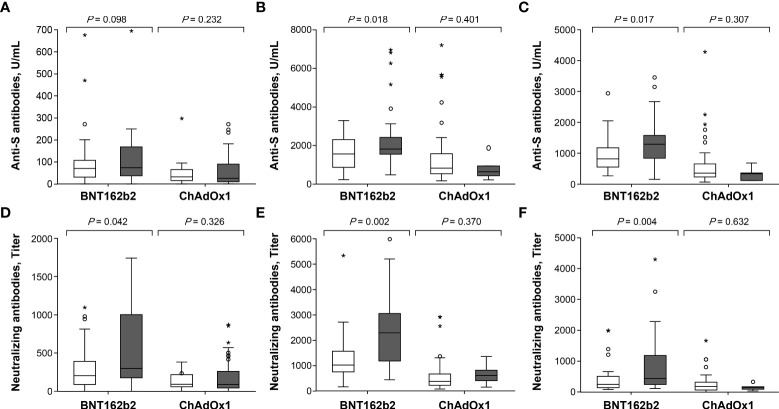
Evaluation of the safety and immunogenicity of new vaccine platforms is needed to increase public acceptance of coronavirus disease 2019 (COVID-19) vaccines. Here, we evaluated the association between reactogenicity and immunogenicity in healthy adults following vaccination by analyzing blood samples before and after sequential two-dose vaccinations of BNT162b2 and ChAdOx1 nCoV-19. Outcomes included anti-S IgG antibody and neutralizing antibody responses, adverse events, and proinflammatory cytokine responses. A total of 59 and 57 participants vaccinated with BNT162b2 and ChAdOx1 nCoV-19, respectively, were enrolled. Systemic adverse events were more common after the first ChAdOx1 nCoV-19 dose than after the second. An opposite trend was observed in BNT162b2 recipients. Although the first ChAdOx1 nCoV-19 dose significantly elevated the median proinflammatory cytokine levels, the second dose did not, and neither did either dose of BNT162b2. Grades of systemic adverse events in ChAdOx1 nCoV-19 recipients were significantly associated with IL-6 and IL-1β levels. Anti-S IgG and neutralizing antibody titers resulting from the second BNT162b2 dose were significantly associated with fever. In conclusion, systemic adverse events resulting from the first ChAdOx1 nCoV-19 dose may be associated with proinflammatory cytokine responses rather than humoral immune responses. Febrile reactions after second BNT162b2 dose were positively correlated with vaccine-induced immune responses rather than with inflammatory responses.
Keywords: COVID-19; cytokine; immunogenicity; reactogenicity; vaccine.
Copyright © 2022 Heo, Seo, Kim, Lee, Kim, Yoon, Noh, Cheong, Kim, Yoon, Choi, Lee, Lee, Kim, Kim and Song.
Conflict of interest statement
The authors declare that the research was conducted in the absence of any commercial or financial relationships that could be construed as a potential conflict of interest.
Figures
References
-
- Our World in Data . Coronavirus (COVID-19) vaccinations. Available at: https://ourworldindata.org/covid-vaccinations (Accessed March 17, 2022).
-
- Voysey M, Clemens SAC, Madhi SA, Weckx LY, Folegatti PM, Aley PK, et al. Safety and efficacy of the ChAdOx1 nCoV-19 nCoV-19 vaccine (AZD1222) against SARS-CoV-2: an interim analysis of four randomised controlled trials in Brazil, south Africa, and the UK. Lancet (2021) 397:99–111. doi: 10.1016/s0140-6736(20)32661-1 - DOI - PMC - PubMed
-
- Ramasamy MN, Minassian AM, Ewer KJ, Flaxman AL, Folegatti PM, Owens DR, et al. Safety and immunogenicity of ChAdOx1 nCoV-19 nCoV-19 vaccine administered in a prime-boost regimen in young and old adults (COV002): a single-blind, randomised, controlled, phase 2/3 trial. Lancet (2020) 396:1979–93. doi: 10.1016/s0140-6736(20)32466-1 - DOI - PMC - PubMed
Publication types
MeSH terms
Substances
LinkOut - more resources
Full Text Sources
Medical
