


Evaluation of CD44+/CD24- and Aldehyde Dehydrogenase Enzyme Markers in Cancer Stem Cells as Prognostic Indicators for Triple-Negative Breast Cancer
- PMID: 36120232
- PMCID: PMC9476834
- DOI: 10.7759/cureus.28056
Evaluation of CD44+/CD24- and Aldehyde Dehydrogenase Enzyme Markers in Cancer Stem Cells as Prognostic Indicators for Triple-Negative Breast Cancer
Abstract
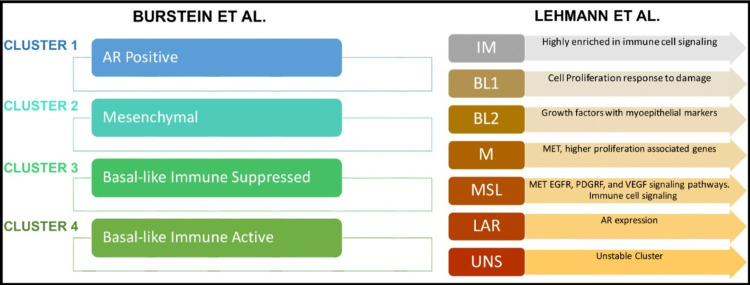
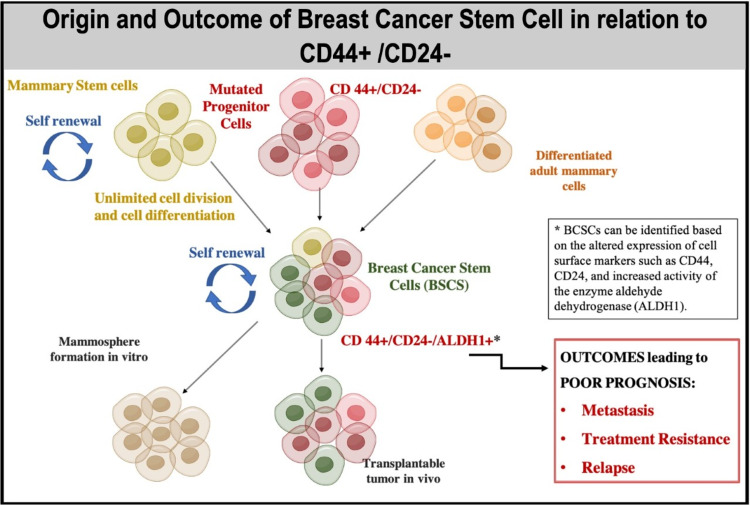
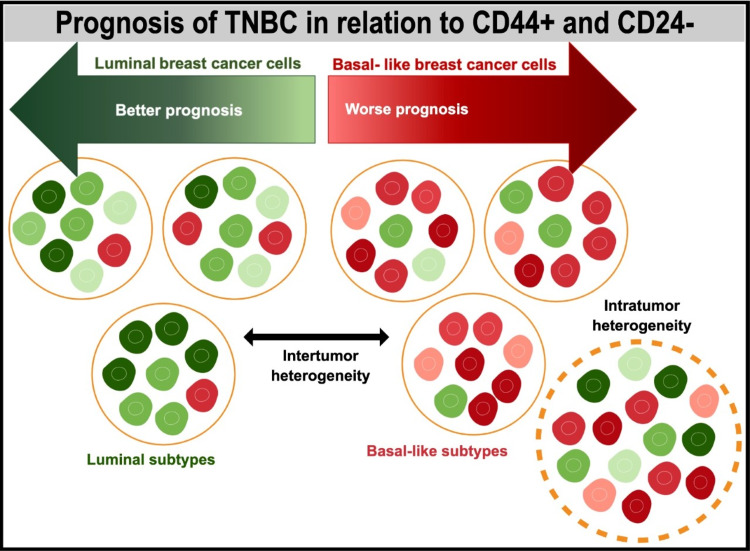
Triple-negative breast cancer (TNBC) has been extensively studied not just for its aggressive behavior but also to understand its complex molecular nature. This type of heterogeneous tumor shows no expression of estrogen receptor (ER) or progesterone receptor (PR) and does not express the HER2 gene, and often these tumors are high grade with distinct histological groups. The basal-like subtype is most commonly related to the TNBC type of neoplasms; it can be further classified according to Lehmann and Burstein expert's criteria. TNBC is related to breast stem cell markers such as CD44+/CD24- and high levels of enzyme aldehyde dehydrogenase (ALDH), which have been shown to possess stem cell features that are involved in differentiation, vascular invasion, tumorigenesis, and metastatic potential. CD44+/CD24- and high levels of ALDH have significance as markers as well as indicators of poor prognosis in TNBC. The databases used in this review are PMC, PubMed, and Google Scholar.
Keywords: cancer stem cells; cd24-; cd44+; ladh or ladh1; prognosis; triple-negative breast cancer.
Copyright © 2022, Escudero Mendez et al.
Conflict of interest statement
The authors have declared that no competing interests exist.
Figures
References
-
- World Health Organization: breast cancer. [ Mar; 2022 ];Breast cancer. World Health Organization.26 Mar. . https://www.who.int/news-room/fact-sheets/detail/breast-cancer. https://www.who.int/news-room/fact-sheets/detail/breast-cancer 2021
-
- Triple-negative breast carcinoma: current and emerging concepts. Schmadeka R, Harmon BE, Singh M. Am J Clin Pathol. 2014;141:462–477. - PubMed
-
- Triple-negative breast cancer: future prospects in diagnosis and management. Elsamany S, Abdullah S. Med Oncol. 2014;31:834. - PubMed
-
- Patients with triple negative breast cancer: is there an optimal adjuvant treatment? Burstein HJ. Breast. 2013;22:0–8. - PubMed
-
- Triple-negative breast cancer. Foulkes WD, Smith IE, Reis-Filho JS. N Engl J Med. 2010;363:1938–1948. - PubMed
Publication types
LinkOut - more resources
Full Text Sources
Research Materials
Miscellaneous