


High Soluble Amyloid-β42 Predicts Normal Cognition in Amyloid-Positive Individuals with Alzheimer's Disease-Causing Mutations
- PMID: 36120786
- PMCID: PMC9661329
- DOI: 10.3233/JAD-220808
High Soluble Amyloid-β42 Predicts Normal Cognition in Amyloid-Positive Individuals with Alzheimer's Disease-Causing Mutations
Abstract
Background: In amyloid-positive individuals at risk for Alzheimer's disease (AD), high soluble 42-amino acid amyloid-β (Aβ42) levels are associated with normal cognition. It is unknown if this relationship applies longitudinally in a genetic cohort.
Objective: To test the hypothesis that high Aβ42 preserves normal cognition in amyloid-positive individuals with Alzheimer's disease (AD)-causing mutations (APP, PSEN1, or PSEN2) to a greater extent than lower levels of brain amyloid, cerebrospinal fluid (CSF) phosphorylated tau (p-tau), or total tau (t-tau).
Methods: Cognitive progression was defined as any increase in Clinical Dementia Rating (CDR = 0, normal cognition; 0.5, very mild dementia; 1, mild dementia) over 3 years. Amyloid-positivity was defined as a standard uptake value ratio (SUVR) ≥1.42 by Pittsburgh compound-B positron emission tomography (PiB-PET). We used modified Poisson regression models to estimate relative risk (RR), adjusted for age at onset, sex, education, APOE4 status, and duration of follow-up. The results were confirmed with multiple sensitivity analyses, including Cox regression.
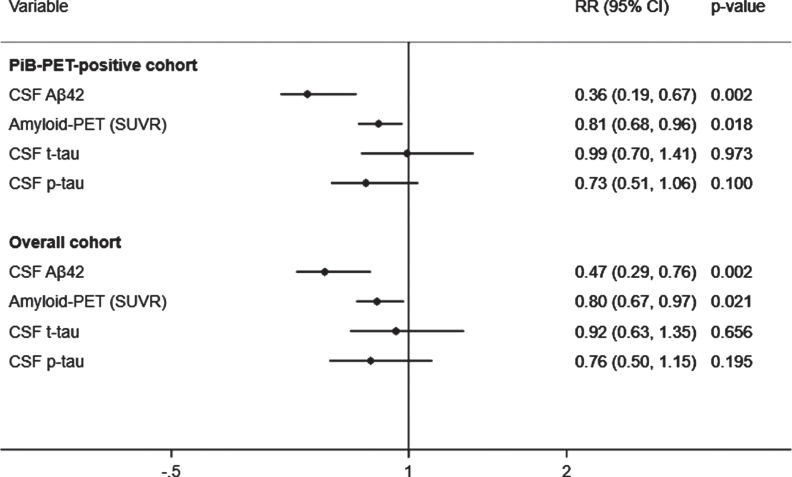
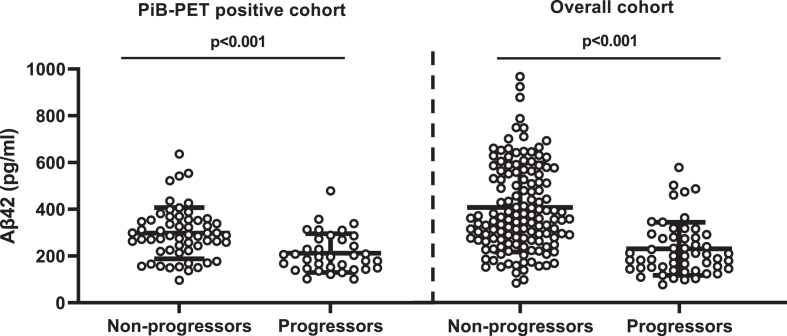
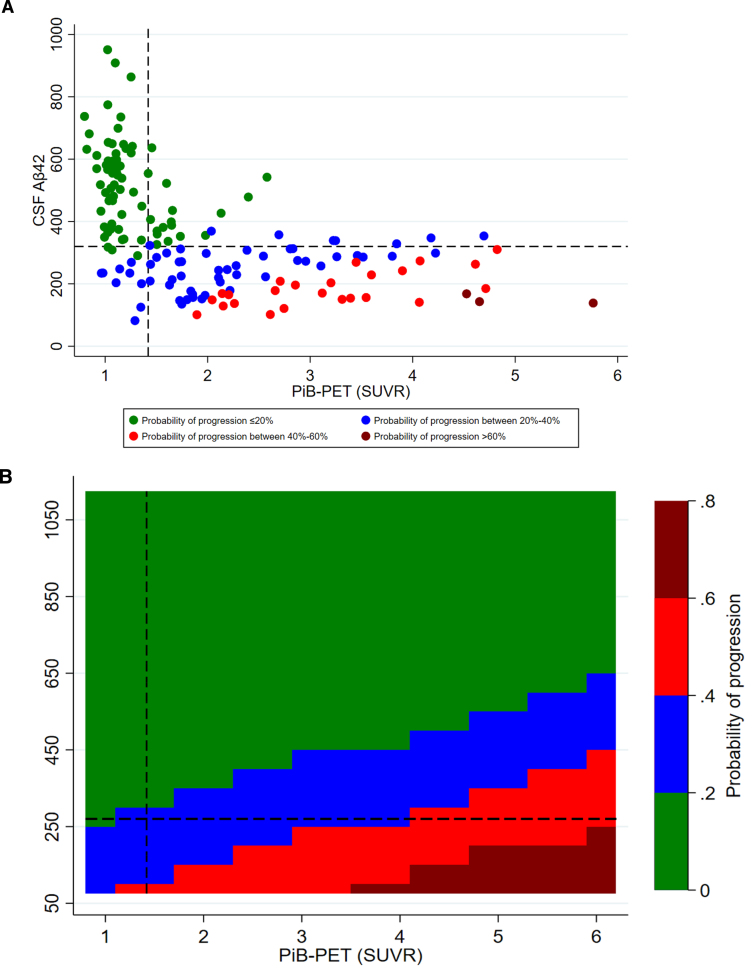
Results: Of 232 mutation carriers, 108 were PiB-PET-positive at baseline, with 43 (39.8%) meeting criteria for progression after 3.3±2.0 years. Soluble Aβ42 levels were higher among CDR non-progressors than CDR progressors. Higher Aβ42 predicted a lower risk of progression (adjusted RR, 0.36; 95% confidence interval [CI], 0.19-0.67; p = 0.002) better than lower SUVR (RR, 0.81; 95% CI, 0.68-0.96; p = 0.018). CSF Aβ42 levels predicting lower risk of progression increased with higher SUVR levels.
Conclusion: High CSF Aβ42 levels predict normal cognition in amyloid-positive individuals with AD-causing genetic mutations.
Keywords: Alzheimer’s disease; FDG-PET; amyloid-β; atrophy; cognition.
Conflict of interest statement
Authors’ disclosures available online (
Figures
References
-
- Bateman RJ, Xiong C, Benzinger TL, Fagan AM, Goate A, Fox NC, Marcus DS, Cairns NJ, Xie X, Blazey TM, Holtzman DM, Santacruz A, Buckles V, Oliver A, Moulder K, Aisen PS, Ghetti B, Klunk WE, McDade E, Martins RN, Masters CL, Mayeux R, Ringman JM, Rossor MN, Schofield PR, Sperling RA, Salloway S, Morris JC; Dominantly Inherited Alzheimer Network (2012) Clinical and biomarker changes in dominantly inherited Alzheimer’s disease, N Engl J Med 367, 795–804. Erratum in: N Engl J Med 367, 780. - PMC - PubMed
-
- Fagan AM, Mintun MA, Mach RH, Lee SY, Dence CS, Shah AR, LaRossa GN, Spinner ML, Klunk WE, Mathis CA, DeKosky ST, Morris JC, Holtzman DM (2006) Inverse relation between in vivo amyloid imaging load and cerebrospinal fluid Abeta42 in humans, Ann Neurol 59, 512–519. - PubMed
-
- Fagan AM, Henson RL, Li Y, Boerwinkle AH, Xiong C, Bateman RJ, Goate A, Ances BM, Doran E, Christian BT, Lai F, Rosas HD, Schupf N, Krinsky-McHale S, Silverman W, Lee JH, Klunk WE, Handen BL, Allegri RF, Chhatwal JP, Day GS, Graff-Radford NR, Jucker M, Levin J, Martins RN, Masters CL, Mori H, Mummery CJ, Niimi Y, Ringman JM, Salloway S, Schofield PR, Shoji M, Lott IT; Alzheimer’s Biomarker Consortium–Down Syndrome; Dominantly Inherited Alzheimer Network (2021) Comparison of CSF biomarkers in Down syndrome and autosomal dominant Alzheimer’s disease: A cross-sectional study, Lancet Neurol 21, 615–626. Erratum in: Lancet Neurol 2022; 21, e7. - PMC - PubMed
-
- McDade E, Wang G, Gordon BA, Hassenstab J, Benzinger TLS, Buckles V, Fagan AM, Holtzman DM, Cairns NJ, Goate AM, Marcus DS, Morris JC, Paumier K, Xiong C, Allegri R, Berman SB, Klunk W, Noble J, Ringman J, Ghetti B, Farlow M, Sperling RA, Chhatwal J, Salloway S, Graff-Radford NR, Schofield PR, Masters C, Rossor MN, Fox NC, Levin J, Jucker M, Bateman RJ; Dominantly Inherited Alzheimer Network (2018) Longitudinal cognitive and biomarker changes in dominantly inherited Alzheimer disease, Neurology 91, e1295–e1306. - PMC - PubMed
-
- Espay AJ, Sturchio A, Schneider LS, Ezzat K (2021) Soluble amyloid-β consumption in Alzheimer’s disease, J Alzheimers Dis 82, 1403–1415. - PubMed
Publication types
MeSH terms
Substances
Grants and funding
LinkOut - more resources
Full Text Sources
Medical
