Dynamics of the Gut Microbiome in Shigella-Infected Children during the First Two Years of Life
- PMID: 36121169
- PMCID: PMC9600951
- DOI: 10.1128/msystems.00442-22
Dynamics of the Gut Microbiome in Shigella-Infected Children during the First Two Years of Life
Abstract
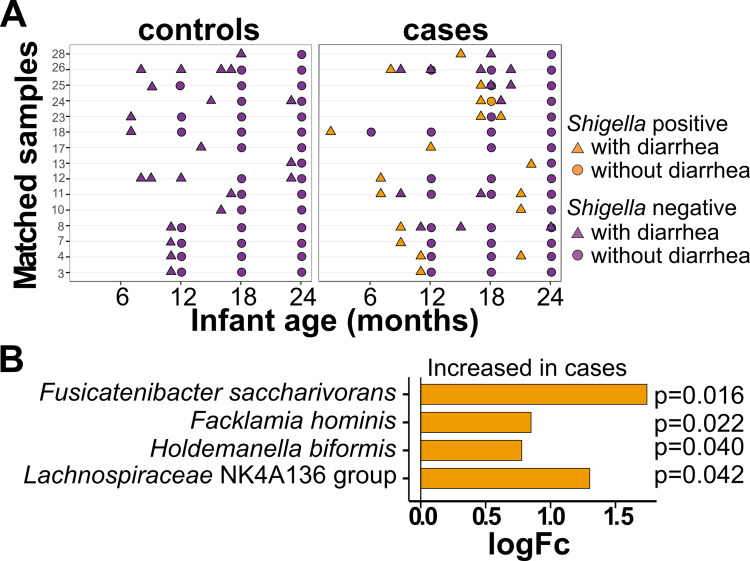
Shigella continues to be a major contributor to diarrheal illness and dysentery in children younger than 5 years of age in low- and middle-income countries. Strategies for the prevention of shigellosis have focused on enhancing adaptive immunity. The interaction between Shigella and intrinsic host factors, such as the microbiome, remains unknown. We hypothesized that Shigella infection would impact the developing microbial community in infancy and, conversely, that changes in the gastrointestinal microbiome may predispose infections. To test this hypothesis, we characterized the gastrointestinal microbiota in a longitudinal birth cohort from Malawi that was monitored for Shigella infection using 16S rRNA amplicon sequencing. Children with at least one Shigella quantitative polymerase chain reaction (qPCR) positive sample during the first 2 years of life (cases) were compared to uninfected controls that were matched for sex and age. Overall, the microbial species diversity, as measured by the Shannon diversity index, increased over time, regardless of case status. At early time points, the microbial community was dominated by Bifidobacterium longum and Escherichia/Shigella. A greater abundance of Prevotella 9 and Bifidobacterium kashiwanohense was observed at 2 years of age. While no single species was associated with susceptibility to Shigella infection, significant increases in Lachnospiraceae NK4A136 and Fusicatenibacter saccharivorans were observed following Shigella infection. Both taxa are in the family Lachnospiraceae, which are known short-chain fatty acid producers that may improve gut health. Our findings identified temporal changes in the gastrointestinal microbiota associated with Shigella infection in Malawian children and highlight the need to further elucidate the microbial communities associated with disease susceptibility and resolution. IMPORTANCE Shigella causes more than 180 million cases of diarrhea globally, mostly in children living in poor regions. Infection can lead to severe health impairments that reduce quality of life. There is increasing evidence that disruptions in the gut microbiome early in life can influence susceptibility to illnesses. A delayed or impaired reconstitution of the microbiota following infection can further impact overall health. Aiming to improve our understanding of the interaction between Shigella and the developing infant microbiome, we investigated changes in the gut microbiome of Shigella-infected and uninfected children over the course of their first 2 years of life. We identified species that may be involved in recovery from Shigella infection and in driving the microbiota back to homeostasis. These findings support future studies into the elucidation of the interaction between the microbiota and enteric pathogens in young children and into the identification of potential targets for prevention or treatment.
Keywords: Shigella; gut microbiome; infant microbiome.
Conflict of interest statement
The authors declare no conflict of interest.
Figures


References
-
- Collaborators GBDCoD. 2018. Global, regional, and national age-sex-specific mortality for 282 causes of death in 195 countries and territories, 1980-2017: a systematic analysis for the Global Burden of Disease Study 2017. Lancet 392:1736–1788. doi: 10.1016/S0140-6736(18)32203-7. - DOI - PMC - PubMed
-
- Kotloff KL, Nataro JP, Blackwelder WC, Nasrin D, Farag TH, Panchalingam S, Wu Y, Sow SO, Sur D, Breiman RF, Faruque AS, Zaidi AK, Saha D, Alonso PL, Tamboura B, Sanogo D, Onwuchekwa U, Manna B, Ramamurthy T, Kanungo S, Ochieng JB, Omore R, Oundo JO, Hossain A, Das SK, Ahmed S, Qureshi S, Quadri F, Adegbola RA, Antonio M, Hossain MJ, Akinsola A, Mandomando I, Nhampossa T, Acacio S, Biswas K, O'Reilly CE, Mintz ED, Berkeley LY, Muhsen K, Sommerfelt H, Robins-Browne RM, Levine MM. 2013. Burden and aetiology of diarrhoeal disease in infants and young children in developing countries (the Global Enteric Multicenter Study, GEMS): a prospective, case-control study. Lancet 382:209–222. doi: 10.1016/S0140-6736(13)60844-2. - DOI - PubMed
-
- Liu J, Platts-Mills JA, Juma J, Kabir F, Nkeze J, Okoi C, Operario DJ, Uddin J, Ahmed S, Alonso PL, Antonio M, Becker SM, Blackwelder WC, Breiman RF, Faruque AS, Fields B, Gratz J, Haque R, Hossain A, Hossain MJ, Jarju S, Qamar F, Iqbal NT, Kwambana B, Mandomando I, McMurry TL, Ochieng C, Ochieng JB, Ochieng M, Onyango C, Panchalingam S, Kalam A, Aziz F, Qureshi S, Ramamurthy T, Roberts JH, Saha D, Sow SO, Stroup SE, Sur D, Tamboura B, Taniuchi M, Tennant SM, Toema D, Wu Y, Zaidi A, Nataro JP, Kotloff KL, Levine MM, Houpt ER. 2016. Use of quantitative molecular diagnostic methods to identify causes of diarrhoea in children: a reanalysis of the GEMS case-control study. Lancet 388:1291–1301. doi: 10.1016/S0140-6736(16)31529-X. - DOI - PMC - PubMed
Publication types
MeSH terms
Substances
Grants and funding
- 1UL1TR003098/HHS | NIH | National Center for Advancing Translational Sciences (NCATS)
- U19 AI110820/AI/NIAID NIH HHS/United States
- T32DK067872/HHS | NIH | National Institute of Diabetes and Digestive and Kidney Diseases (NIDDK)
- R01AI117734/HHS | NIH | National Institute of Allergy and Infectious Diseases (NIAID)
- R01 AI125841/AI/NIAID NIH HHS/United States
LinkOut - more resources
Full Text Sources