Efficacy of Transcendental Meditation to Reduce Stress Among Health Care Workers: A Randomized Clinical Trial
- PMID: 36121655
- PMCID: PMC9486450
- DOI: 10.1001/jamanetworkopen.2022.31917
Efficacy of Transcendental Meditation to Reduce Stress Among Health Care Workers: A Randomized Clinical Trial
Abstract
Importance: Health care workers (HCWs) have been experiencing substantial stress and burnout, and evidence-based mitigation strategies are needed. Transcendental Meditation (TM) is a mantra meditation practice with potential efficacy in reducing stress.
Objective: To assess the efficacy of TM practice in reducing stress among HCWs over a 3-month period.
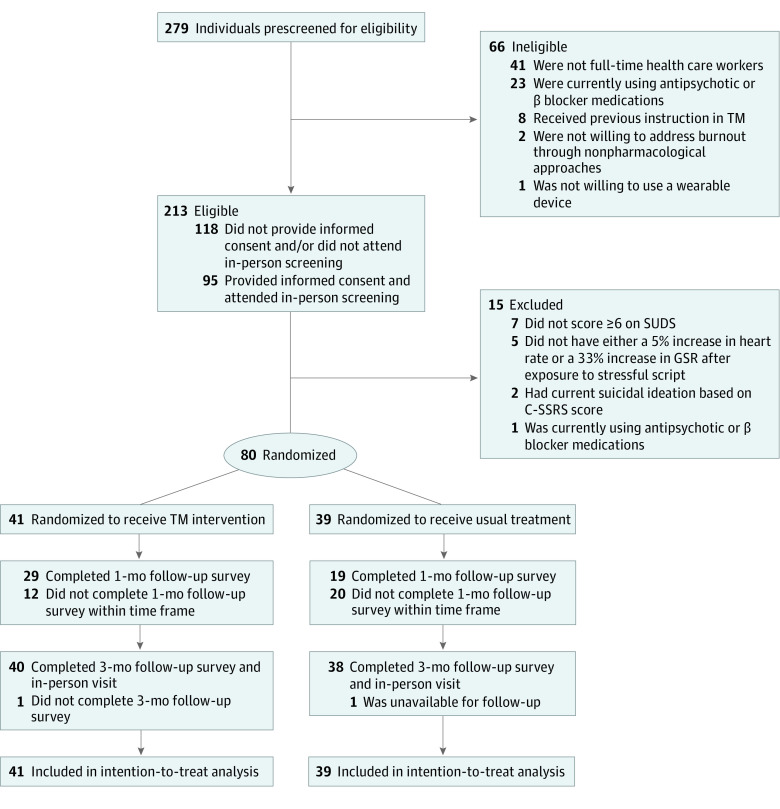
Design, setting, and participants: This single-center open-label randomized clinical trial was conducted among HCWs at an academic medical center from November 19, 2020, to August 31, 2021. Inclusion criteria comprised a score of 6 points or greater on the Subjective Units of Distress Scale and an increase of 5% or greater in baseline heart rate or an increase of 33% or greater in galvanic skin response after exposure to a stressful script. Exclusion criteria included the use of antipsychotic or β blocker medications, current suicidal ideation, or previous TM training. Of 213 HCWs who participated in prescreening, 95 attended in-person visits, resulting in 80 eligible participants who were randomized to receive a TM intervention (TM group) or usual treatment (control group).
Interventions: The TM group practiced TM for 20 minutes twice daily over a 3-month period. The control group received usual treatment, which consisted of access to wellness resources.
Main outcomes and measures: The primary outcome was change in acute psychological distress measured by the Global Severity Index. Secondary outcomes included changes in burnout (measured by the Maslach Burnout Inventory), insomnia (measured by the Insomnia Severity Index), and anxiety (measured by the Generalized Anxiety Disorder-7 scale).
Results: Among 80 participants, 66 (82.5%) were women, with a mean (SD) age of 40 (11) years. One participant (1.3%) was American Indian or Alaska Native, 5 (6.3%) were Asian, 12 (15.0%) were Black, 59 (73.8%) were White, and 3 (3.8%) were of unknown or unreported race; 4 participants (5.0%) were Hispanic, and 76 (95.0%) were non-Hispanic. A total of 41 participants were randomized to the TM group, and 39 were randomized to the control group. Participants in the TM group did not show a statistically significant decrease in psychological distress on the Global Severity Index compared with those in the control group (-5.6 points vs -3.8 points; between-group difference, -1.8 points; 95% CI, -4.2 to 0.6 points; P = .13). Compared with the control group, the TM group had significantly greater reductions in the secondary end points of emotional exhaustion (Maslach Burnout Inventory subscore: -8.0 points vs -2.6 points; between-group difference, -5.4 points; 95% CI, -9.2 to -1.6 points; P = .006), insomnia (Insomnia Severity Scale score: -4.1 points vs -1.9 points; between-group difference, -2.2 points; 95% CI, -4.4 to 0 points; P = .05), and anxiety (Generalized Anxiety Disorder-7 score: -3.1 points vs -0.9 points; between-group difference, -2.2 points; 95% CI, -3.8 to -0.5; P = .01) at 3 months. A total of 38 participants (92.7%) in the TM group adhered to home practice.
Conclusions and relevance: In this randomized clinical trial, TM practice among HCWs over a 3-month period did not result in a statistically significant reduction in the primary outcome of acute psychological distress compared with usual treatment but significantly improved the secondary outcomes of burnout, anxiety, and insomnia. These findings suggest that TM may be a safe and effective strategy to alleviate chronic stress among HCWs.
Trial registration: ClinicalTrials.gov identifier: NCT04632368.
Conflict of interest statement
Figures
References
-
- Pearl R. Physician burnout is increasing, gender inequality is making it worse. Forbes. April 26, 2022. Accessed August 12, 2022. https://www.forbes.com/sites/robertpearl/2022/04/26/physician-burnout-is...
-
- World Health Organization . Burn-out an “occupational phenomenon: International Classification of Diseases. World Health Organization. May 28, 2019. Accessed April 12, 2022. https://www.who.int/news/item/28-05-2019-burn-out-an-occupational-phenom...