


PhaSepDB in 2022: annotating phase separation-related proteins with droplet states, co-phase separation partners and other experimental information
- PMID: 36124686
- PMCID: PMC9825587
- DOI: 10.1093/nar/gkac783
PhaSepDB in 2022: annotating phase separation-related proteins with droplet states, co-phase separation partners and other experimental information
Abstract
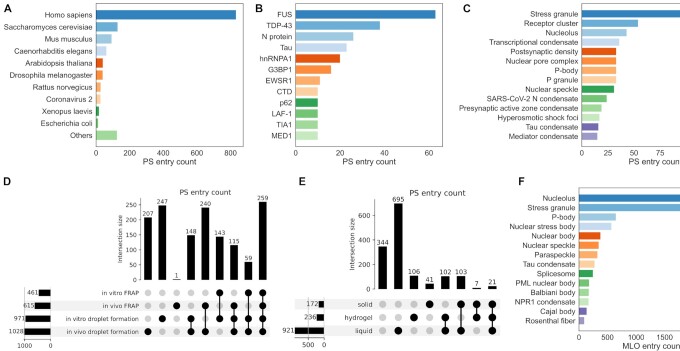
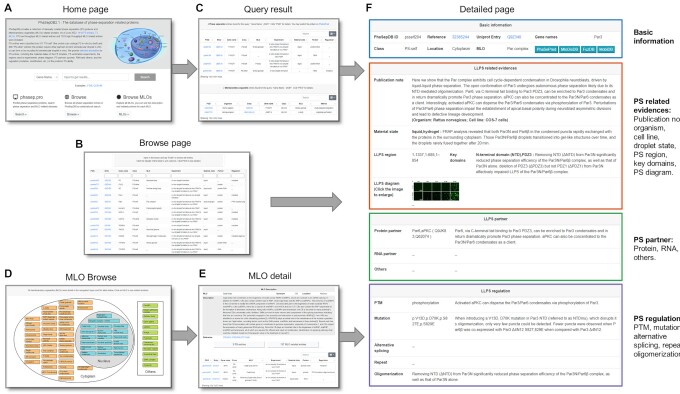
Phase separation (PS) proteins form droplets to regulate myriad membraneless organelles (MLOs) and cellular pathways such as transcription, signaling transduction and protein degeneration. PS droplets are usually liquid-like and can convert to hydrogel/solid-like under certain conditions. The PS behavior of proteins is regulated by co-PS partners and mutations, modifications, oligomerizations, repeat regions and alternative splicing of the proteins. With growing interest in PS condensates and associated proteins, we established PhaSepDB 1.0, which provided experimentally verified PS proteins and MLO-related proteins. The past few years witnessed a surge in PS-related research works; thus, we kept updating PhaSepDB. The current PhaSepDB contains 1419 PS entries, 770 low-throughput MLO-related entries and 7303 high-throughput MLO-related entries. We provided more detailed annotations of PS proteins, including PS verification experiments, regions used in experiments, phase diagrams of different experimental conditions, droplet states, co-PS partners and PS regulatory information. We believe that researchers can go further in studying PS proteins with the updated PhaSepDB (http://db.phasep.pro/).
© The Author(s) 2022. Published by Oxford University Press on behalf of Nucleic Acids Research.
Figures
References
-
- Zhang H., Ji X., Li P., Liu C., Lou J., Wang Z., Wen W., Xiao Y., Zhang M., Zhu X.. Liquid–liquid phase separation in biology: mechanisms, physiological functions and human diseases. Sci. China Life Sci. 2020; 63:953–985. - PubMed
Publication types
MeSH terms
Substances
LinkOut - more resources
Full Text Sources
Miscellaneous
