. 2022 Sep 20;12(1):15682.
doi: 10.1038/s41598-022-20030-z.

Diagnostic accuracy and safety of CT-guided percutaneous lung biopsy with a coaxial cutting needle for the diagnosis of lung cancer in patients with UIP pattern

Affiliations

Diagnostic accuracy and safety of CT-guided percutaneous lung biopsy with a coaxial cutting needle for the diagnosis of lung cancer in patients with UIP pattern

Da Young Kim et al. Sci Rep. .

Abstract

This study aimed to assess the diagnostic accuracy and safety of CT-guided percutaneous core needle biopsy (PCNB) with a coaxial needle for the diagnosis of lung cancer in patients with an usual interstitial pneumonia (UIP) pattern of interstitial lung disease. This study included 70 patients with UIP and suspected to have lung cancer. CT-guided PCNB was performed using a 20-gauge coaxial cutting needle. The diagnostic accuracy, sensitivity, specificity, and percentage of nondiagnostic results for PCNB were determined in comparison with the final diagnosis. PCNB-related complications were evaluated. Additionally, the risk factors for nondiagnostic results and pneumothorax were analyzed. The overall diagnostic accuracy, sensitivity, and specificity were 85.7%, 85.5%, and 87.5%, respectively. The percentage of nondiagnostic results was 18.6% (13/70). Two or less biopsy sampling was a risk factor for nondiagnostic results (p = 0.003). The overall complication rate was 35.7% (25/70), and pneumothorax developed in 22 patients (31.4%). A long transpulmonary needle path was a risk factor for the development of pneumothorax (p = 0.007). CT-guided PCNB using a coaxial needle is an effective method with reasonable accuracy and an acceptable complication rate for the diagnosis of lung cancer, even in patients with UIP.


Conflict of interest statement

The authors declare no competing interests.

Figures
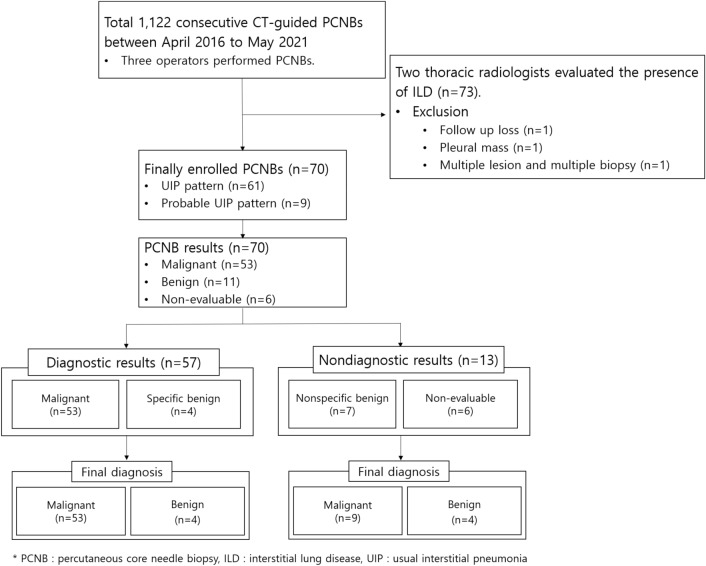
Figure 1
Figure 1
Patient flow diagram and pathology results of percutaneous core needle biopsies (PCNBs) in this study.
Figure 2
Figure 2
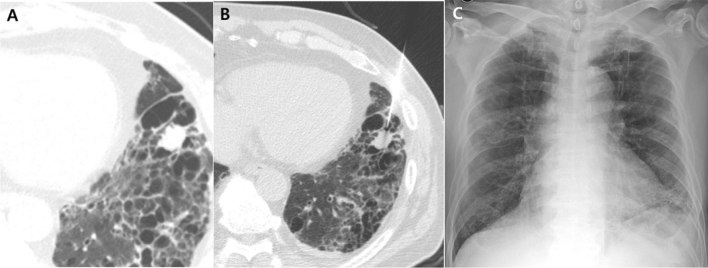
A 69-year-old male patient with idiopathic pulmonary fibrosis. The patient showed a 1.4-cm nodule in his right upper lobe (A). CT-guided percutaneous core needle biopsy (PCNB) was performed with the patient in the supine position. The length of the needle path (pleura to lesion) was 5.1 cm (B). Small cell carcinoma was confirmed through PCNB. He presented with pneumothorax after PCNB on follow-up radiography (C).
Figure 3
Figure 3
A 67-year-old male patient with underlying idiopathic pulmonary fibrosis. The patient showed a 1.6-cm irregular nodule in his left lower lobe (A). CT-guided percutaneous core needle biopsy (PCNB) was performed with the patient in the supine position. The needle traversed the honeycomb cysts (B). There was no complication after PCNB (C). Squamous cell carcinoma was confirmed through PCNB.

References

    1. Lynch DA, et al. Idiopathic interstitial pneumonias: CT features. Radiology. 2005;236:10–21. doi: 10.1148/radiol.2361031674. - DOI - PubMed
    1. Adegunsoye A, et al. Computed tomography honeycombing identifies a progressive fibrotic phenotype with increased mortality across diverse interstitial lung diseases. Ann. Am. Thorac. Soc. 2019;16:580–588. doi: 10.1513/AnnalsATS.201807-443OC. - DOI - PMC - PubMed
    1. Salisbury ML, et al. Hypersensitivity pneumonitis: Radiologic phenotypes are associated with distinct survival time and pulmonary function trajectory. Chest. 2019;155:699–711. doi: 10.1016/j.chest.2018.08.1076. - DOI - PMC - PubMed
    1. Zamora-Legoff JA, Krause ML, Crowson CS, Ryu JH, Matteson EL. Progressive decline of lung function in rheumatoid arthritis-associated interstitial lung disease. Arthrit. Rheumatol. 2017;69:542–549. doi: 10.1002/art.39971. - DOI - PMC - PubMed
    1. Walsh SL, et al. Connective tissue disease related fibrotic lung disease: high resolution computed tomographic and pulmonary function indices as prognostic determinants. Thorax. 2014;69:216–222. doi: 10.1136/thoraxjnl-2013-203843. - DOI - PubMed