


Initial experience of radiofrequency ablation for the treatment of advanced haemorrhoidal disease
- PMID: 36127948
- PMCID: PMC9475478
- DOI: 10.5114/pg.2021.110011
Initial experience of radiofrequency ablation for the treatment of advanced haemorrhoidal disease
Abstract
Introduction: The ideal approach to the management of haemorrhoidal disease (HD) remains to be elucidated. A procedure that returns the anal cushions to their normal size without destroying them or damaging the surrounding tissues is sought. Radiofrequency ablation (RFA) overcomes many of the disadvantages of the previously described repairs and may be a valuable alternative in the management of advanced HD.
Aim: To evaluate the efficacy and outcomes of the Rafaelo® technique for treatment of HD.
Material and methods: A retrospective observational study was carried out between June 2019 and October 2020. The haemorrhoidal severity score (HSS), the Cleveland Incontinence Score (CIS), and the visual analogue scale (VAS) for pain were compared prior to and post procedure using a paired t-test.
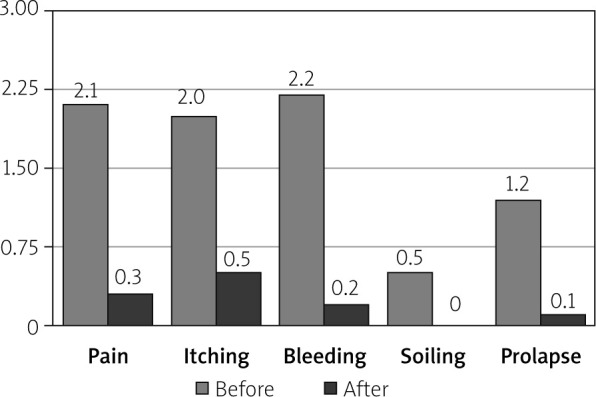
Results: Forty-seven patients were included in the study, with a mean age of 43 years. All individual symptom scores of HSS showed statistically significant improvement post RFA (p < 0.05). Minor complications like urinary retention (6.3%) and bleeding (12%) were noted. There were 2 instances of recurrence at 2 months. No major complications like anal stenosis or infections were observed.
Conclusions: The RFA technique is a safe and effective treatment alternative for advanced HD. It results in a statistically significant improvement in the symptoms of HD and is associated with minimal discomfort to the patient with early return to normal activity.
Keywords: Haemorrhoidal Severity Score; Rafaelo®; haemorrhoids; radiofrequency ablation.
Copyright © 2022 Termedia.
Conflict of interest statement
The Rafaelo® equipment was provided to our hospital free of cost by F Care Systems, Antwerp, Belgium. However, the authors had full control of the primary data and study design. The authors declare no conflict of interest.
Figures


References
-
- Riss S, Weiser FA, Schwameis K, et al. The prevalence of hemorrhoids in adults. Int J Colorectal Dis 2012; 27: 215-20. - PubMed
-
- Jacobs D. Hemorrhoids. N Engl J Med 2014; 371: 944-51. - PubMed
-
- Gupta PJ, Heda PS, Kalaskar S. Randomized controlled study between suture ligation and radio wave ablation and suture ligation of grade III symptomatic hemorrhoidal disease. Int J Colorectal Dis 2009; 24: 455-60. - PubMed
-
- Rivadeneira DE, Steele SR, Ternent C, et al. Practice parameters for the management of hemorrhoids. Dis Colon Rectum 2011; 54: 1059-64. - PubMed
-
- Altomare DF, Roveran A, Pecorella G, et al. The treatment of hemorrhoids: guidelines of the Italian Society of Colo-Rectal Surgery. Tech Coloproctol 2006; 10: 181-6. - PubMed
LinkOut - more resources
Full Text Sources
