Review
. 2022 Dec;13(1):1666-1680.
doi: 10.1080/21505594.2022.2127196.

Two-component systems regulate bacterial virulence in response to the host gastrointestinal environment and metabolic cues

Affiliations
Review

Two-component systems regulate bacterial virulence in response to the host gastrointestinal environment and metabolic cues

Claire Shaw et al. Virulence. 2022 Dec.

Abstract

Two-component systems are ubiquitous signaling mechanisms in bacteria that enable intracellular changes from extracellular cues. These bacterial regulatory systems couple external stimuli to control genetic expression via an autophosphorylation cascade that transduces membrane signals to intracellular locations, thereby allowing bacteria to rapidly adapt to the changing environmental conditions. Well known to control basic cellular processes, it is evident that two-component systems also exercise control over virulence traits, such as motility, secretion systems, and stress responses that impact the complex cascade of networks that alter virulence traits. In the gastrointestinal system, cues for activation of virulence-related two-component systems include metal ions, host-derived metabolites, and gut conditions. The diversity and origin of these cues suggest that the host can exert control over enteric pathogenicity via regulation in the gastrointestinal system. With the rise in multi-drug resistant pathogens, the potential control of pathogenicity with host cues via two-component systems presents a potential alternative to antimicrobials. Though the signaling mechanism itself is well studied, to date there is no systematic review compiling the host-associated cues of two-component systems and virulence traits. This review highlights the direct link between the host gastrointestinal environment and pathogenicity by focusing on two-component systems that are associated with the genetic expression of virulence traits, and that are activated by host-derived cues. The direct link between the host gastrointestinal environment, metabolites, and pathogenicity established in this review both underscores the importance of host-derived cues on bacterial activity and presents an enticing therapeutic target in the fight against antimicrobial resistant pathogens.

Keywords: Metabolic cross talk; enteric bacteria; host–microbe interaction; infection modulation; pathogenesis.


Conflict of interest statement

No potential conflict of interest was reported by the author(s).

Figures
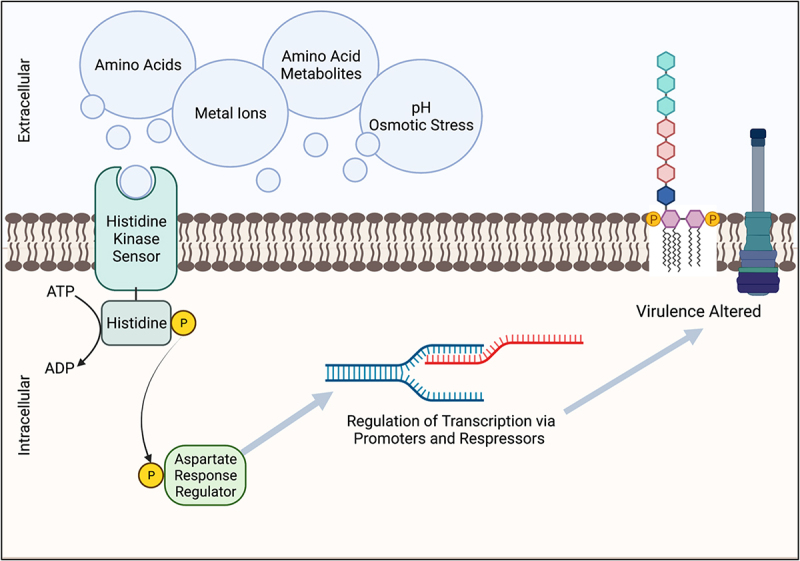
Figure 1.
Figure 1.
Two-component receptors systems (TCS) related to virulence can be modulated by host-derived metabolic products. Signaling molecules are sensed via the multidomain surface membrane protein histidine kinase (HK), which is then undergoes autophosphorylation. The phosphoryl group is then transferred to an intracellular aspartate residue response regulator (RR). Transcription of the corresponding genes is then repressed or activated, dependent upon the originating TCS and signal. Virulence factors controlled in part by TCSs include LPS modifications for decreased host detection and upregulation of type 3 secretion systems (T3SS).
Figure 2.
Figure 2.
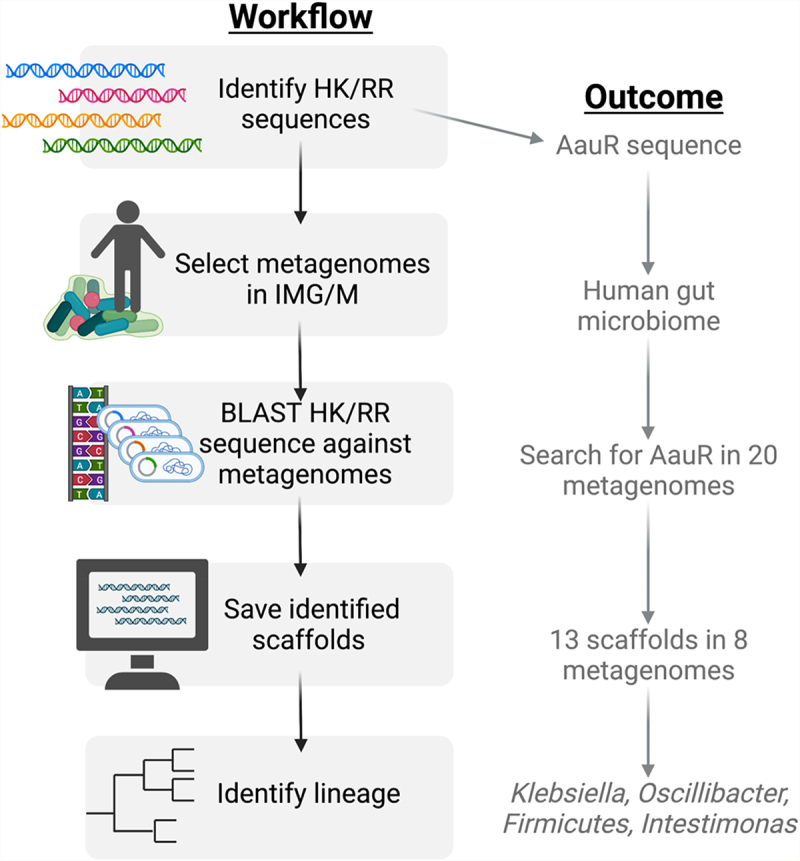
How to search for two-component systems in ecosystems via metagenome-specific BLAST. Known histidine kinase and response regulator sequences can be found via multiple genetic databases, including NCBI GenBank. Publicly available host and ecosystem-specific assembled metagenomes can be found on the Joint Genome Institute’s Integrated Microbial Genomes and Microbiomes (IMG/M) platform. BLAST searches with imported HK/RR sequences restricted to specific metagenomes can be done via the IMG/M platform. Search hits in the form of metagenome scaffolds can be saved and analysed for lineage and further analysis. This platform was used to search for the AauR response regulator in the human microbiome. 20 different human microbiome metagenomes were used as the search parameters, out of which 8 returned hits for the AauR regulator. The results were further narrowed into 4 different taxa: Klebsiella, Oscillibacter, Firmicutes, and Intestinimonas.

References

    1. Skerker JM, Prasol MS, Perchuk BS, et al. Two-component signal transduction pathways regulating growth and cell cycle progression in a bacterium: a system-level analysis. PLoS Biol. 2005;3(10):e334. DOI: 10.1371/journal.pbio.0030334 - DOI - PMC - PubMed
    1. Li YH, Lau PCY, Tang N, et al. Novel two-component regulatory system involved in biofilm formation and acid resistance in Streptococcus mutans. J Bacteriol. 2002;184(22):6333–6342. DOI: 10.1128/JB.184.22.6333-6342.2002 - DOI - PMC - PubMed
    1. Beier D, Gross R.. Regulation of bacterial virulence by two-component systems. Curr Opin Microbiol. 2006;9(2):143–152. - PubMed

    1. Mitrophanov AY, Groisman EA. Signal integration in bacterial two-component regulatory systems. Genes Dev. 2008;22(19):2601–2611. - PMC - PubMed
    1. Nowicki EM, O’Brien JP, Brodbelt JS, et al. Extracellular zinc induces phosphoethanolamine addition to Pseudomonas aeruginosa lipid a via the ColRS two-component system. Mol Microbiol. 2015;97(1):166–178. DOI: 10.1111/mmi.13018 - DOI - PMC - PubMed

Substances