


Prenatal exposure to a natural disaster and early development of psychiatric disorders during the preschool years: stress in pregnancy study
- PMID: 36129196
- PMCID: PMC10027622
- DOI: 10.1111/jcpp.13698
Prenatal exposure to a natural disaster and early development of psychiatric disorders during the preschool years: stress in pregnancy study
Abstract
Background: Growing evidence shows an association between in utero exposure to natural disasters and child behavioral problems, but we still know little about the development of specific psychopathology in preschool-aged children.
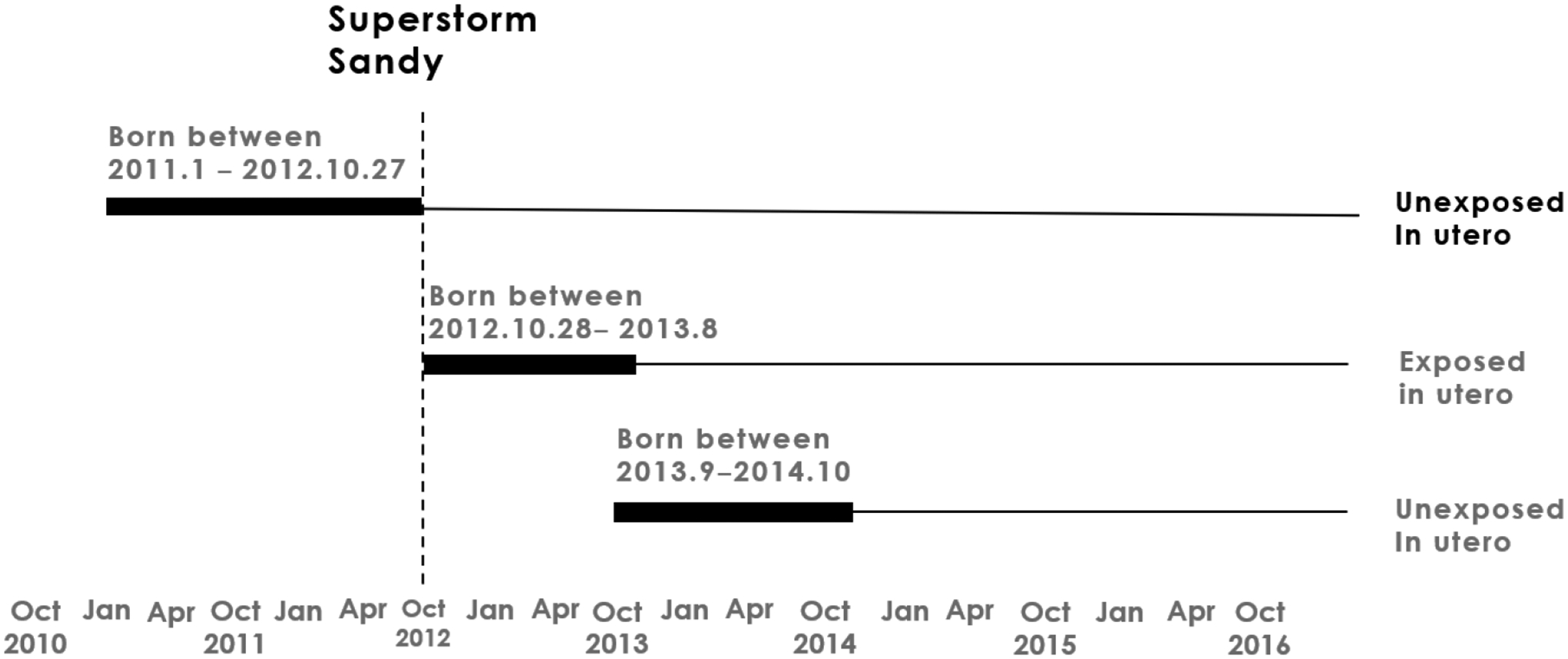
Methods: Preschool children (n = 163, mean age = 3.19, 85.5% racial and ethnic minorities) and their parents (n = 151) were evaluated annually at ages 2-5 to assess the emergence of psychopathology using the Preschool Age Psychopathological Assessment (PAPA), a parent-report structured diagnostic interview developed for preschool-age children. Sixty-six (40.5%) children were exposed to Sandy Storm (SS) in utero and 97 (59.5%) were not. Survival analysis evaluated patterns of onset and estimated cumulative risks of psychopathology among exposed and unexposed children, in total and by sex. Analyses were controlled for the severity of objective and subjective SS-related stress, concurrent family stress, and demographic and psychosocial confounders, such as maternal age, race, SES, maternal substance use, and normative prenatal stress.
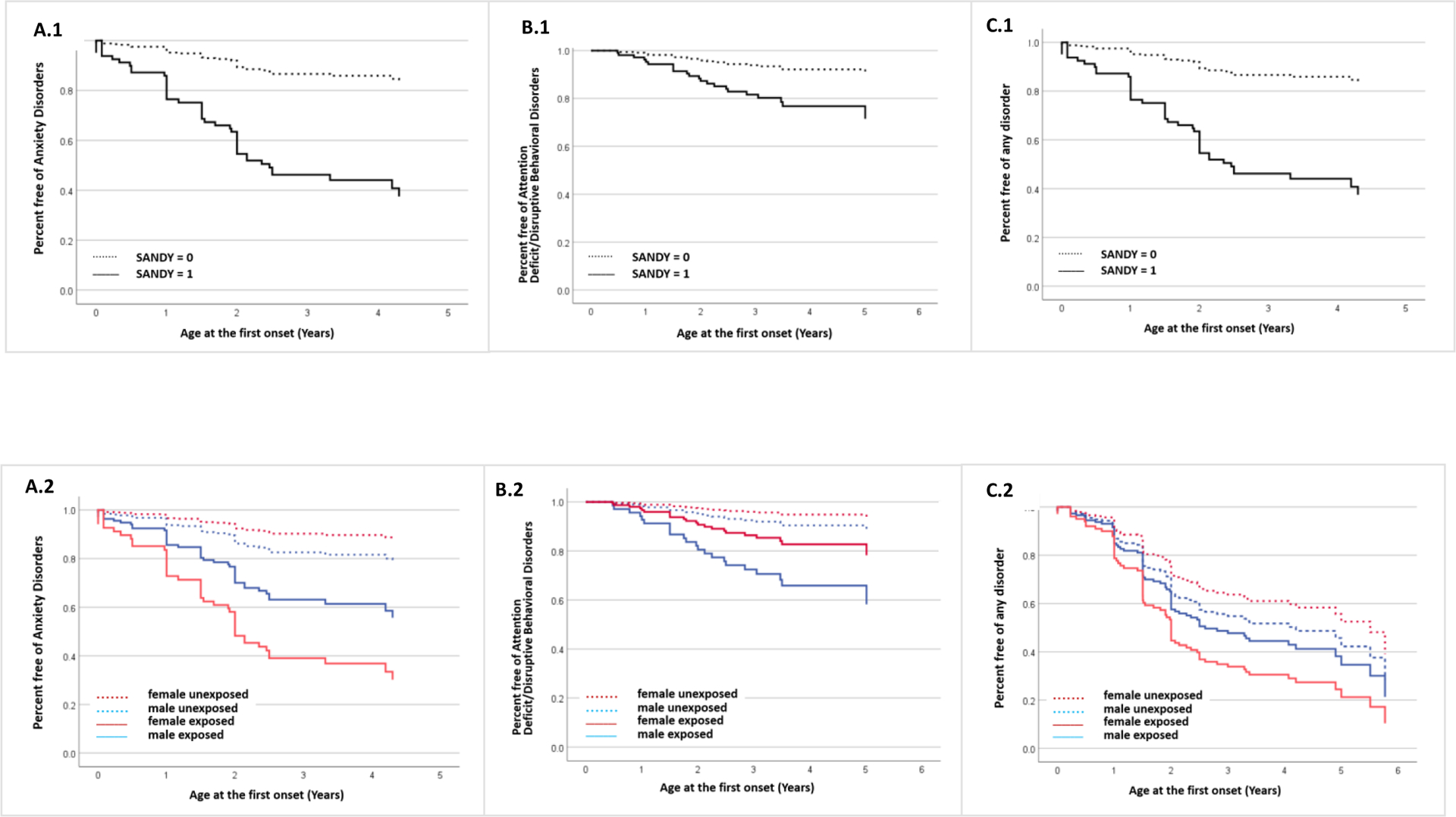
Results: Exposure to SS in utero was associated with a substantial increase in depressive disorders (Hazard Ratio (HR) = 16.9, p = .030), anxiety disorders (HR = 5.1, p < .0001), and attention-deficit/disruptive behavioral disorders (HR = 3.4, p = .02). Diagnostic rates were elevated for generalized anxiety disorder (GAD; HR = 8.5, p = .004), attention-deficit/hyperactivity disorder (ADHD; HR = 5.5, p = .01), oppositional-defiant disorder (ODD; HR = 3.8, p = .05), and separation-anxiety disorder (SAD; HR = 3.5, p = .001). Males had distinctively elevated risks for attention-deficit/disruptive behavioral disorders (HR = 7.8, p = .02), including ADHD, CD, and ODD, whereas females had elevated risks for anxiety disorders (HR = 10.0, p < .0001), phobia (HR = 2.8, p = .02) and depressive disorders (HR = 30.0, p = .03), including SAD, GAD, and dysthymia.
Conclusions: The findings demonstrate that in utero exposure to a major weather-related disaster (SS) was associated with increased risk for psychopathology in children and provided evidence of distinct psychopathological outcomes as a function of sex. More attention is needed to understand specific parent, child, and environmental factors which account for this increased risk, and to develop mitigation strategies.
Keywords: Natural disasters; anxiety; developmental psychopathology; disruptive behavior; sex differences.
© 2022 Association for Child and Adolescent Mental Health.
Conflict of interest statement
Figures
Comment in
-
Commentary: Natural disaster studies on prenatal stress - moving forward - a commentary/reflection on Nomura et al. (2023).J Child Psychol Psychiatry. 2023 Jul;64(7):1092-1095. doi: 10.1111/jcpp.13763. Epub 2023 Feb 7. J Child Psychol Psychiatry. 2023. PMID: 36751877
-
Uncertainty in Developmental Origins of Health and Disease research: commentary on Nomura et al. (2023).J Child Psychol Psychiatry. 2023 Sep;64(9):1396-1398. doi: 10.1111/jcpp.13842. Epub 2023 Jun 1. J Child Psychol Psychiatry. 2023. PMID: 37264709 Free PMC article.
References
-
- Abidin RR. Parenting stress index (4th ed.). Lutz, FL: PAR. 2012.
-
- Barker DJP (1995). The Wellcome Foundation Lecture, 1994. The fetal origins of adult disease. Proceedings of the Royal Society of London. Series B: Biological Sciences, 262, 37–43. - PubMed
-
- Barker DJ, & Osmond C (1986). Infant mortality, childhood nutrition, and ischaemic heart disease in England and Wales. The Lancet, 327, 1077–1081. - PubMed
-
- Binder DA (1992). Fitting Cox’s proportional hazards models from survey data. Biometrika, 79, 139–147.
-
- Botting N, Powls A, Cooke RWI, & Marlow N (1997). Attention deficit hyperactivity disorders and other psychiatric outcomes in very low birthweight children at 12 years. Journal of Child Psychology and Psychiatry, 38, 931–941. - PubMed
Publication types
MeSH terms
Grants and funding
LinkOut - more resources
Full Text Sources
Medical
