. 2022 Oct 20;90(10):e0035522.
doi: 10.1128/iai.00355-22. Epub 2022 Sep 21.

A Co-Association of Streptococcus mutans and Veillonella parvula/dispar in Root Caries Patients and In Vitro Biofilms

Affiliations

A Co-Association of Streptococcus mutans and Veillonella parvula/dispar in Root Caries Patients and In Vitro Biofilms

Amber M Abram et al. Infect Immun. .

Abstract

Root caries in geriatric patients is a growing problem as more people are maintaining their natural teeth into advanced age. We determined the levels of various bacterial species previously implicated in root caries disease or health using quantitative real-time PCR in a pilot study of 7 patients with 1 to 4 root caries lesions per person. Levels of 12 different species on diseased roots compared to healthy (contralateral control) roots were measured. Four species were found at significantly higher levels on diseased roots (Streptococcus mutans, Veillonella parvula/dispar, Actinomyces naeslundii/viscosus, and Capnocytophaga granulosa) compared across all plaque samples. The level of colonization by these species varied dramatically (up to 1,000-fold) between patients, indicating different patients have different bacteria contributing to root caries disease. Neither of the two species previously reported to correlate with healthy roots (C. granulosa and Delftia acidovorans) showed statistically significant protective roles in our population, although D. acidovorans showed a trend toward higher levels on healthy teeth (P = 0.08). There was a significant positive correlation between higher levels of S. mutans and V. parvula/dispar on the same diseased teeth. In vitro mixed biofilm studies demonstrated that co-culturing S. mutans and V. parvula leads to a 50 to 150% increase in sucrose-dependent biofilm mass compared to S. mutans alone, depending on the growth conditions, while V. parvula alone did not form in vitro biofilms. The presence of V. parvula also decreased the acidification of S. mutans biofilms when grown in artificial saliva and enhanced the health of mixed biofilms.

Keywords: biofilms; metabolism; root caries.


Conflict of interest statement

The authors declare no conflict of interest.

Figures
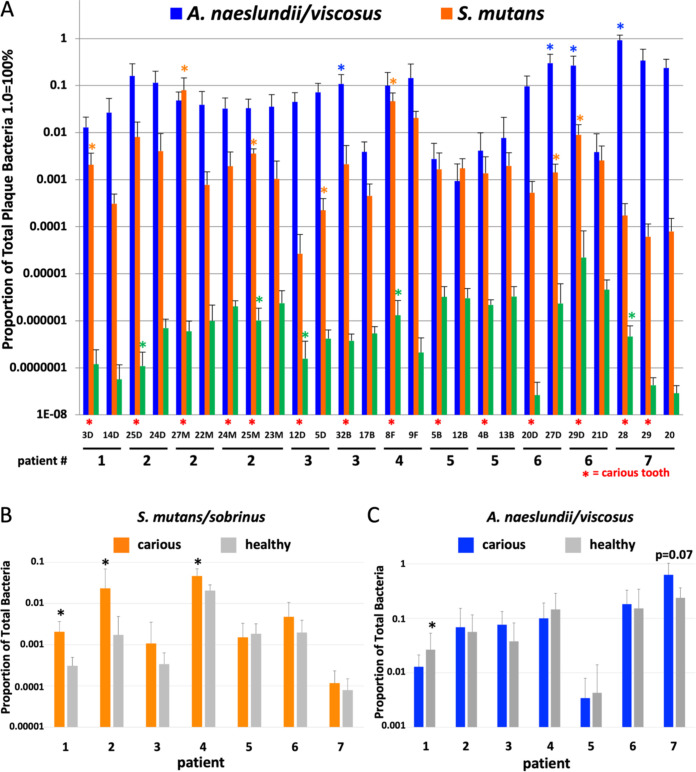
FIG 1
FIG 1
Reverse transcription-quantitative PCR (qRT-PCR) analysis of DNA isolated from plaque from seven root caries patients (n = 6 to 8). Five of seven teeth with increased S. mutans levels relative to their contralateral controls had caries. Three of four teeth with increased Actinomyces levels relative to their contralateral controls had caries. In general, Lactobacillus levels on all teeth were low, but in two cases, increased Lactobacillus casei levels correlated with caries. (A) Analysis of three species by tooth pair (carious and noncarious). (B and C) Analysis of S. mutans/sobrinus (B) or Actinomyces naeslundii/viscosus (C) by combining colonization levels of all carious or healthy teeth per patient. *, P ≤ 0.05 by Student’s t test (A) or Mann-Whitney test for multiple teeth per patient (B and C). Tooth numbers are shown in panel A. Tooth surfaces are represented as follows: D, distal; M, mesial; B, buccal; and F, facial.
FIG 2
FIG 2
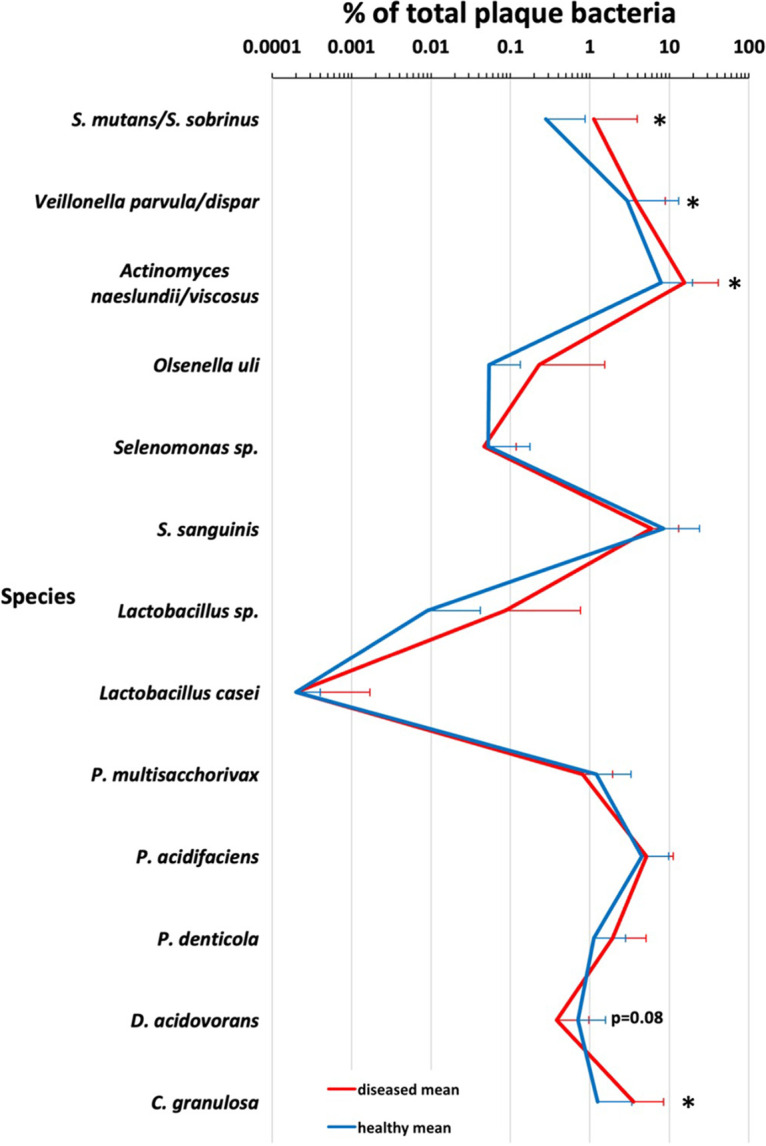
Four species tested showed a correlation between higher levels on teeth and caries, including S. mutans, A. naeslundii/viscosus, V. parvula/dispar, and C. granulosa. One species, D. acidovorans, showed a trend toward association with health (P = 0.08). *, P < 0.05 using Mann-Whitney multivariate logistic regression analysis to account for differences between patients. n = 6 to 10, except general Lactobacillus species, where n = 3 to 7.
FIG 3
FIG 3
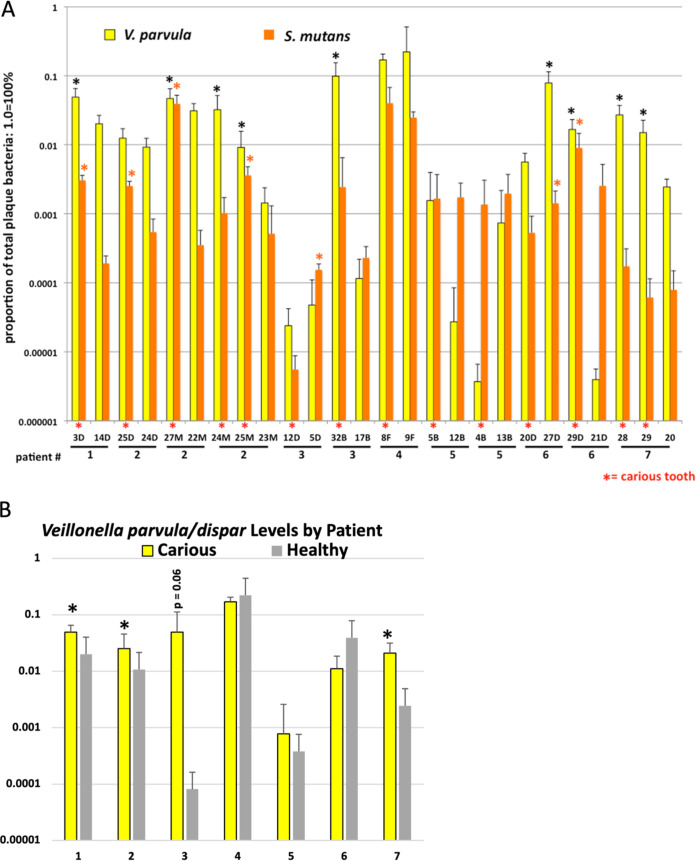
qPCR analysis of S. mutans and V. parvula/dispar in plaque-isolated DNA from seven root caries patients (n = 6 to 8). Given previous studies suggesting Veillonella species can be associated with increased caries risk or lower caries risk (20, 21), we sought to assess Veillonella levels in our root caries samples. In 8 out of 9 cases where one tooth was more highly colonized by Veillonella (shown with an asterisk), that tooth was carious. Furthermore, in 5 out of 8 cases, that higher level of Veillonella was associated with an increased level of S. mutans (shown with an asterisk). Data were analyzed by paired-tooth analysis (A) or as aggregates of carious or healthy teeth in each patient (B). *, P ≤ 0.05 by Student’s t test (A) and Mann-Whitney test for multiple teeth (B). Student’s t test was used in panel B if only one carious and one healthy tooth was present in the patient (patients 1 and 4).
FIG 4
FIG 4
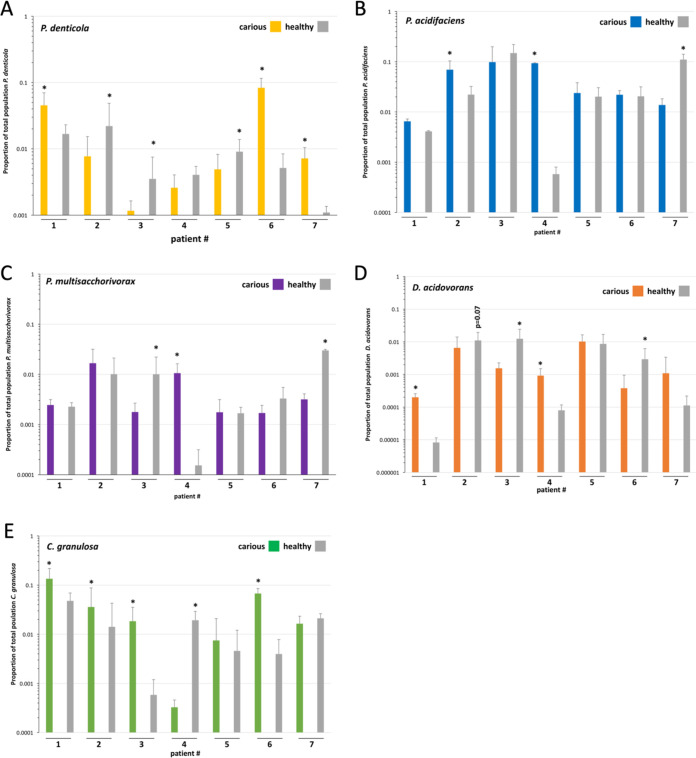
qPCR analysis of plaque-isolated DNA from seven root caries patients for Prevotella denticola (A), Propionibacterium acidifaciens (B), Prevotella multisaccharivorax (C), Delftia acidovorans (D), and Capnocytophaga granulosa (E) (n = 6). All data are presented as aggregates of carious or healthy tooth colonization levels per patient. Tooth pair analysis is shown in Fig. S5 in the supplemental material. *, P ≤ 0.05 by the Mann-Whitney test for multiple teeth and Student’s t test if only one carious and one healthy tooth was present in the patient (patients 1 and 4).
FIG 5
FIG 5
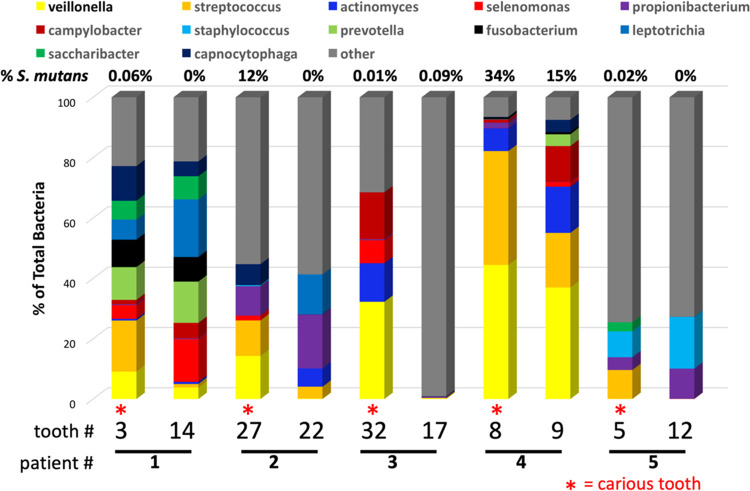
Microbiome analysis of 10 samples from patients 1 to 5. Following PCR amplification of the plaque DNA samples by using universal 16S rRNA primers, the entire 16S rRNA locus was sequenced and analyzed by Molecular Research DNA Analysis, Inc. Any genus that represented >5% of the total population in either the carious or health toothy was illustrated. A complete table of microbiome results at the genus and species levels of identification can be found in Table S3 in the supplemental material.
FIG 6
FIG 6
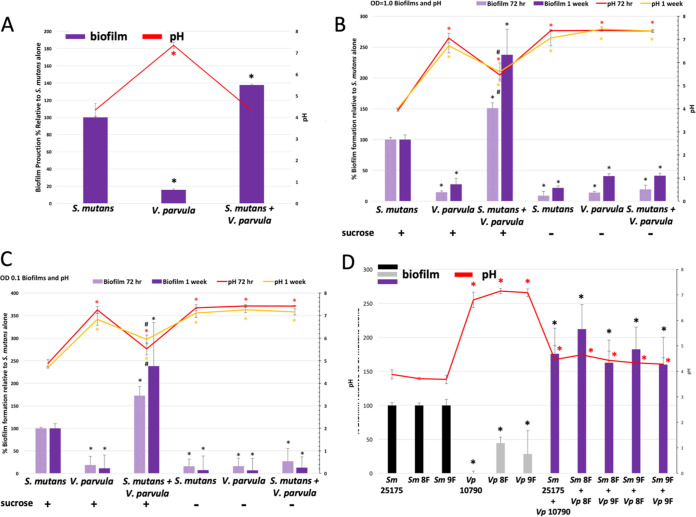
Co-culturing of S. mutans with V. parvula leads to enhanced biofilm formation. Cultures were grown for 24 h, 72 h, or 1 week in an anaerobic chamber prior to processing the biofilms and measuring the pH of the supernatants. Biofilms were formed in BB+ broth with 0.5% sucrose (A) or artificial saliva with 0.5% sucrose (B to D) (29). Bacteria were inoculated at a starting OD600 of 1.0 (A, B, and D) or 0.1 (C) by using S. mutans ATCC 25175 and V. parvula ATCC 10790. (D) S. mutans and V. parvula clinical isolates from patient 4 (teeth 8 and 9) were also assessed for biofilm formation and acidification. *, P ≤ 0.05 by Student’s t test.
FIG 7
FIG 7
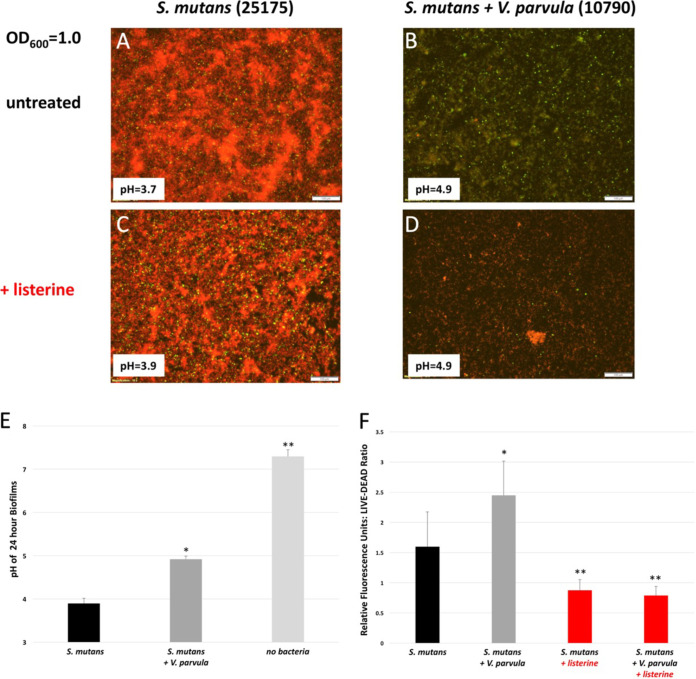
V. parvula enhances the health of S. mutans biofilms. S. mutans biofilms with or without V. parvula were initiated with cultures at an OD600 of 1.0 and grown for 24 h in artificial saliva with 0.5% sucrose. Biofilms were stained with SYTO 9 (green, live) and propidium iodide (red, dead) for LIVE/DEAD staining followed by fluorescence microscopy (A to D) or LIVE/DEAD ratio measurements in a plate reader (F). (E) pH levels from both microscope slide wells and 24-well plates were measured. As a control for dead cells, Listerine Naturals was used to kill biofilms for 10 min prior to imaging. The pH for individual wells used for imaging are shown as inserts to the image. (A to D) Shown are images from the same day, representative of results from 3 different days. pH measurements constitute measurements averaged from 16 wells over 8 experiments. (E) *, P < 0.01 relative to S. mutans 25175; **, P < 0.01 relative to S. mutans 25175 with V. parvula 10790 by Student’s t test. (F) *, P < 0.01 relative to S. mutans 25175; **, P < 0.01 relative to S. mutans 25175 or S. mutans 25175 with V. parvula 10790 without Listerine by Student’s t test.

References

    1. Hoppenbrouwers PM, Driessens FC, Borggreven JM. 1987. The mineral solubility of human tooth roots. Arch Oral Biol 32:319–322. 10.1016/0003-9969(87)90085-9. - DOI - PubMed
    1. Takahashi N, Nyvad B. 2016. Ecological hypothesis of dentin and root caries. Caries Res 50:422–431. 10.1159/000447309. - DOI - PubMed
    1. de Soet JJ, Nyvad B, Kilian M. 2000. Strain-related acid production by oral streptococci. Caries Res 34:486–490. 10.1159/000016628. - DOI - PubMed
    1. Zambon JJ, Kasprzak SA. 1995. The microbiology and histopathology of human root caries. Am J Dent 8:323–328. - PubMed
    1. Fure S, Romaniec M, Emilson CG, Krasse B. 1987. Proportions of Streptococcus mutans, lactobacilli and Actinomyces spp in root surface plaque. Scand J Dent Res 95:119–123. 10.1111/j.1600-0722.1987.tb01817.x. - DOI - PubMed

Publication types

Supplementary concepts

LinkOut - more resources