. 2023 Feb 1;44(2):559-570.
doi: 10.1002/hbm.26084. Epub 2022 Sep 21.

The salience network is activated during self-recognition from both first-person and third-person perspectives

Affiliations

The salience network is activated during self-recognition from both first-person and third-person perspectives

Shoko Asakage et al. Hum Brain Mapp. .

Abstract

We usually observe ourselves from two perspectives. One is the first-person perspective, which we perceive directly with our own eyes, and the other is the third-person perspective, which we observe ourselves in a mirror or a picture. However, whether the self-recognition associated with these two perspectives has a common or separate neural basis remains unclear. To address this, we used functional magnetic resonance imaging to examine brain activity while participants viewed pretaped video clips of themselves and others engaged in meal preparation taken from first-person and third-person perspectives. We found that the first-person behavioral videos of the participants and others induced greater activation in the premotor-intraparietal region. In contrast, the third-person behavioral videos induced greater activation in the default mode network compared with the first-person videos. Regardless of the perspective, the videos of the participants induced greater activation in the salience network than the videos of others. On the other hand, the videos of others induced greater activation in the precuneus and lingual gyrus than the videos of the participants. These results suggest that the salience network is commonly involved in self-recognition from both perspectives, even though the brain regions involved in action observation for the two perspectives are distinct.

Keywords: first-person perspective; precuneus; salience network; self-recognition; third-person perspective.


Conflict of interest statement

The author declares that there is no conflict of interest that could be perceived as prejudicing the impartiality of the research reported.

Figures

FIGURE 1
FIGURE 1
Experimental stimuli and behavioral results. (a) Video clips of the participant and other people preparing food, filmed from their own (first‐person) and third‐person perspectives. (b) Histogram of the correct response rate in self–other discrimination task. SF, ST, OF, and OT represent self‐images with a first‐person perspective, images of others with a first‐person perspective, self‐images with a third‐person perspective, and images of others with a third‐person perspective, respectively. (c) Histogram of the number of correct responses to the questions about meal preparation (three questions) for self and others' videos.
FIGURE 2
FIGURE 2
Brain regions exhibiting differences in activation between the first‐person and third‐person perspectives. (a) Brain regions showing greater activation when viewing the video clip taken from the third‐person perspective versus the first‐person perspective (hot colors, ST and OT > SF and OF), and the first‐person perspective versus the third‐person perspective (cool colors, SF and OF > ST and OT). The colored bars represent voxel‐level t‐values (FWEc p < .05, voxel level p < .001). (b) The mean time course of signal intensity in each ROI in response to each condition. AG, angular gyrus; mPFC, medial prefrontal cortex; PCC, posterior cingulate cortex; SPL, superior parietal lobe. (c) Mean beta value in each ROI for each condition. The error bars represent standard error. OF, video clips of others from a first‐person perspective; OT, video clips of others from a third‐person perspective; ROI, region of interest; SF, video clips of the self from a first‐person perspective; ST, video clips of the self from a third‐person perspective
FIGURE 3
FIGURE 3
Brain regions exhibiting a difference in activation between video clips of the participant versus other individuals. (a) Brain regions showing greater activation when participants viewed the video clip of themselves versus others (hot colors, SF and ST > OF and OT), and of others versus themselves (cool colors, OF and OT > SF and ST). The colored bars represent voxel‐level t‐values (FWEc p < .05, voxel‐level p < .001). (b) Mean time courses of signal intensity in each ROI in response to each condition. AI, Anterior insular; dACC, dorsal anterior cingulate cortex; SMG, superior marginal gyrus. (c) Mean beta value in each ROI for each condition. The error bars represent standard error. FWE, family wise error; FWEc, cluster‐level FWE; OF, video clips of others from a first‐person perspective; OT, video clips of others from a third‐person perspective; ROI, region of interest; SF, video clips of the self from a first‐person perspective; ST, video clips of the self from a third‐person perspective
FIGURE 4
FIGURE 4
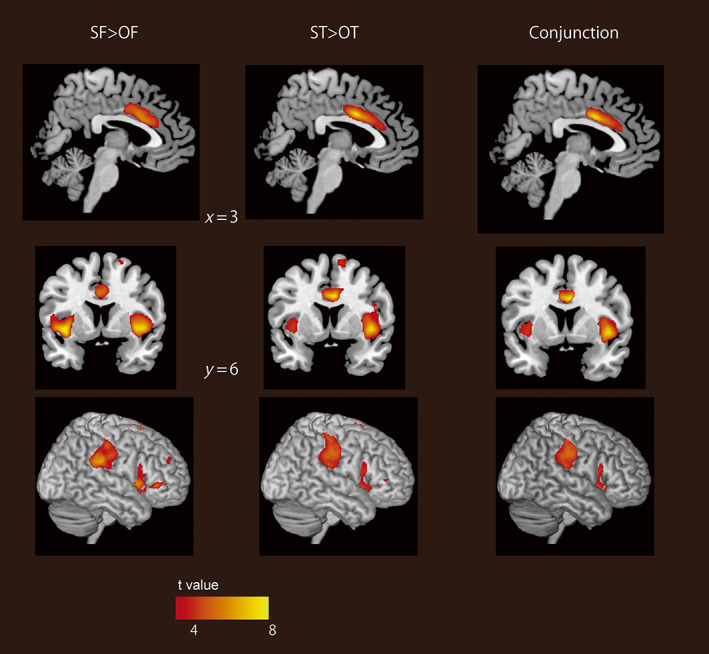
Brain regions showing greater activation when participants viewed images of themselves from each perspective. The left panels show the contrast for the first‐person perspective (SF > OF), and the center panels show the contrast for the third‐person perspective (ST > OT). The right panes show a result of conjunction analysis between the first‐person perspective (SF > OF) and the third‐person perspective (ST > OT). The colored bars represent voxel‐level t‐values (FWEc p < .05, voxel‐level p < .001). FWE, family wise error; FWEc, cluster‐level FWE; OF, video clips of others from a first‐person perspective; OT, video clips of others from a third‐person perspective; SF, video clips of the self from a first‐person perspective; ST, video clips of the self from a third‐person perspective.

References

    1. Allman, J. M. , Tetreault, N. A. , Hakeem, A. Y. , Manaye, K. F. , Semendeferi, K. , Erwin, J. M. , Park, S. , Goubert, V. , & Hof, P. R. (2011). The von Economo neurons in the frontoinsular and anterior cingulate cortex. Annals of the New York Academy of Sciences, 1225, 59–71. 10.1111/j.1749-6632.2011.06011.x - DOI - PMC - PubMed
    1. Allman, J. M. , Tetreault, N. A. , Hakeem, A. Y. , & Park, S. (2011). The von Economo neurons in apes and humans. American Journal of Human Biology, 23(1), 5–21. 10.1002/ajhb.21136 - DOI - PubMed
    1. Allman, J. M. , Watson, K. K. , Tetreault, N. A. , & Hakeem, A. Y. (2005). Intuition and autism: A possible role for Von Economo neurons. Trends in Cognitive Sciences, 9(8), 367–373. 10.1016/j.tics.2005.06.008 - DOI - PubMed
    1. Araujo, H. F. , Kaplan, J. , Damasio, H. , & Damasio, A. (2015). Neural correlates of different self domains. Brain and Behavior: A Cognitive Neuroscience Perspective, 5(12), e00409. 10.1002/brb3.409 - DOI - PMC - PubMed
    1. Blanke, O. , Slater, M. , & Serino, A. (2015). Behavioral, neural, and computational principles of bodily self‐consciousness. Neuron, 88(1), 145–166. 10.1016/j.neuron.2015.09.029 - DOI - PubMed

Publication types