


Social Media Use and Health and Well-being of Lesbian, Gay, Bisexual, Transgender, and Queer Youth: Systematic Review
- PMID: 36129741
- PMCID: PMC9536523
- DOI: 10.2196/38449
Social Media Use and Health and Well-being of Lesbian, Gay, Bisexual, Transgender, and Queer Youth: Systematic Review
Abstract
Background: Lesbian, gay, bisexual, transgender, and queer (LGBTQ) individuals are at higher risk of poor mental health and well-being. Social media platforms can provide LGBTQ youths with a space that counters heteronormative environments and potentially supports mental health and well-being. Mental health includes an individual's state of psychological and emotional well-being and not merely the absence of mental disorders.
Objective: We sought to identify how LGBTQ youths and adolescents use social media for connection with other LGBTQ peers and groups, identity development, and social support and how these affect mental health and well-being.
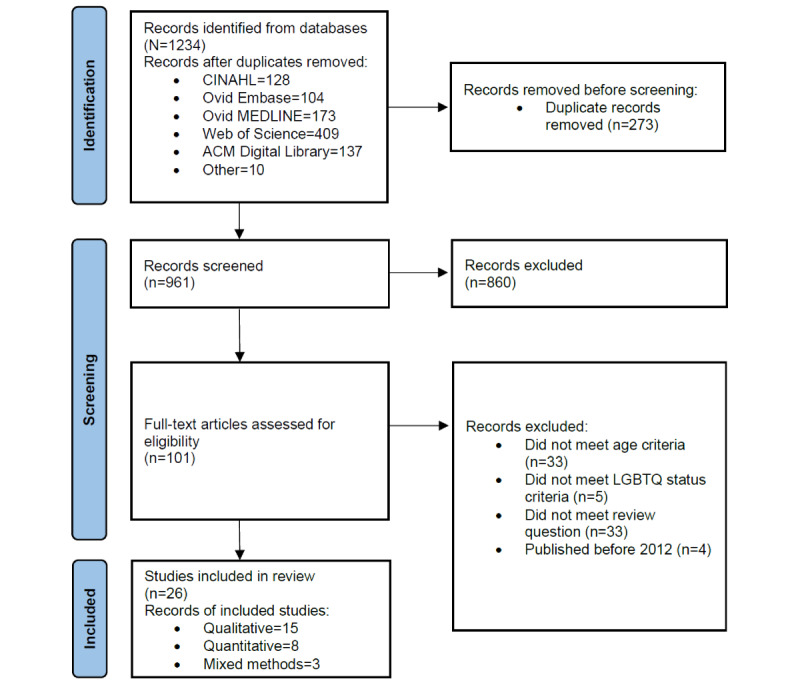
Methods: PRISMA (Preferred Reporting Items for Systematic Reviews and Meta-Analyses) procedures were used to guide this review. Searches were conducted in ACM Digital Library, CINAHL, Ovid Embase, Ovid MEDLINE, and Web of Science in March 2021. This review focused on LGBTQ youths aged 10 to 24 years. Included peer-reviewed studies must comprise social media; explore peer connection, identity development, or social support; and be published from 2012 onward. In total, 2 researchers extracted data and performed quality assessments independently using the Newcastle-Ottawa Scale for quantitative articles and the Critical Appraisal Skills Programme for qualitative articles. Qualitative synthesis was performed on articles that satisfied the eligibility criteria.
Results: A total of 26 studies (n=15, 58% qualitative; n=8, 31% quantitative; n=3, 12% mixed methods) met the inclusion criteria. Of the 8 quantitative studies, 6 (75%) were cross-sectional, and 2 (25%) were cohort studies. All studies ranged from moderate to high quality. Social media was a popular tool used by LGBTQ youths to connect with LGBTQ communities. In qualitative data, we found that LGBTQ youths negotiated and explored identity and obtained support from peers on social media. Instagram, Tumblr, and Twitter were commonly used to access LGBTQ content owing to ease of anonymity. Identity management was the most studied social media affordance, important to LGBTQ youths for strategic disclosure. Key strategies for managing identities included being anonymous, censoring locations or content, restricting audiences, and using multiple accounts. Quantitative studies (3/8, 38%) showed that social media was associated with reduced mental health concerns and increased well-being among LGBTQ youths. Mental health concerns arising from social media use were attributed to discrimination, victimization, and policies that did not accommodate changed identities.
Conclusions: We found that social media may support the mental health and well-being of LGBTQ youths through peer connection, identity management, and social support, but findings were limited by weaknesses in the evidence. More robust and longitudinal studies are needed to determine the relationship between social media use and LGBTQ mental health, particularly among adolescents. The findings may inform interventions to promote social media health literacy and the mental health and well-being of this vulnerable group.
Trial registration: PROSPERO CRD42020222535; https://www.crd.york.ac.uk/prospero/display_record.php?RecordID=222535.
Keywords: LGBTQ; adolescence; identity; lesbian, gay, bisexual, transgender, and queer; mental health; mobile phone; social media; support; well-being; youth.
©Matthew N Berger, Melody Taba, Jennifer L Marino, Megan S C Lim, S Rachel Skinner. Originally published in the Journal of Medical Internet Research (https://www.jmir.org), 21.09.2022.
Conflict of interest statement
Conflicts of Interest: None declared.
Figures
References
-
- Household use of information technology. Australian Bureau of Statistics. 2018. Mar 28, [2021-04-10]. https://www.abs.gov.au/statistics/industry/technology-and-innovation/hou... .
-
- Fisher C, Waling A, Kerr L, Bellamy R, Ezer P, Mikolajczak G. 6th national survey of secondary students and sexual health. 6th National Survey of Australian Secondary Students and Sexual Health. 2019. [2021-05-03]. https://www.researchgate.net/publication/333812458_6th_National_Survey_o... . - PMC - PubMed
-
- Anderson M, Jiang J. Teens, social media and technology. Pew Research Center. 2018. May 31, [2021-05-04]. https://www.pewresearch.org/internet/2018/05/31/teens-social-media-techn...
-
- Trifiro BM, Gerson J. Social media usage patterns: research note regarding the lack of universal validated measures for active and passive use. Social Media Soc. 2019 May 25;5(2):205630511984874. doi: 10.1177/2056305119848743. - DOI
-
- Subrahmanyam K, Reich SM, Waechter N, Espinoza G. Online and offline social networks: use of social networking sites by emerging adults. J Applied Development Psychol. 2008 Nov;29(6):420–33. doi: 10.1016/j.appdev.2008.07.003. - DOI
Publication types
MeSH terms
LinkOut - more resources
Full Text Sources
Miscellaneous
