Extended resection for seizure control of pure motor strip focal cortical dysplasia during awake craniotomy: illustrative case
- PMID: 36130534
- PMCID: PMC9379631
- DOI: 10.3171/CASE21605
Extended resection for seizure control of pure motor strip focal cortical dysplasia during awake craniotomy: illustrative case
Abstract
Background: Focal cortical dysplasias (FCD) represent highly intrinsically epileptogenic lesions that require complete resection for seizure control. Resection of pure motor strip FCD can be challenging. Effective control of postoperative seizures is crucial and extending the boundaries of resection in an eloquent zone remains controversial.
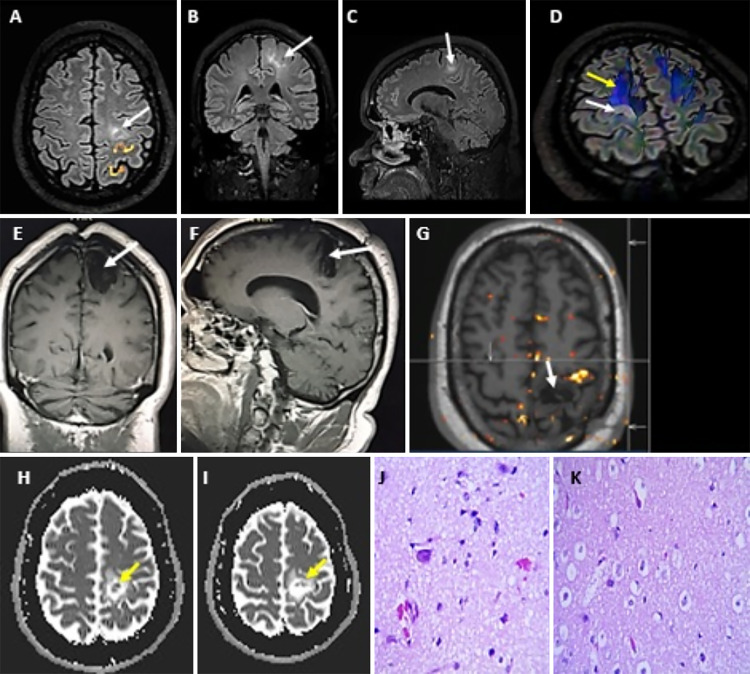
Observations: The authors report a 52-year-old right-handed male with refractory epilepsy. The seizure phenotype was a focal crisis with preserved awareness and a clonic motor onset of right-hemibody. Epilepsy surgery protocol demonstrated a left pure motor strip FCD and a full-awake resective procedure with motor brain mapping was performed. Further resection of surgical boundaries monitoring function along intraoperative motor tasks with no direct electrical stimulation corroborated by intraoperative-neuromonitorization was completed as the final part of the surgery. In the follow-up period of 3-years, the patient has an Engel-IB seizure-control with mild distal lower limb palsy and no gate compromise.
Lessons: This report represents one of the few cases with pure motor strip FCD resection. In a scenario similar to this case, the authors consider that this variation can be useful to improve seizure control and the quality of life of these patients by extending the resection of a more extensive epileptogenic zone minimizing functional damage.
Keywords: awake craniotomy; brain mapping; epilepsy surgery; focal cortical dysplasia.
Conflict of interest statement
Figures
References
-
- Raabe A, Beck J, Schucht P, Seidel K. Continuous dynamic mapping of the corticospinal tract during surgery of motor eloquent brain tumors: evaluation of a new method. J Neurosurg. 2014;120(5):1015–1024. - PubMed
-
- Szelényi A, Bello L, Duffau H, et al. Intraoperative electrical stimulation in awake craniotomy: methodological aspects of current practice. Neurosurg Focus. 2010;28(2):E7. - PubMed
-
- Landazuri P, Eccher M. Simultaneous direct cortical motor evoked potential monitoring and subcortical mapping for motor pathway preservation during brain tumor surgery: is it useful? J Clin Neurophysiol. 2013;30(6):623–625. - PubMed
-
- Shiban E, Krieg SM, Haller B, et al. Intraoperative subcortical motor evoked potential stimulation: how close is the corticospinal tract? J Neurosurg. 2015;123(3):711–720. - PubMed
-
- Seidel K, Beck J, Stieglitz L, Schucht P, Raabe A. The warning-sign hierarchy between quantitative subcortical motor mapping and continuous motor evoked potential monitoring during resection of supratentorial brain tumors. J Neurosurg. 2013;118(2):287–296. - PubMed
LinkOut - more resources
Full Text Sources