


Provider discussion of health goals and psychosocial needs: Comparing older to younger veteran experience
- PMID: 36130799
- PMCID: PMC9843079
- DOI: 10.1111/1475-6773.14054
Provider discussion of health goals and psychosocial needs: Comparing older to younger veteran experience
Abstract
Objective: To examine by age, the veterans' report on whether components of age-friendly health systems were discussed during primary care visits.
Data sources and study setting: Veterans Affairs (VA) Survey of Healthcare Experience of Patients from October 2015 to September 2019.
Study design: Cross-sectional survey of VA users by age group (18-44 years, 45-64 years, 65+ years; N = 1,042,318). We used weighted logistic regression models to evaluate disparities in whether veterans discussed with anyone in their provider's office: health goals, depression symptoms, stress, personal problems, and medications. Models were adjusted for socio-demographic characteristics (sex, socioeconomic status, education, rurality) and comorbidity.
Data collection/extraction method: Surveys were administered by mail and online. Additional veteran characteristics were extracted from VA administrative data.
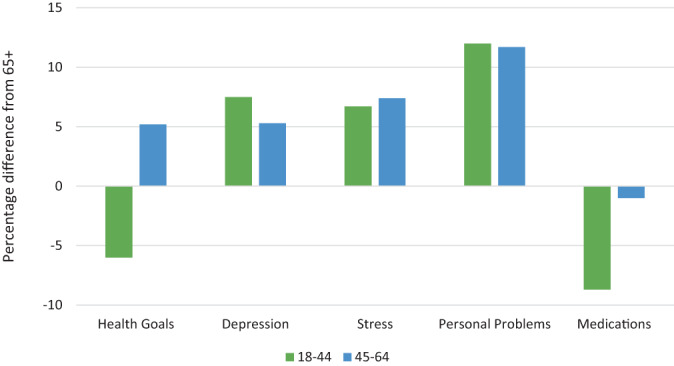
Principal findings: In unadjusted analyses, VA users age 18-44 had a higher (-8.2%; CI: -9.0, -7.3) and users aged 45 to 64 had lower (4.0%; CI: 3.7, 4.3) predicted, probably discussing health goals compared to age 65+. Fewer VA users age 65+ reported discussing depression symptoms, personal problems, and stress than other age groups, whereas more VA users age 65+ discussed medications. Results were unchanged after adjusting for socio-demographics and comorbidity.
Conclusions: Delivery of goal-concordant care relies on understanding the needs of individual patients. Lower rates of discussing what matters and mood represent potential missed opportunities to deliver age-friendly care for older veterans.
Keywords: geriatrics; goal concordance; health care; health services for older adults; patient experience; psychosocial functioning; veterans.
Published 2022. This article is a U.S. Government work and is in the public domain in the USA.
Figures
References
-
- U.S. Census Bureau . Sex by age by Veteran status for the Civilian population 18 years and over. 2022. Accessed March 9, 2022. https://data.census.gov/cedsci/table?q=veteran%20age&tid=ACSDT1Y2019.B21001
-
- U.S. Department of Veterans Affairs . Department of Veterans Affairs FY 2018–2024 strategic plan. U.S. Department of Veterans Affairs. 2019. https://www.va.gov/oei/docs/va2018-2024strategicplan.pdf
-
- Popham L, Tavares J, Cohen M. A Profile of Older U.S. Veterans. National Council on Aging. 2019. Accessed February 18, 2022. https://www.ncoa.org/article/a-profile-of-older-us-veterans
-
- Agency for, Healthcare Research and Quality. National Healthcare Quality and Disparities Report Chartbook on Healthcare for Veterans. 2020. https://www.ahrq.gov/sites/default/files/wysiwyg/research/findings/nhqrd... - PubMed
-
- Fulmer T. Discovering the 4Ms: A framework for creating age‐friendly health systems. The John a Hartford Foundation Published August 7, 2018. Accessed March 8, 2022. https://www.johnahartford.org/blog/view/discovering‐the‐4ms‐a‐framework‐...
