. 2022 Sep 21;23(1):199.
doi: 10.1186/s13059-022-02770-3.

Genomics and epigenetics guided identification of tissue-specific genomic safe harbors

Affiliations

Genomics and epigenetics guided identification of tissue-specific genomic safe harbors

Dewan Shrestha et al. Genome Biol. .

Abstract

Background: Genomic safe harbors are regions of the genome that can maintain transgene expression without disrupting the function of host cells. Genomic safe harbors play an increasingly important role in improving the efficiency and safety of genome engineering. However, limited safe harbors have been identified.

Results: Here, we develop a framework to facilitate searches for genomic safe harbors by integrating information from polymorphic mobile element insertions that naturally occur in human populations, epigenomic signatures, and 3D chromatin organization. By applying our framework to polymorphic mobile element insertions identified in the 1000 Genomes project and the Genotype-Tissue Expression (GTEx) project, we identify 19 candidate safe harbors in blood cells and 5 in brain cells. For three candidate sites in blood, we demonstrate the stable expression of transgene without disrupting nearby genes in host erythroid cells. We also develop a computer program, Genomics and Epigenetic Guided Safe Harbor mapper (GEG-SH mapper), for knowledge-based tissue-specific genomic safe harbor selection.

Conclusions: Our study provides a new knowledge-based framework to identify tissue-specific genomic safe harbors. In combination with the fast-growing genome engineering technologies, our approach has the potential to improve the overall safety and efficiency of gene and cell-based therapy in the near future.

Keywords: Chromatin organization; Epigenome; Gene therapy; Genetic engineering; Genomic safe harbor; Mobile genetic elements.


Conflict of interest statement

The authors declare that they have no competing interests.

Figures
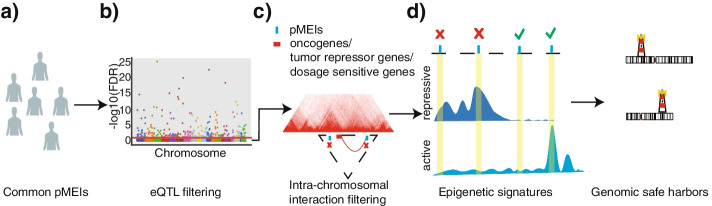
Fig. 1
Fig. 1
A schematic representation of the overall genomic safe harbor identification strategy. a Selection of common pMEIs from healthy individuals with AF > 0.1. b Removing pMEIs significantly associated with gene expression (FDR < 0.1 in eQTL mapping). c Removing pMEIs showing spatial proximity with oncogenes, tumor suppressor genes, and dosage-sensitive genes based on TADs and chromatin interaction mapping. d Removing pMEIs overlapping repressive chromatin regions
Fig. 2
Fig. 2
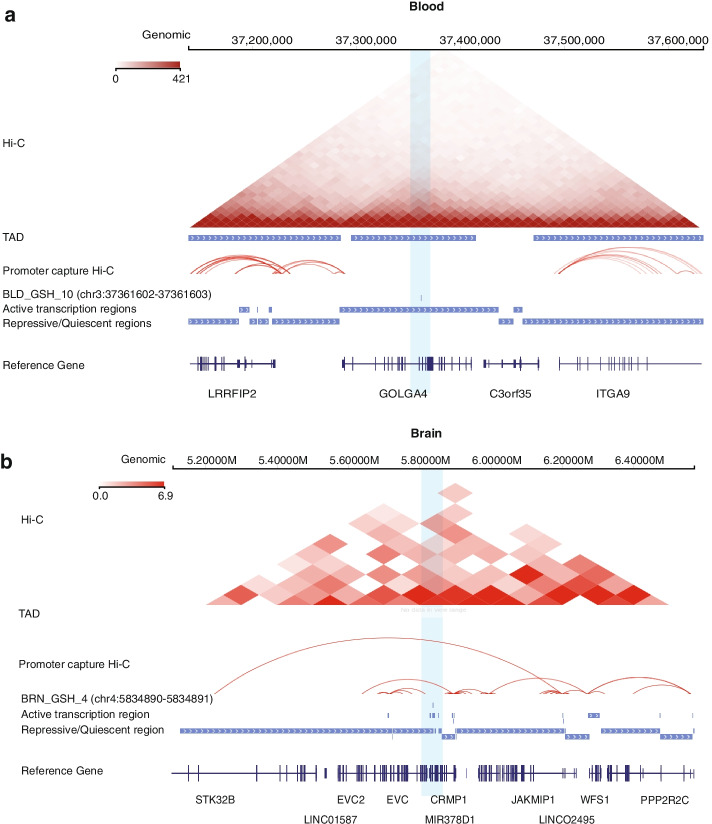
Epigenetic and chromatin interactions near the candidate GSH sites in blood and brain. a Genome browser screenshot of a representative GSH in blood. From top to bottom: Interaction heatmap and TADs from Hi-C in GM12878 cells. Chromatin interaction loops from promoter capture Hi-C in blood cells (see Method section for details). The coordinate of the GSH. Active and repressive genomic regions defined by 15-state ChromHMM from blood cells in the Roadmap project (Additional file 9: Table S8), and reference genes. b Genome browser screenshot of a representative GSH in brain. From top to bottom: Interaction heatmap and TADs from Hi-C in brain hippocampus. Chromatin interaction loops from promoter capture Hi-C in brain cells (dorsolateral prefrontal cortex, hippocampus, and neural progenitor cells). The coordinate of the GSH. Active and repressive genomic regions defined by 15-state ChromHMM from brain cells in the Roadmap project (Additional file 9: Table S8), and reference genes. Regions surrounding the GSH sites are highlighted with blue shade
Fig. 3
Fig. 3
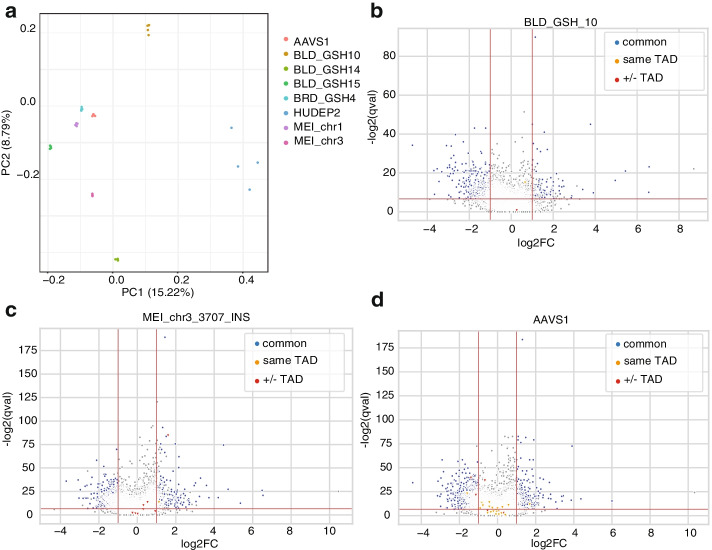
Experimental validation of GSHs in HUDEP2 cells. a PCA plot showing the RNA-seq data for all tested cell lines. b–d Volcano plots showing differential expressed genes (DEGs) in a blood GSH (BLD_GSH_10), non-GSH MEI (MEI_chr3_3707_INS) and AAVS1. Common: DEGs share by more than two cell lines. Same TAD: genes within the same TAD of the GFP integration site; +/− TAD: genes in the TADs flanking to the GFP integration site
Fig. 4
Fig. 4
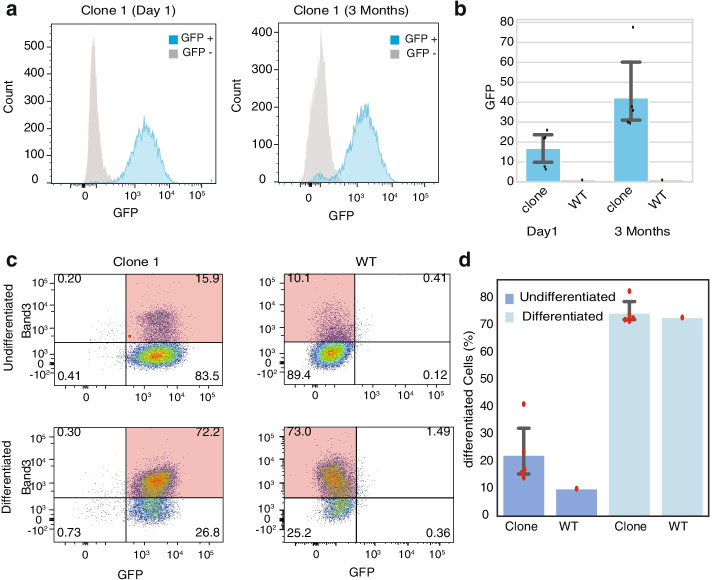
Long-term validation of BLD_GSH_10 clones. a Representative distribution of GFP fluorescence signals in HUDEP2 WT cells (gray) and cells from a HUDEP2 clone with a GFP reporter transgene integrated in the GSH site (blue) in day 1 and day 90, respectively. b Bar plots showing the normalized GFP fluorescence signals of five independent clones and WT HUDEP2 cells. c Representative immuno-flow cytometry results showing cell differentiation comparison between WT cells and cells from one GFP clone. Y-axis is the signal for red blood cell maturation marker Band3. X-axis is the signals for GFP. The mature red blood cell compartment is highlighted in red. d Bar plots showing the percent of Band3 high cell populations before and after differentiation for five GFP clones and WT cells

References

    1. Ali HG, Ibrahim K, Elsaid MF, Mohamed RB, Abeidah MIA, Al Rawwas AO, et al. Gene therapy for spinal muscular atrophy: the Qatari experience. Gene Ther. 2021;28:676–80. doi: 10.1038/s41434-021-00273-7. - DOI - PMC - PubMed
    1. Mamcarz E, Zhou S, Lockey T, Abdelsamed H, Cross SJ, Kang G, et al. Lentiviral gene therapy combined with low-dose busulfan in infants with SCID-X1. N Engl J Med. 2019;380:1525–1534. doi: 10.1056/NEJMoa1815408. - DOI - PMC - PubMed
    1. Tang R, Harasymowicz NS, Wu CL, Collins KH, Choi YR, Oswald SJ, et al. Gene therapy for follistatin mitigates systemic metabolic inflammation and post-traumatic arthritis in high-fat diet–induced obesity. Sci Adv. 2020;6:eaaz7492. doi: 10.1126/sciadv.aaz7492. - DOI - PMC - PubMed
    1. Papapetrou EP, Schambach A. Gene insertion into genomic safe harbors for human gene therapy. Mol Ther. 2016;24:678–684. doi: 10.1038/mt.2016.38. - DOI - PMC - PubMed
    1. Kimura Y, Shofuda T, Higuchi Y, Nagamori I, Oda M, Nakamori M, et al. Human genomic safe harbors and the suicide gene-based safeguard system for iPSC-based cell therapy. Stem Cells Transl Med. 2019;8:627–638. doi: 10.1002/sctm.18-0039. - DOI - PMC - PubMed

Publication types