


Ethnic and socioeconomic disparities in initiation of second-line antidiabetic treatment for people with type 2 diabetes in England: A cross-sectional study
- PMID: 36134467
- PMCID: PMC10092566
- DOI: 10.1111/dom.14874
Ethnic and socioeconomic disparities in initiation of second-line antidiabetic treatment for people with type 2 diabetes in England: A cross-sectional study
Abstract
Aims: To assess any disparities in the initiation of second-line antidiabetic treatments prescribed among people with type 2 diabetes mellitus (T2DM) in England according to ethnicity and social deprivation level.
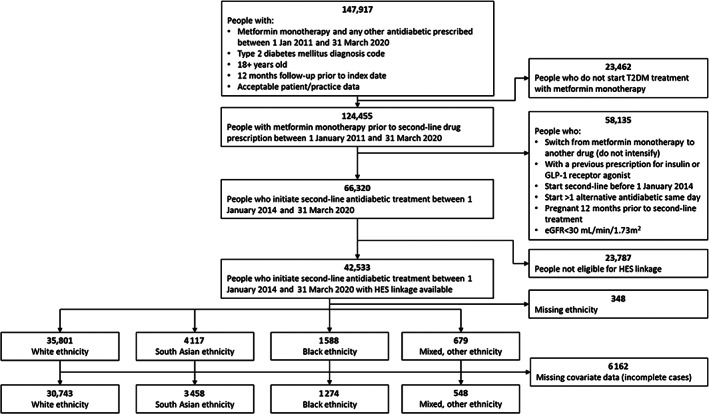
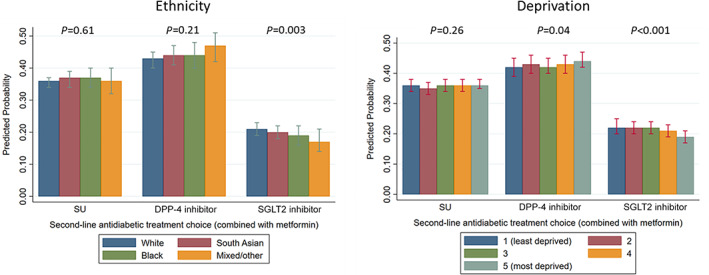
Materials and methods: This cross-sectional study used linked primary (Clinical Practice Research Datalink) and secondary care data (Hospital Episode Statistics), and the Index of Multiple Deprivation (IMD). We included people aged 18 years or older with T2DM who intensified to second-line oral antidiabetic medication between 2014 and 2020 to investigate disparities in second-line antidiabetic treatment prescribing (one of sulphonylureas [SUs], dipeptidyl peptidase-4 [DPP-4] inhibitors, or sodium-glucose cotransporter-2 [SGLT2] inhibitors, in combination with metformin) by ethnicity (White, South Asian, Black, mixed/other) and deprivation level (IMD quintiles). We report prescriptions of the alternative treatments by ethnicity and deprivation level according to predicted percentages derived from multivariable, multinomial logistic regression.
Results: Among 36 023 people, 85% were White, 10% South Asian, 4% Black and 1% mixed/other. After adjustment, the predicted percentages for SGLT2 inhibitor prescribing by ethnicity were 21% (95% confidence interval [CI] 19-23%), 20% (95% CI 18-22%), 19% (95% CI 16-22%) and 17% (95% CI 14-21%) among people with White, South Asian, Black, and mixed/other ethnicity, respectively. After adjustment, the predicted percentages for SGLT2 inhibitor prescribing by deprivation were 22% (95% CI 20-25%) and 19% (95% CI 17-21%) for the least deprived and the most deprived quintile, respectively. When stratifying by prevalent cardiovascular disease (CVD) status, we found lower predicted percentages of people with prevalent CVD prescribed SGLT2 inhibitors compared with people without prevalent CVD across all ethnicity groups and all levels of social deprivation.
Conclusions: Among people with T2DM, there were no substantial differences by ethnicity or deprivation level in the percentage prescribed either SGLT2 inhibitors, DPP-4 inhibitors or SUs as second-line antidiabetic treatment.
Keywords: ethnicity; oral antidiabetics; pharmacoepidemiology; socioeconomic deprivation; type 2 diabetes.
© 2022 The Authors. Diabetes, Obesity and Metabolism published by John Wiley & Sons Ltd.
Conflict of interest statement
All authors have completed an ICJME form. Patrick Bidulka, Stephen O'Neill, Anirban Basu, Richard Silverwood and Liam Smeeth have nothing to declare. Kamlesh Khunti has acted as a consultant, speaker or received grants for investigator‐initiated studies for Astra Zeneca, Novartis, Novo Nordisk, Sanofi‐Aventis, Lilly and Merck Sharp & Dohme, Boehringer Ingelheim, Bayer, Berlin‐Chemie AG / Menarini Group, Janssen and Napp. Rohini Mathur has received consulting fees from AMGEN. Paul Charlton sat on an NIHR HTA Commissioning Committee member until September 2021. Anirban Basu is an economic advisor on the DiRECT trial, with ongoing responsibility for economic analysis during the long‐term follow‐up phase, and has also acted as consultant to GlaxoSmithKline, Merck, Novo Nordisk and Boehringer Ingelheim in relation to their diabetes products. Amanda Adler receives salary from the NIHR BRC via the Oxford Centre for Diabetes, Endocrinology and Metabolism. Ian Douglas holds an unrestricted research grant from GSK and holds shares in GSK. Richard Grieve sits on the NIHR commissioning committee.
Figures
References
-
- NICE: 20 years of evidence‐based decision making . Web. National Institute for Health and Care Excellence (NICE). Accessed September 10, 2021. https://indepth.nice.org.uk/20-years-of-NICE/index.html
-
- NHS body 'to end postcode prescribing' . Web. BBC News. Accessed September 10, 2021. http://news.bbc.co.uk/1/hi/health/271522.stm
-
- Our principles : The principles that guide the development of NICE guidance and standards. Web. National Institute for Health and Care Excellence. https://www.nice.org.uk/about/who-we-are/our-principles - PubMed
MeSH terms
Substances
Grants and funding
LinkOut - more resources
Full Text Sources
Medical
Miscellaneous
