


Hybrid Ablation of Atrial Fibrillation: A Contemporary Overview
- PMID: 36135447
- PMCID: PMC9504578
- DOI: 10.3390/jcdd9090302
Hybrid Ablation of Atrial Fibrillation: A Contemporary Overview
Abstract
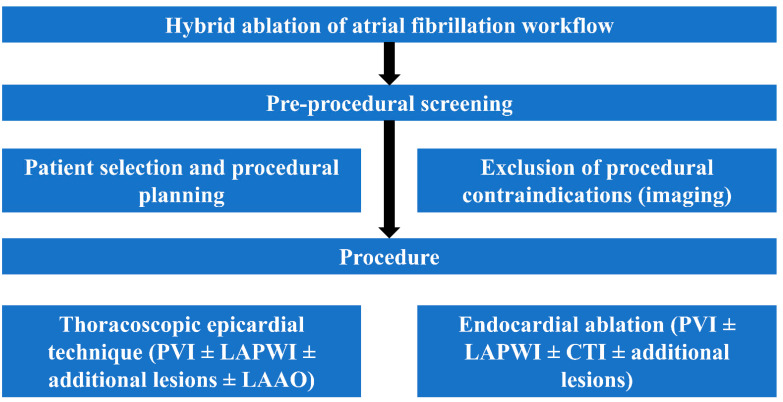
Electrical isolation of pulmonary veins (PVI) is the cornerstone of invasive treatment of atrial fibrillation (AF). However, arrhythmia-free survival of a PVI only approach is suboptimal in patients with persistent and long-term persistent AF. Hybrid AF ablation has been developed with the aim of combining the advantages of a thoracoscopic surgical ablation (direct visualization of anatomical structures to be spared and the possibility to perform epicardial lesions) and endocardial ablation (possibility to check line block, confirm PVI, and possibility to perform cavotricuspid isthmus ablation). Patient selection is of utmost importance. In persistent and long-term persistent AF, hybrid AF ablation demonstrated promising results in terms of AF free survival. It has been associated with a relatively low complication rate if performed in centers with expertise in hybrid procedures and experience with both surgical and endocardial ablation. Different techniques have been described, with different approaches and lesion sets. The aim of this review is to provide a state-of-the-art overview of hybrid AF ablation.
Keywords: atrial arrhythmias; atrial fibrillation; atrial fibrillation ablation; hybrid ablation.
Conflict of interest statement
A.B. is consultant for Biotronik; G.C. received compensation for teaching purposes and proctoring from Medtronic, Abbott, Biotronik, Boston Scientific, Acutus Medical. M.L.M. is consultant for Atricure. C.D.A. receives research grants on behalf of the center from Biotronik, Medtronic, Abbott, LivaNova, Boston Scientific, AtriCure, Philips, and Acutus; C.D.A. received compensation for teaching purposes and proctoring from Medtronic, Abbott, Biotronik, Livanova, Boston Scientific, Atricure, Acutus Medical Daiichi Sankyo. The remaining authors have nothing to disclose.
Figures
References
-
- Haïssaguerre M., Jaïs P., Shah D.C., Takahashi A., Hocini M., Quiniou G., Garrigue S., Le Mouroux A., Le Métayer P., Clémenty J. Spontaneous Initiation of Atrial Fibrillation by Ectopic Beats Originating in the Pulmonary Veins. N. Engl. J. Med. 1998;339:659–666. doi: 10.1056/NEJM199809033391003. - DOI - PubMed
-
- Pappone C., Rosanio S., Oreto G., Tocchi M., Gugliotta F., Vicedomini G., Salvati A., Dicandia C., Mazzone P., Santinelli V., et al. Circumferential radiofrequency ablation of pulmonary vein ostia: A new anatomic approach for curing atrial fibrillation. Circulation. 2000;102:2619–2628. doi: 10.1161/01.CIR.102.21.2619. - DOI - PubMed
-
- Sultan A., Lüker J., Andresen D., Kuck K.H., Hoffmann E., Brachmann J., Hochadel M., Willems S., Eckardt L., Lewalter T., et al. Predictors of Atrial Fibrillation Recurrence after Catheter Ablation: Data from the German Ablation Registry. Sci. Rep. 2017;7:16678. doi: 10.1038/s41598-017-16938-6. - DOI - PMC - PubMed
Publication types
LinkOut - more resources
Full Text Sources
