. 2022 Nov;21(11):1324-1332.
doi: 10.1038/s41563-022-01360-9. Epub 2022 Sep 22.

Nanoparticle-modified microrobots for in vivo antibiotic delivery to treat acute bacterial pneumonia

Affiliations

Nanoparticle-modified microrobots for in vivo antibiotic delivery to treat acute bacterial pneumonia

Fangyu Zhang et al. Nat Mater. 2022 Nov.

Abstract

Bioinspired microrobots capable of actively moving in biological fluids have attracted considerable attention for biomedical applications because of their unique dynamic features that are otherwise difficult to achieve by their static counterparts. Here we use click chemistry to attach antibiotic-loaded neutrophil membrane-coated polymeric nanoparticles to natural microalgae, thus creating hybrid microrobots for the active delivery of antibiotics in the lungs in vivo. The microrobots show fast speed (>110 µm s-1) in simulated lung fluid and uniform distribution into deep lung tissues, low clearance by alveolar macrophages and superb tissue retention time (>2 days) after intratracheal administration to test animals. In a mouse model of acute Pseudomonas aeruginosa pneumonia, the microrobots effectively reduce bacterial burden and substantially lessen animal mortality, with negligible toxicity. Overall, these findings highlight the attractive functions of algae-nanoparticle hybrid microrobots for the active in vivo delivery of therapeutics to the lungs in intensive care unit settings.


Conflict of interest statement

Competing interests

The authors declare no competing interests.

Figures
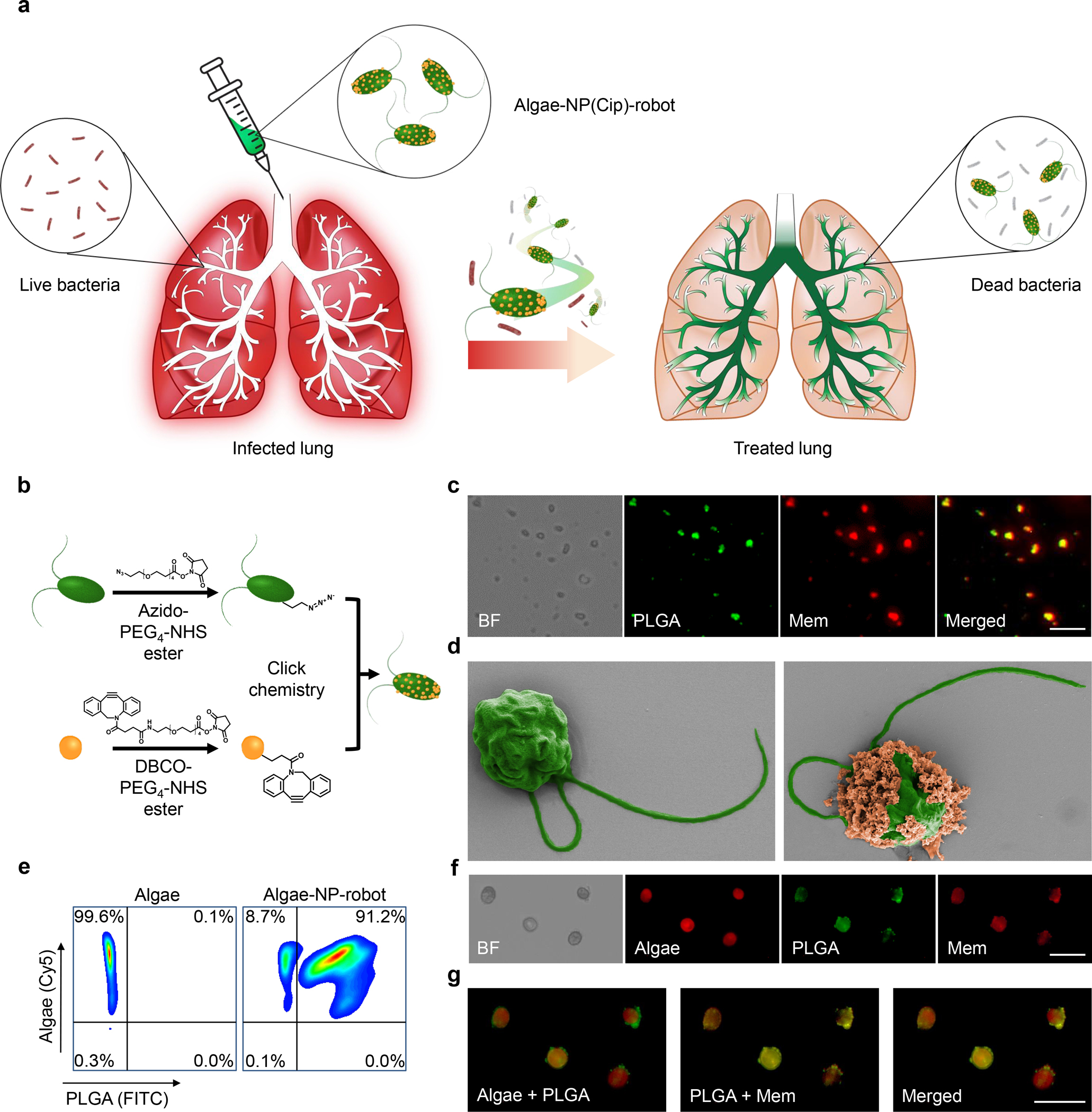
Figure 1 |
Figure 1 |. Preparation and structural characterization of the algae-nanoparticle hybrid microrobot (denoted “algae-NP-robot”).
a, Schematic depicting the use of algae-NP-robot for the treatment of a bacterial lung infection. C. reinhardtii algae is modified with drug-loaded NPs and then administered in vivo for the treatment of P. aeruginosa lung infection. The NP is consisting of neutrophil membrane-coated poly(lactic-co-glycolic) (PLGA) core. b, Schematic of the functionalization of C. reinhardtii with drug-loaded NP using click chemistry. c, Brightfield and fluorescent images of the NP, in which the PLGA cores are labeled with DiO (green color) and the neutrophil membranes are labeled with DiI (red color). Scale bar: 1 μm. d, Pseudocolored scanning electron microscopy images of an unmodified algae (left) and an algae-NP-robot (right). Scale bar: 2 μm. e, Flow cytometric analysis of algae before (left) and after (right) functionalization with DiO-labeled NP. f, Brightfield and fluorescent images of algae-NP-robot. Autofluorescence of natural algae chloroplast in Cy5 channel; DiO-labeled PLGA cores in GFP channel; DiI-labeled cell membranes in RFP channel. Scale bar: 20 μm. g, Merged images from (f). Cy5 and GFP channels (left); GFP and RFP channels (center); all three channels (right). Scale bar: 20 μm. In panels c, f, and g, independent experiments were performed (n = 3) with similar results.
Figure 2 |
Figure 2 |. Motion behavior of algae-NP-robot.
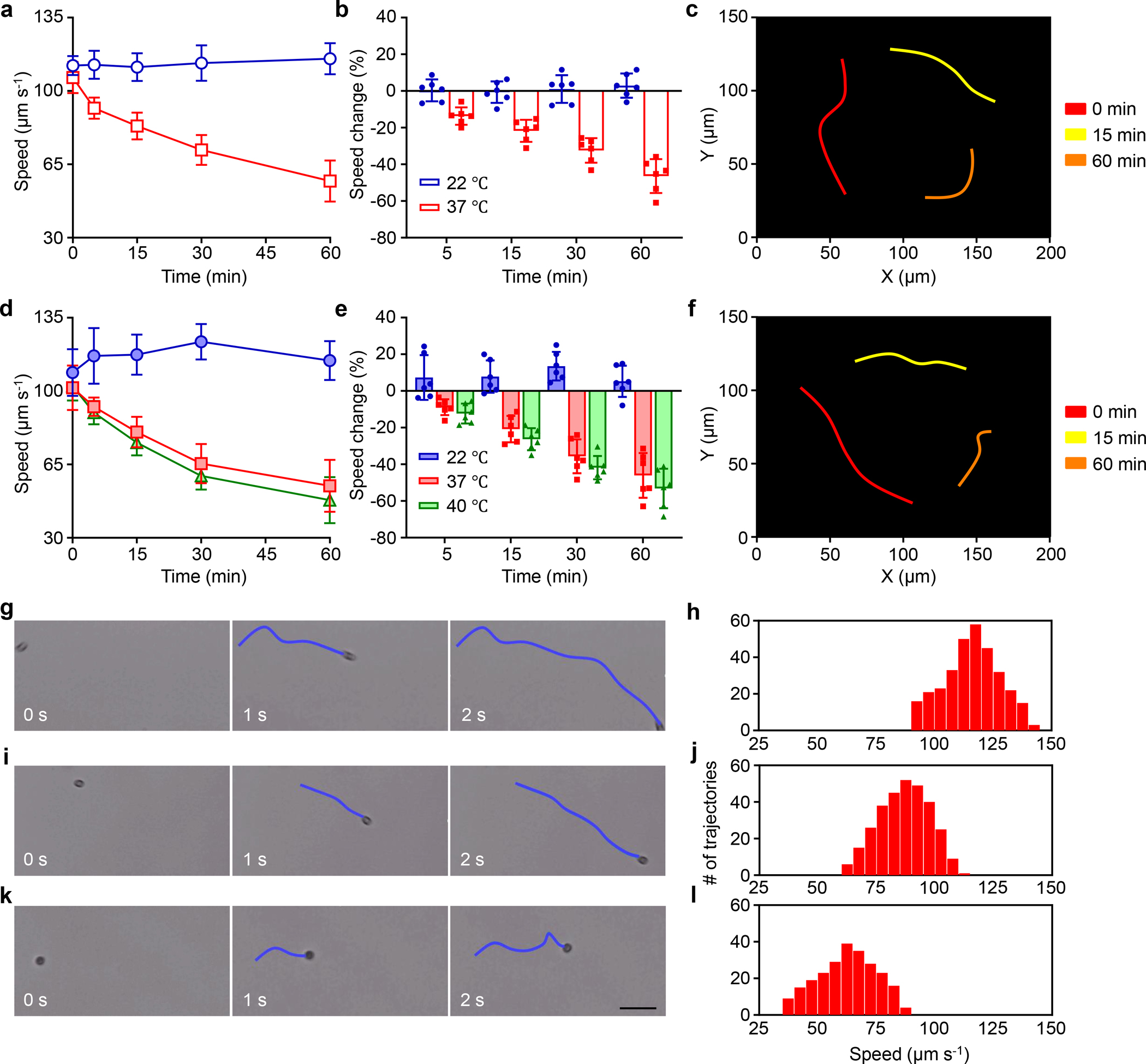
a-f, Comparison of the speed of bare algae (a,b) and algae-NP-robot (d,e) in simulated lung fluid (SLF) at room (22 °C), body (37 °C), and elevated body (40 °C) temperatures (blue, red, and green bars, respectively) (n = 6; mean ± s.d.). Optical tracking trajectories of the motion of bare algae (c) and algae-NP-robot (f) in SLF at 37 °C over 1 s (obtained at 0, 15, and 60 min: red, yellow, and orange, respectively) (Supplementary Movie 1). g-l, Representative trajectories (g, i, and k) from Supplementary Movie 2 corresponding to 0 s, 1 s, and 2 s, respectively, and mean speed distribution (h, j, and l) of algae-NP-robot in SLF at 37 °C after 0 min (g and h), 15 min (i and j), and 60 min (k and l). Scale bar: 50 μm.
Figure 3 |
Figure 3 |. Lung distribution of algae-NP-robot.
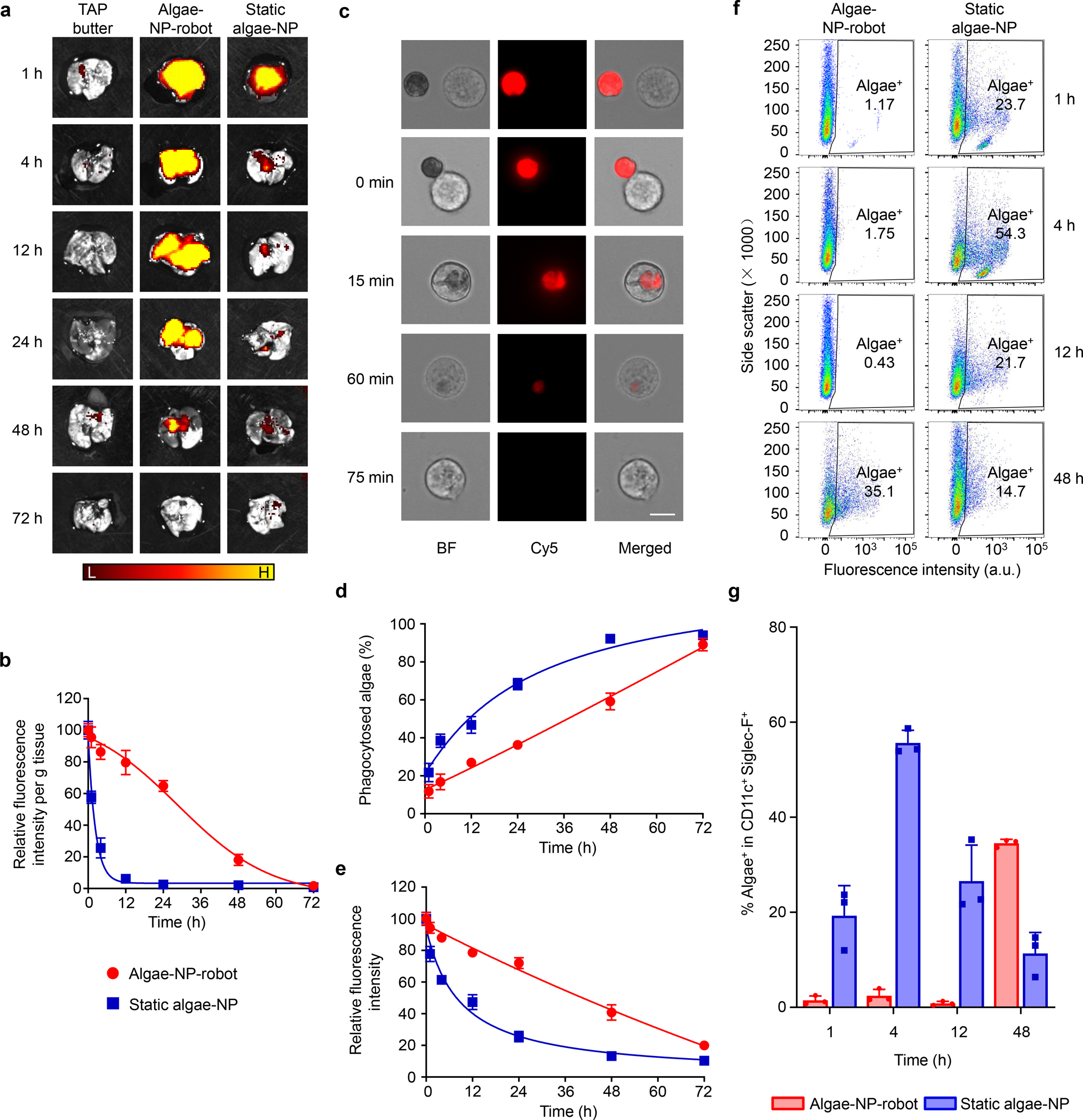
a, Ex vivo fluorescent imaging of lungs at various timepoints after intratracheal administration with tris-acetate-phosphate (TAP) medium, algae-NP-robot, or static algae-NP as a negative control (H, high signal; L, low signal). b, Normalized intensity per gram of tissue of lung samples collected in (a) (n = 3; mean + s.d.). c, Brightfield and fluorescence microscopy images of representative algae-NP-robot incubated with macrophages at various stages of their interaction. Scale bar = 10 μm. Independent experiments (n = 3) were performed with similar results. d, Macrophage phagocytosis of static algae-NP or algae-NP-robot over time (n = 3; mean + s.d.). e, Relative fluorescence intensity of algae-NP-robot or static algae-NP over time after incubation with macrophage cells in vitro (n = 3; mean + s.d.). f, Representative flow cytometry dot plots of algae-NP-robot (left) and static algae-NP (right) uptake by alveolar macrophages (CD11c+ Siglec-F+) at various timepoints after intratracheal administration in vivo. g, Comparison of algae-NP-robot and static algae-NP uptake in alveolar macrophages at various timepoints after intratracheal administration in vivo (n = 3; mean + s.d.).
Figure 4 |
Figure 4 |. In vivo therapeutic efficacy of algae-NP-robot.
a, Quantification of ciprofloxacin (Cip) loading on different numbers of algae (n = 6; mean + s.d.). b, The cumulative drug release profile of NP(Cip) and algae-NP(Cip)-robot (n = 3; mean + s.d.). c, Optical density at 600 nm (OD600) measurements of P. aeruginosa treated with control TAP buffer, free Cip, NP(Cip), static algae-NP(Cip), and algae-NP(Cip)-robot (n = 3; mean + s.d.). d, In vitro antibacterial activity of free Cip, NP(Cip), static algae-NP(Cip), and algae-NP(Cip)-robot against P. aeruginosa (n = 3; geometric mean + s.d.). e,f, In vivo antibacterial efficacy of control TAP buffer, NP(Cip), static algae-NP(Cip), and algae-NP(Cip)-robot with a dosage of 500 ng by intratracheal administration and free Cip with the same dosage of 500 ng as used in intratracheal administration and clinical dosage of 1.64 mg by intravenous (IV) administration in P. aeruginosa-infected mice, as determined by bacterial enumeration (e, n = 6; geometric mean +_s.d.) and survival (g, n = 12 per group) studies. g. Quantification of bacterial load in the lungs at 24 h, 48 h, 72 h, and 168 h after the algae-NP(Cip)-robot treatment (n = 6; geometric mean + s.d.). UD: undetectable. h,i, Experimental timeline (h) and data (i) for the enumeration of the bacterial load in the lungs of mice treated with algae-NP(Cip)-robot at different times after challenge with P. aeruginosa (n = 6; geometric mean + s.d.). one-way ANOVA for e, g, and i and log-rank (Mantel-Cox) test for f.
Figure 5 |
Figure 5 |. In vivo safety evaluation of algae-NP(Cip)-robot.
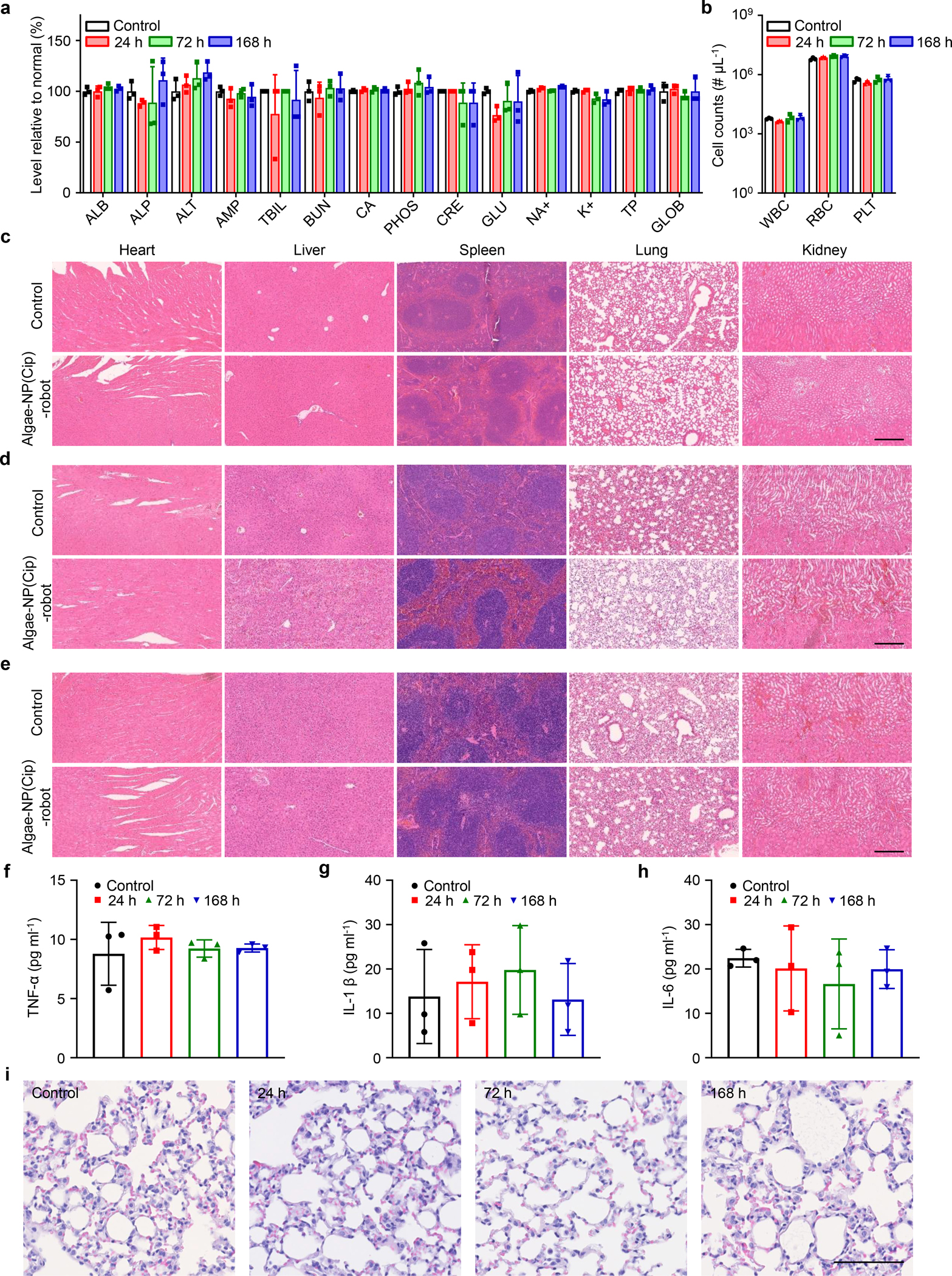
a, Comprehensive blood chemistry panel taken 24 h after intratracheal administration of TAP buffer or 24 h, 72 h, and 168 h after that of algae-NP(Cip)-robot (n = 3; mean + s.d.). ALB: albumin; ALP: alkaline phosphatase; ALT: alanine transaminase; AMY: amylase; TBIL: total bilirubin; BUN: blood urea nitrogen; CA: calcium; PHOS: phosphorus; CRE: creatinine; GLU: glucose; NA+: sodium; K+: potassium; TP: total protein; GLOB: globulin. b, Counts of various blood cells 24 h after intratracheal administration of TAP buffer or 24 h, 72 h, and 168 h after that of algae-NP(Cip)-robot (n = 3; geometric mean + s.d.). WBC: white blood cells; RBC: red blood cells; PLT: platelets. c-e, Hematoxylin and eosin staining of histology sections from major organs 24 h (c), 72 h (d), and 168 h (e) after intratracheal administration of TAP buffer or algae-NP(Cip)-robot. Scale bar: 250 μm. Independent experiments (n = 3) were performed with similar results. f-h, Cytokines, including TNF-α (f), IL-1β (g), IL-6 (h), measured in bronchoalveolar lavage fluid from healthy control mice or 24 h, 72 h, and 168 h after intratracheal administration of algae-NP(Cip)-robot. (n = 3; mean ± s.d.) i, Representative images of H&E staining on lung histology sections taken from healthy control mice or 24 h, 72 h, and 168 h after intratracheal administration of algae-NP(Cip)-robot. Scale bar: 100 μm. Independent experiments were performed (n = 3) with similar results.

References

    1. Li J, Esteban-Fernández de Ávila B, Gao W, Zhang L, Wang J Micro/nanorobots for biomedicine: delivery, surgery, sensing, and detoxification. Sci. Robot 2, eaam6431 (2017). - PMC - PubMed
    1. Gao C et al. Biomedical micro-/nanomotors: from overcoming biological barriers to in vivo imaging. Adv. Mater. 2000512 (2020). - PubMed
    1. Wu Z, Chen Y, Mukasa D, Pak OS, Gao W Medical micro/nanorobots in complex media. Chem. Soc. Rev. 49, 8088–8112 (2020). - PubMed
    1. Esteban-Fernández de Ávila B et al. Micromotor-enabled active drug delivery for in vivo treatment of stomach infection. Nat. Commun. 8, 272 (2017). - PMC - PubMed
    1. Wu Z et al. A microrobotic system guided by photoacoustic computed tomography for targeted navigation in intestines in vivo. Sci. Robot. 4, eaax0613 (2019). - PMC - PubMed

Publication types

Substances