Review
. 2022 Sep;54(9):1390-1400.
doi: 10.1038/s12276-022-00855-4. Epub 2022 Sep 22.

The updated role of exosomal proteins in the diagnosis, prognosis, and treatment of cancer

Affiliations
Review

The updated role of exosomal proteins in the diagnosis, prognosis, and treatment of cancer

Xinyi Wang et al. Exp Mol Med. 2022 Sep.

Abstract

Exosomes are vesicles encompassed by a lipid bilayer that are released by various living cells. Exosomal proteins are encapsulated within the membrane or embedded on the surface. As an important type of exosome cargo, exosomal proteins can reflect the physiological status of the parent cell and play an essential role in cell-cell communication. Exosomal proteins can regulate tumor development, including tumor-related immune regulation, microenvironment reconstruction, angiogenesis, epithelial-mesenchymal transition, metastasis, etc. The features of exosomal proteins can provide insight into exosome generation, targeting, and biological function and are potential sources of markers for cancer diagnosis, prognosis, and treatment. Here, we summarize the effects of exosomal proteins on cancer biology, the latest progress in the application of exosomal proteins in cancer diagnosis and prognosis, and the potential contribution of exosomal proteins in cancer therapeutics and vaccines.


Conflict of interest statement

The authors declare no competing interests.

Figures
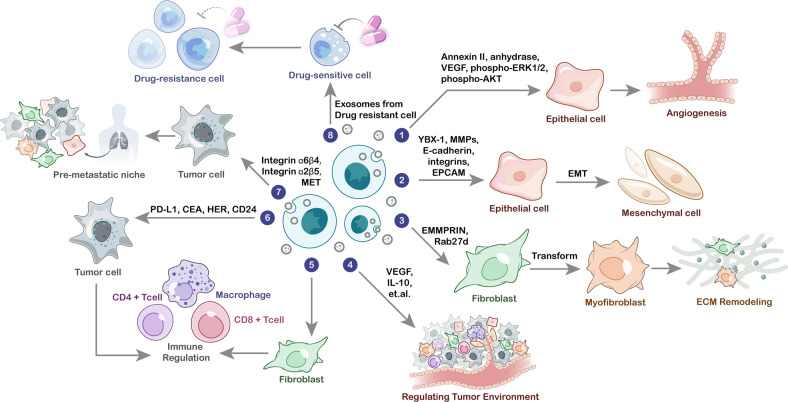
Fig. 1
Fig. 1. The role of exosomal proteins in cancer biology.
Exosomal proteins play an important role in different stages of tumor development, including angiogenesis, epithelial–mesenchymal transition (EMT), extracellular matrix (ECM) remodeling, tumor-related immune regulation, premetastatic behavior, and therapeutic resistance.
Fig. 2
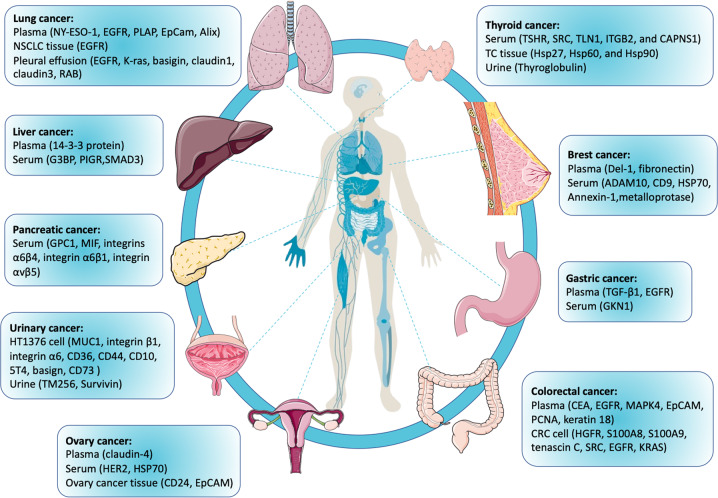
Fig. 2. Exosomal protein biomarkers for multiple types of human cancer.
Exosomal proteins obtained from body fluids (plasma, serum, urine, and pleural effusion), tumor tissue, and cultured cell lines have been reported as specific diagnostic and prognostic factors for numerous types of cancer, including breast, urinary, lung, gastric, liver, colorectal, ovarian, thyroid, and pancreatic cancers.
Fig. 3
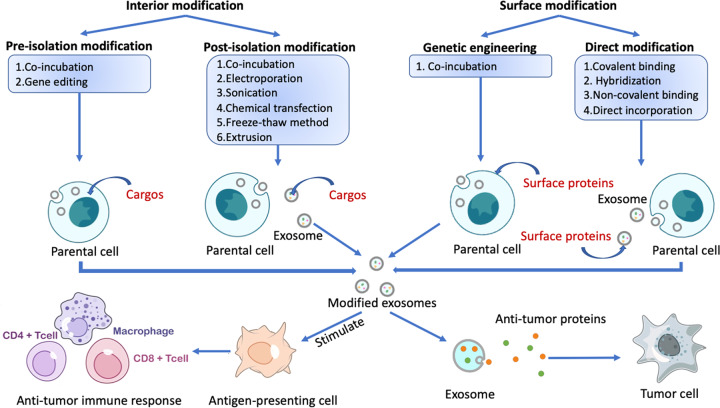
Fig. 3. The internal and surface protein modification of exosomes.
Exosomes can be modified by targeting internal proteins (adding protein cargo into the parent cell or exosome) and altering the surface (adding proteins onto the membrane of the parent cell or exosomes). Exosomes containing tumor antigens can stimulate antigen‐presenting cells (APCs) and drive antitumor immune responses in the human body. Engineered exosomes can also directly release antitumor proteins and attack tumor cells.

References

    1. Zhang Y, Liu Y, Liu H, Tang WH. Exosomes: biogenesis, biologic function and clinical potential. Cell Biosci. 2019;9:19. doi: 10.1186/s13578-019-0282-2. - DOI - PMC - PubMed
    1. Kalluri R, LeBleu VS. The biology, function, and biomedical applications of exosomes. Science. 2020;367:eaau6977. doi: 10.1126/science.aau6977. - DOI - PMC - PubMed
    1. Jan A, Rahman S, Khan S, Tasduq S, Choi I. Biology, pathophysiological role, and clinical implications of exosomes: a critical appraisal. Cells. 2019;8:99. doi: 10.3390/cells8020099. - DOI - PMC - PubMed
    1. Gluszko A, et al. The role of tumor-derived exosomes in tumor angiogenesis and tumor progression. Curr. Issues Pharm. Med. Sci. 2019;32:193–202. doi: 10.2478/cipms-2019-0034. - DOI
    1. da Costa VR, et al. Exosomes in the tumor microenvironment: from biology to clinical applications. Cells. 2021;10:2617. doi: 10.3390/cells10102617. - DOI - PMC - PubMed

Publication types